

JEE Main PYQ Rank Improvement Strategy: Turn Past Papers into a Rank-Boosting Engine
Walk into any calm study hour and you’ll see the same scene: a pile of past papers, a laptop for mocks, a messy notebook of errors, and that familiar mix of hope and nervous energy. If you’ve been wondering how to turn those previous year questions (PYQs) into an actual, measurable jump in rank rather than just another study ritual, this blog is written for you. I’ll walk you through a clear, step-by-step playbook — practical, honest, and crafted for students who want real rank gains from smart effort, not miracle hacks.

Why PYQs are your best study currency — and how to spend them wisely
PYQs are not just nostalgia. They are the closest thing to the exam’s fingerprint: question style, recurring topics, the level of numerical complexity, and the way concepts are combined. But simply solving PYQs once won’t move the needle. The difference between a question-solved-and-forgotten and a question-solved-and-converted-to-rank is the analysis that follows.
Keep these exam realities in mind as you plan:
- JEE-style tests are MCQ-heavy and built around accuracy under time pressure.
- Full-length mock practice under exam timing (three-hour simulation for full papers) builds stamina and reveals timing problems.
- There is negative marking for incorrect answers; blind guessing is costly unless managed strategically.
- Whether you practice with OMR sheets or computer-based tests, answer-recording discipline is essential.
- The syllabus centers on Physics, Chemistry, and Mathematics — treat each subject with the approach it demands.
- Partial credit for incomplete workings is not a factor in MCQ scoring; final-answer accuracy is what counts.
Quick mindset shift
Stop treating PYQs like a homework chore. Treat each PYQ set as a research study: hypothesize (what do I expect from this topic?), experiment (solve under exam-like conditions), observe (collect errors), and iterate (targeted fixes). That loop is the engine of rank improvement.
Set up a surgical PYQ analysis routine
Discipline here is everything. A reproducible routine reduces emotional noise and forces you to learn from your mistakes.
- Step 1 — Attempt once under time pressure: Do a PYQ or a mock in strictly timed conditions (simulate the three-hour structure where relevant).
- Step 2 — Score honestly: Mark answers and calculate raw score; don’t fudge time or rough guesses.
- Step 3 — Root-cause every error: Was it concept, calculation, careless mistake, time pressure, or misreading?
- Step 4 — Log and fix: Create a short, actionable item for each error and schedule it into your study blocks.
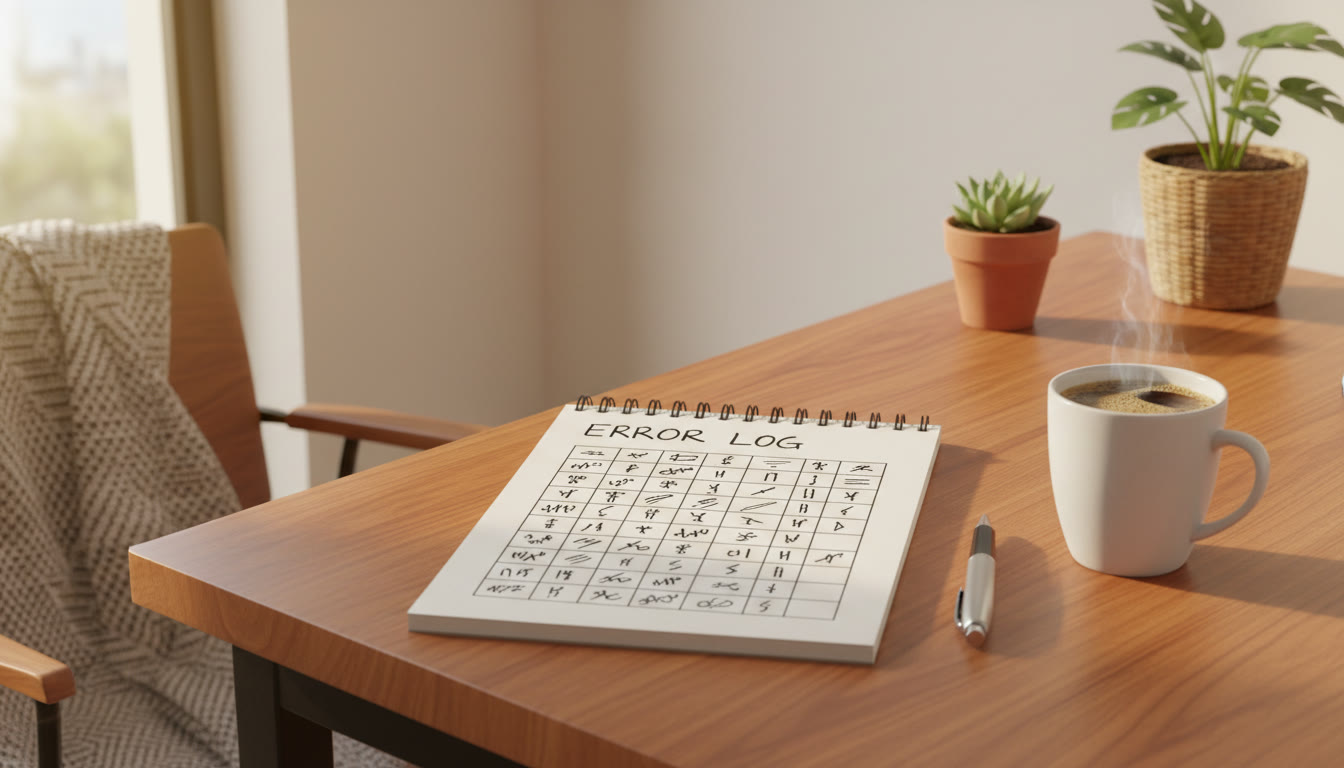
Error log template (use this every time)
| Date | Mock / PYQ | Subject | Topic | Q No. | Outcome | Time (min) | Reason | Action |
|---|---|---|---|---|---|---|---|---|
| DD/MM | Mock 7 | Physics | Kinematics | 12 | Incorrect | 8 | Concept gap | Revisit derivation + 10 targeted problems |
| DD/MM | PYQ Set 2 | Chemistry | Thermodynamics | 7 | Skipped | – | Time pressure | Timed micro-practice: 15 focused numericals |
Use the error log like a workout diary. Track it, review weekly, and watch patterns emerge (the same topic failing repeatedly is a sign to change your approach).
Map PYQ findings to a mock-driven plan
Mocks are not a random endurance test — they are measurement tools. If you want rank gains, align every mock to a target: strengthen a weak area, improve speed, or sharpen accuracy. Measure the same metrics each time to see trends.
- Raw score and sectional scores — basic performance numbers.
- Accuracy (correct / attempted) — reveals risk management problems.
- Time per question distribution — tells you if you’re spending too long on certain question types.
- Error categories — repeat offenders need learning-phase changes.
Mock progress tracker (example)
| Mock # | Raw Score | Physics | Chemistry | Mathematics | Accuracy % | Key Fix for Next |
|---|---|---|---|---|---|---|
| 1 | 120 | 40 | 38 | 42 | 68 | Speed in math: timed sets |
| 5 | 150 | 52 | 48 | 50 | 79 | Target organic chemistry recall |
Designing a mock-centric weekly and month plan
Here’s a simple, adaptable rhythm you can use. The point is consistency: regular timed mocks, immediate analysis, and targeted remediation.
- Week 1–3: Build base — 2 full mocks per week, 3 subject-focused revision blocks, persistent error logging.
- Week 4–8: Consolidate — increase mock difficulty, add one tough PYQ session, include sectional timed drills.
- Final phase: Peak & recover — replicate exam day once per week and taper intensity before the real test.
Sample 6-week micro-schedule (compact)
| Week | Main Focus | Mock Frequency | Target |
|---|---|---|---|
| 1 | PYQs: identify weak topics | 2 full | Baseline score + error log |
| 3 | Speed & Accuracy drills | 2 full | Improve accuracy by 6–8% |
| 6 | Full exam simulation & recovery | 1 full | Stability: consistent score in mock series |
Subject-by-subject PYQ strategies
Physics
Think concept-first. Many PYQs reward a quick conceptual insight rather than brute calculation. After you solve a PYQ, summarize the core idea in one sentence (e.g., “conserve angular momentum — reduces to energy equation”). That mini-summary becomes your memory hook.
- Always write down the basic relation before manipulating symbols.
- For numerical-heavy problems, practice the same problem with slightly changed numbers to build intuition.
- Use PYQs to map common traps: missing sign conventions, overlooking initial conditions, or mixing frames.
Chemistry
Split your chemistry PYQ practice by sub-domain. Physical chemistry demands numerical fluency and multi-step logic; organic is pattern recognition and mechanism memory; inorganic is smart recall aided by small mnemonic systems.
- Create micro-tables for common reagents and typical transformations.
- For PYQs, practice converting a question’s statement into a minimal, exam-style diagram or reaction wheel.
Mathematics
Math is practice plus pattern recognition. A PYQ that uses a clever substitution or an inequality trick is a goldmine — learn the trick and then create 5 variations to make it automatic.
- Save elegant solutions in a ‘tricks’ notebook and revisit weekly.
- Time yourself by topic: if integrals take too long, allocate micro-sessions for that chapter only.
Timed-test tactics: how to manage three-hour pressure
Three hours is long enough for deep concentration but short enough that poor pacing kills you. Treat the three-hour mock like an algorithm to follow every time.
- First pass (60–75% of test time): Answer all questions that look straightforward. This is where you collect easy marks quickly.
- Second pass (20–30% of test time): Tackle medium-difficulty problems that need more thought.
- Final pass (remaining time): Attempt harder questions only if confident; avoid wild guesses because of negative marking.
- Reserve 5–10 minutes at the end for answer verification and to correct any OMR/CBT input mistakes.
Practice this systematic pass structure in every full mock until it becomes second nature. That way, your brain is focused on strategy instead of panic during the real exam.
How to handle negative marking intelligently
Negative marking makes expected-value thinking useful. If you can eliminate options and your confidence of being correct is reasonably high, go ahead. If you’re guessing blind, the math rarely favors it. Instead of raw guessing, cultivate “educated elimination” as a consistent habit.
- Eliminate impossible options first.
- If you can reduce choices from four to two with reasonable thought, attempt strategically.
- Keep track of how many attempted/guessed questions hurt your accuracy; adjust the threshold for guessing in subsequent mocks.
Using PYQs to shape revision cycles — not just to practice
Don’t save PYQs only for the end. Rotate short PYQ sessions into your regular study week: a single PYQ mini-set after finishing a chapter is a powerful consolidation tool. It highlights whether your revision produced exam-ready fluency or just temporary familiarity.
Tools and tech: how to make practice more intelligent
Use a simple toolkit: timed mocks, a digital or paper error log, and a spaced-revision schedule. For learners who want structured, personalized guidance, having focused tutoring and adaptive diagnosis can shave months off the trial-and-error phase. Sparkl‘s personalized tutoring offers 1-on-1 guidance, tailored study plans, expert tutors, and AI-driven insights that help translate PYQ patterns into precise study actions.
Common PYQ traps and how to avoid them
- Trap — Over-committing time to a single hard question: Use a strict time cap for any one problem and move on when it’s exceeded.
- Trap — Misreading units or signs: Circle units and initial conditions in the first 10 seconds.
- Trap — Relying on partial answers: Remember MCQs reward final correctness, so structure work to reach the final choice efficiently.
- Trap — Not replicating exam conditions: Simulate the real testing environment regularly — no phone, single seat, full time block.
Sample weekly drill list you can implement tonight
- One full timed mock (three-hour simulation) with strict answer recording.
- Immediate three-hour debrief: error log + one-hour targeted practice on worst topic.
- Two short timed sets (30–45 minutes) focusing on speed (one physics, one math).
- Daily 20-minute revision flash: formulas, key reactions, standard integrals.
- Weekly review of the error log to find stubborn topics and adjust the study plan.
When to bring in targeted tutoring and personalized help
If your mock scores plateau despite diligent practice, consider targeted interventions: a short run of 1-on-1 sessions to clarify a conceptual core, a few AI-driven diagnostic sessions to find subtle time-wasters, or a tailored study plan to reorganize your revision priorities. Personalized help is most effective when it follows a clear diagnostic: test, log, and then bring in help for the exact weak points. For students who benefit from this model, Sparkl‘s approach to personalized tutoring combines one-on-one attention with analysis-driven study plans and can fit naturally into a mock-focused roadmap.
How to measure improvement — metrics that matter
Forget vanity metrics. Focus on a few numbers that tell the truth:
- Net score growth over a sequence of 6–8 mocks.
- Sectional stability — consistent scores in each subject, not wild swings.
- Accuracy percentage — rising accuracy usually beats raw speed gains early on.
- Reduction in repeat errors per topic — fewer repeat offenders means real learning.
Mental and physical readiness
Rank improvement is partly physical: sleep, nutrition, and recovery matter. Train the same mental muscle you use for problem-solving by practicing calm focus for long stretches. Short, scheduled breaks, a consistent sleep window, and a short pre-test ritual (light warm-up problems and breathing exercises) will help ensure your practice performance transfers to exam day.
Final checklist before any mock or PYQ session
- Clear time block — no interruptions.
- Tools ready — calculator if allowed in practice, rough sheets, timer.
- Answer discipline — simulate the answer-recording process (OMR or CBT clicks).
- Post-test plan — immediate scoring and 60–90 minutes for analysis.
Closing academic thought
Turning PYQs into rank improvement is a systematic process: simulate the exam, analyze with discipline, fix the root causes, and repeat with targeted drills. Build a reliable error-log habit, focus on accuracy before reckless speed, and use mocks not as a verdict but as diagnostic instruments that guide where to invest effort next. Consistent, measurable iteration on PYQs and mocks is the practical path from anxiety to performance.

















No Comments
Leave a comment Cancel