

Last-Year JEE Main: A Calm, Tactical Roadmap to Finish Strong
You’re in the final lap — classes are wrapping up, boards are on your radar, and JEE Main is looming. The pressure is real, but so is your opportunity to convert months of hard work into confident performance. This guide is written like a conversation with a slightly older friend who’s been in your shoes: realistic, kind, and tactical. I’ll walk you through high-impact routines, subject-wise tactics, mock-test mastery, and the mental habits that turn panic into productivity. Read this as a compact playbook you can adapt to your life.

Start with a clear exam map (what the test actually rewards)
The most important clarity for the last year is to know what the test rewards and what it doesn’t. The JEE Main environment prizes fast, accurate problem solving under time pressure. It is primarily objective-item based (multiple-choice and objective numeric-type items) and requires three-hour full-length practice to match the rhythm of the real session. Negative marking penalizes careless guesses, and exam-day discipline — how you read questions, mark answers, and manage the answer interface or OMR-type sheet — matters as much as raw knowledge.
Actionable takeaway: don’t chase new, flashy topics now. Focus on accuracy, question selection, and exam simulation. Make your revision habit-driven — small, repeatable actions win.
Make a realistic final-year plan (structure beats panic)
When you’ve got limited time, structure is your superpower. Break your remaining months into blocks: consolidation, intensive problem practice, and exam-simulation. Each week should have a rhythm: focused study blocks, a full-length mock under strict conditions, and a thorough test analysis routine.
Sample 4-week rolling template (repeat and refine)
| Week | Primary Focus | Daily Hours | Key Activity |
|---|---|---|---|
| 1 | Concept consolidation (weak topics) | 6–8 | Target 2 topics/day + 30 solved problems |
| 2 | Problem practice (moderate & mixed) | 6–8 | Timed practice sets + 1 mock |
| 3 | Full-length simulation & revision | 5–7 | Full mock + detailed error log work |
| 4 | High-yield polishing & rest cycles | 4–6 | Short revision notes, formula checks, sleep |
Repeat this rolling cycle, shrinking new-syllabus learning as you approach the test window. In the final 4–6 weeks, the aim is not volume but sharpness: fewer topics, perfect recall, and reliable exam habits.
Daily time-template you can customize
- Morning (2–3 hours): High-focus subject (Math on fresh mornings; heavy problem solving).
- Afternoon (1.5–2 hours): Lighter conceptual work (Chemistry theory, inorganic revision).
- Evening (2–3 hours): Practice sets and mixed-problem solving; active recall and quick revisions.
- Night (30–60 minutes): Flash notes, one-page revision, or mental rehearsal.
Subject-wise tactics that actually change scores
Each subject needs a different kind of attention in the last year. Instead of vague advice, here are concrete habits.
Physics — prioritize mechanisms and representative problems
Physics rewards conceptual clarity and numerical fluency. In the last year, treat every chapter as two parts: (a) core concepts and formulas, and (b) representative problem types. For each chapter pick 6–10 problems that capture the range — simple checks, moderate application, and one tricky integrative problem. Solve them until you can reproduce the solution without panic.
- Make one-page concept sheets with key assumptions (where friction is negligible, linear approximations valid, sign conventions, etc.).
- Practice dimensional checks and quick estimation — these catch silly sign or unit errors.
- Work on speed by timing problem families: 10 minutes for a standard mechanics problem, 5 for an easy kinematics exercise, 12–15 for an integrative electricity problem.
Chemistry — convert memory into quick recall and logic
Chemistry in the last year is about triaging: convert rote items into flashable chunks and mechanistic concepts into reaction maps. Physical chemistry is practice-heavy (equations, numerical problems), organic needs pattern spotting (reaction types, reagents), and inorganic benefits from systematic tabular notes.
- Use tabular sheets for facts you must recall quickly (oxidation states, common reagents, periodic trends).
- Practice a few numerical sets until you can do them with minimal scratch work.
- In organic, convert every named reaction into a simple two-line mechanism and a list of typical errors.
Mathematics — build a reliable toolbox and avoid over-experimentation
Mathematics is both theorem-memory and pattern recognition. In the last year, avoid chasing exotic problems that take enormous time but give small score gains. Instead: strengthen core chapters (calculus, coordinate geometry, algebra) by drilling standard problem sets until speed and accuracy improve.
- Maintain a concise formula-cum-trick sheet; test yourself every 3 days by solving a problem using only that sheet.
- For each topic, pick a difficulty ladder: easy practice (10–15 mins), medium (20 mins), and a challenging question (30+ mins). Keep a separate log of questions you can’t solve in one sitting and revisit weekly.
Mocks: how to treat them like gold (not like extra homework)
Mistake many students make in the last year: taking mocks, then moving on. The test result is only the starting point. The analysis is worth more than the score. Full-length mocks (three-hour timed tests) are essential because they condition your mind to the pacing and stress of the real session.
Mock-test routine
- Simulate test conditions exactly: same start time, minimal breaks, same order of subjects, the same device or OMR technique you’ll use in the exam. If your exam is computer-based, practice on a computer. If there’s an OMR-based session, practice with a bubble-sheet and a strict time-check.
- After the mock, don’t celebrate the score. Spend 1.5–2 hours analyzing every mistake: conceptual gap, careless slip, calculation error, or time pressure. Classify them and note recurring patterns.
- Make a weekly error-log and track improvements. If negative marking cost you points, mark ‘risky attempts’ separately and adjust your attempt strategy.
Here is a simple mock-analysis metric you can use:
- Accuracy target by slot: 85–90% correctness on attempted low-to-medium questions; minimize time wasted on 1–2 impossible questions per slot.
- Time distribution: Keep an eye on minutes per question in each slot; adjust so you have 15–20 minutes at the end for review.
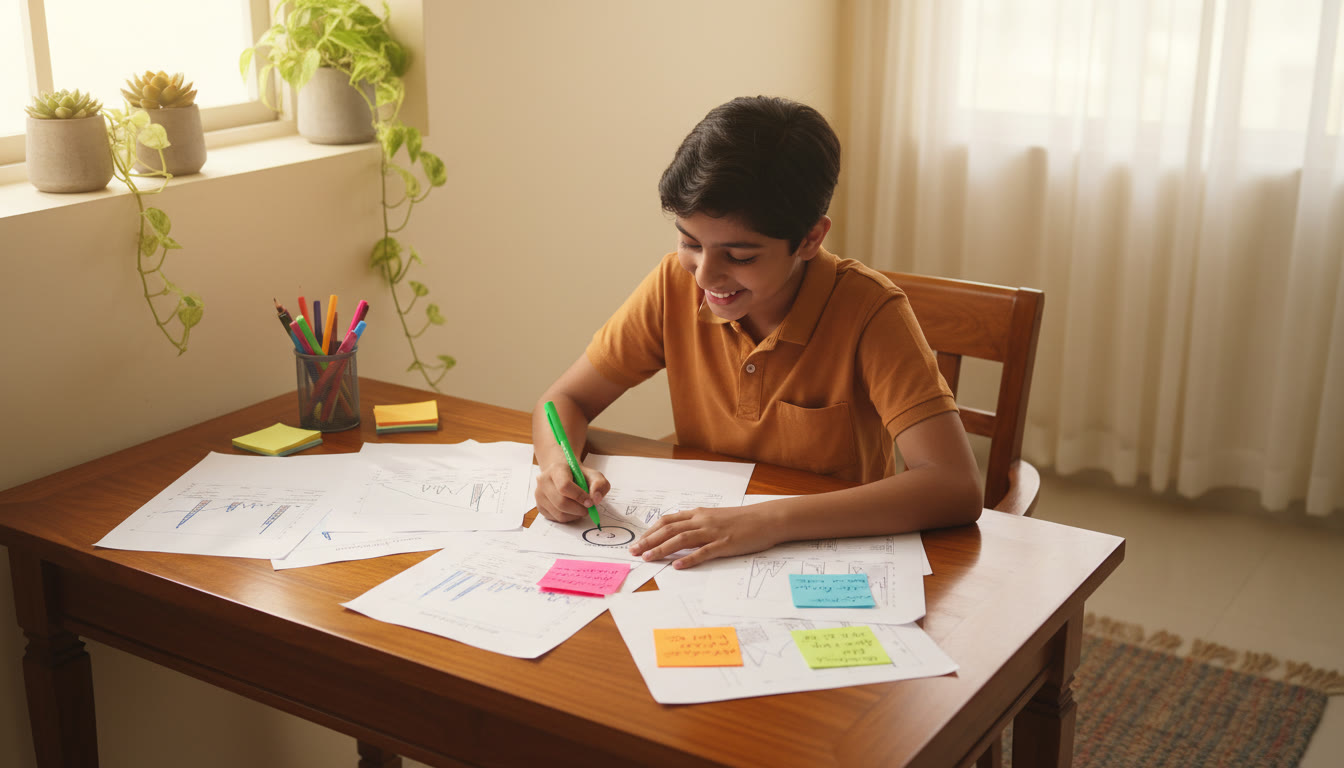
Practical exam-day and answer-sheet tactics
Exam day mechanics are small edges that matter. They’re about discipline and micro-decisions: when to skip, how to mark answers, and how to use review time.
- Attempt selection: Start with high-confidence questions to build momentum. Move to medium-level questions next. Only invest time in a question if there’s a clear path to solution within your time limit.
- Guessing strategy: Random guessing is punished by negative marking. Use elimination: if you can eliminate one or two options, your expected value improves; otherwise, don’t risk it.
- OMR/CBT discipline: practice filling answers steadily — bubbling mistakes can cost precious minutes. If your test uses an OMR-like sheet in practice, rehearse bubble-filling speed. If computer-based, be comfortable with the on-screen navigation and flagging system.
- Review time: Save at least the last 15–20 minutes to re-check marked questions, arithmetic, and exact answer formats for numeric entries.
Last month, last two weeks: what to cut and what to keep
The final stretch is not the time to learn entire new chapters. It’s the art of subtraction: preserve high-yield practice, polish weak links, and protect mental energy. Here’s a progressive checklist:
- 4–6 weeks out: Stop starting large new topics. Finish any small remaining topics, then move to heavy mixed practice and timed mocks.
- 2–3 weeks out: Switch largely to revision — brief concept sheets, error-log corrections, and short daily mock or sectional tests. Sleep and nutrition become part of your strategy; cognitive sharpness matters more than extra late-night hours.
- Last 3–5 days: No new learning. Stick to one-page formulas, light practice to keep fingers nimble, and calm routines. Visualize the test day and your pacing plan.
Common last-year mistakes and how to avoid them
- Over-cramming: Cramming new chapters creates false confidence. Replace it with targeted practice on familiar topics.
- Poor mock analysis: Taking mocks without structured review wastes time. Always follow a set mock-analysis routine.
- Skipping mental fitness: Endless study without rest leads to burnout. Scheduled breaks and sleep hygiene improve recall and reaction time.
- Panic re-reading: Re-reading long notes is passive. Test yourself actively — solve, recall, and teach concepts aloud.
How to get tailored help without losing your voice
Last-year students often benefit from occasional 1-on-1 calibration: a tutor who pinpoints exactly which weak habits to fix, a study plan that reflects real time availability, and test analytics that translate mocks into action. If you look for structured, personalized support, consider options that offer tailored study plans, expert tutors, and data-informed insights that tell you what to practice next. For example, Sparkl provides 1-on-1 guidance, tailored study plans, expert tutors, and AI-driven insights to help you convert mock-test feedback into clear, daily practice goals — use such resources sparingly and only to accelerate focused practice, not to outsource responsibility.
Quick tools and habits you must build
- Error log: A single notebook where every mistake gets one-line diagnosis and one corrective action. Revisit it weekly.
- Formula sheets: Pocket-size sheets for each subject you can glance at during short breaks.
- Timed problem blocks: 45–60 minute problem sprints followed by 10–15 minute reviews.
- Sleep and micro-rest: 7–8 hours sleep target and short 20-minute naps when needed — quality rest improves consolidation.
Measuring progress: metrics that mean something
Score alone is noisy. Use a few cleaner indicators:
- Accuracy on attempted medium questions (aim for progressive improvement).
- Reduction in recurring error types in your error log (calculation, concept, silly mistake).
- Average time per question in mock tests and the time left at the end of each section.
Simple weekly checklist
- 3 full-length mocks and 2 sectional timed practices.
- One full revision pass over your error log.
- Two new problem families mastered per subject.
- One relaxation activity and consistent sleep schedule maintained.
Final advice: consistency, not perfection
In the last year, small habits compound. A steady cadence of smart practice, honest mock analysis, and healthy routines will get you much farther than frantic, last-minute binges. Keep a prioritized shortlist for every week: three things to master, three errors to fix, and one mock to analyze deeply. Trust systems over moods; when you can’t focus, do a short, high-impact task rather than an aimless long session.
Approach the exam as a well-practiced skill: pace, planning, and calm execution. That’s where most marks are won.
All the best as you enter this final, exciting stretch of your JEE Main journey. Focused practice, disciplined mocks, and clarity of priorities will carry you through to the finish line.






















No Comments
Leave a comment Cancel