
JEE Main PYQ Revision Guide: Turn Previous-Year Questions into Reliable Strength
There’s a particular kind of calm that comes from watching your answers improve on mock tests. If you’re juggling dozens of topics, feeling the pressure to finish full-length papers in the prescribed time, and trying not to panic about negative marking — this guide is for you. We’ll treat previous-year questions (PYQs) not as fossils to be memorized, but as a diagnostic lab: a place to learn patterns, polish timing, and correct the tiny habits that cost marks on exam day.

Why PYQs are the revision north star
PYQs are compact lessons disguised as questions. Each question tells you what the exam setters value: the crisp concept, the tricky wording, the time a particular idea takes to test. Use PYQs to:
- Calibrate timing — know how long a typical MCQ takes for you when under pressure during a 3‑hour full-length mock test.
- Expose recurring patterns — certain ideas reappear across cycles; recognizing them reduces surprise on exam day.
- Spot your error profile — careless slips, calculation errors, and conceptual gaps show up quickly when you track PYQ performance.
- Train exam temperament — keeping cool through a paper, resisting the urge to overwork a single problem, and handling negative marking.
Get the basics right: exam style and ground rules
Approach PYQ practice with the real exam context in mind. The current JEE-style testing emphasizes objective, multiple-choice questions taken in a timed environment. A full-length mock is a continuous block (about three hours), so your practice must mimic that intensity. Negative marking penalizes wrong attempts, and there’s no partial credit for incomplete derivations in MCQ formats — therefore clarity and precision win.
Note on delivery: the exam itself is delivered on a computer-based platform, but many of your timed practices will still be paper-based or use offline test formats. Practicing OMR-like discipline (careful selection, avoiding stray marks, accurate transferring of answers) helps whether you’re filling bubbles in an offline mock or clicking choices on a screen.
How to build a PYQ-first revision strategy
Don’t just solve PYQs — build a system around them. Here’s a simple loop you can repeat:
- Sort PYQs by topic, not by year. That lets you see how a single concept gets tested over time.
- Attempt under timed conditions. Simulate the 3‑hour rhythm: no phone, one sitting, real breaks only.
- Log every question you get wrong and categorize the reason: conceptual, calculation, careless, or misread.
- Re-solve incorrect PYQs after targeted study until you can do them cleanly within time limits.
Subject-wise tactics that make PYQs more effective
Physics
Physics PYQs reward clarity. Most will test a single principle elegantly, so your job is to spot that principle quickly. Use this approach:
- Sketch the scenario first — diagrams reduce errors and often make the method obvious.
- Write down the governing equation(s) and symbols; sanity-check units before plugging numbers.
- Practice order-of-magnitude checks: a wrong-looking answer is often outside physically reasonable limits.
- Use PYQs to build a mini-list of high-yield tricks (e.g., common approximations, boundary cases, and standard substitutions).
Chemistry
Chemistry PYQs split into three flavors: physical (numerical), inorganic (facts/trends), and organic (mechanisms/reactions). Tailor practice accordingly:
- Physical chemistry: practice speed with accuracy — many PYQs are calculation-based and reward neat setup and careful arithmetic.
- Inorganic chemistry: transform rote lists into patterns — periodicity, oxidation-state logic, and simple bonding models make memorization efficient.
- Organic chemistry: focus on reaction type recognition. PYQs often test reaction outcomes or simple mechanism steps rather than long organic synthesis chains.
Mathematics
Math PYQs prize crisp methods and shortcut awareness. When you practice with PYQs:
- Learn standard forms: many questions collapse with the right substitution or identity.
- Time drills on algebraic manipulation and standard integrals/derivatives — fluency saves crucial minutes.
- Practice elimination and estimation methods for MCQs — sometimes a bounding argument or test value is faster than full solution work.
Turn each mock into a learning file: the analysis workflow
After every timed mock, invest the same time analyzing as you spent taking it — this is non-negotiable. Use this structured approach:
- Score first, then don’t rush. Categorize each mistake and note the reason in an error log.
- Tag mistakes: Conceptual / Calculation / Carelessness / Time management / Marking error (CBT/OMR slip).
- Create a corrective micro-plan for the most frequent tag. If careless errors dominate, slow down; if conceptual gaps dominate, schedule targeted revision slots.
- Reshuffle PYQs you solved incorrectly into a ‘red book’ — these get revisited every 4–6 days until error rates drop.
Sample PYQ-focused 6-week revision plan
| Week | Focus | PYQ Tasks | Mocks (timed) | Goal |
|---|---|---|---|---|
| 1 | Core concepts consolidation | Solve topic-wise PYQs; make micro-notes | 1 half-length practice | Clean up obvious conceptual gaps |
| 2 | Speed & accuracy drills | Timed sets (30–40 Q) from PYQs | 1 full mock at end of week | Stabilize time per question |
| 3 | Error log focus | Re-solve all logged PYQs; concept revision | 1 full mock | Reduce repeat mistakes by 50% |
| 4 | Advanced application | Mixed-topic PYQ batches; tricky problem practice | 2 full mocks | Improve ability on multi-concept questions |
| 5 | Consolidation & shortcut library | Create cheat-sheets from PYQs; quick recall practice | 2 full mocks | Sharpen recall and elimination techniques |
| 6 | Polish and stamina | Daily 30–60 minute PYQ revision; light topic review | 3 full mocks (spaced) | Peak exam stamina and calmness |
How to manage time in a 3-hour full-length mock
Time-management is a practiced habit, and PYQs are the drill ground for it. Start with a realistic per-question average and refine it by subject and difficulty. A few practical rules:
- First pass: Solve the lowest-effort questions quickly — build a bank of secure marks early.
- Flag and move on: If a question will take longer than your per-question target, flag and return to it after the first pass.
- Reserve the last 20–30 minutes for flagged questions and a quick sweep of numeric answers or entries.
- Remember negative marking: don’t make blind guesses. Only attempt guesses when elimination gives you a clear advantage.
Practical PYQ drill examples (how to practice, not full solutions)
Take a set of 10 PYQs from a single topic and time yourself. Immediately after finishing, sort them into three piles:
- Clean solves (done without hesitation)
- Workouts (needed some thought or algebra)
- Rewrite-needed (incorrect or guessed)
For the next session, recycle the last two piles first. That repetition is the engine of improvement.
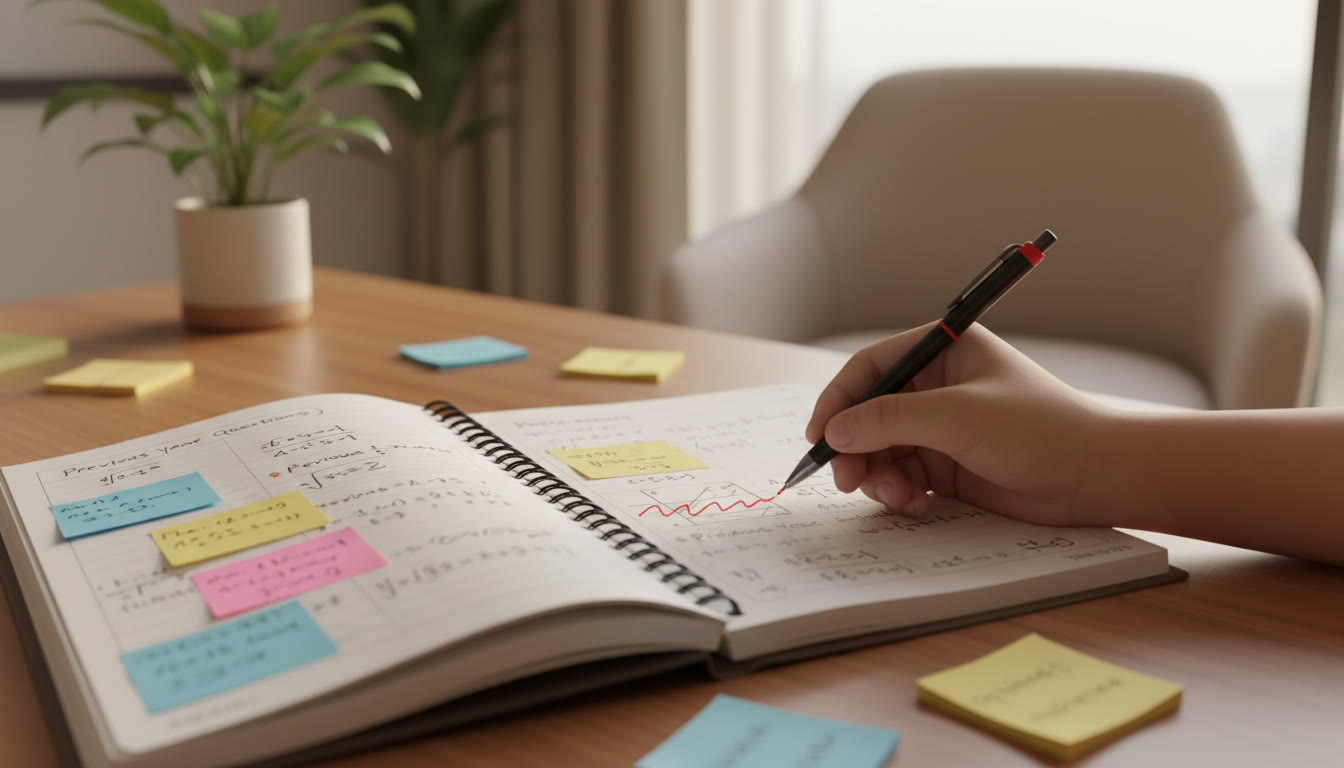
Use PYQs to build compact revision artifacts
Make two short, portable documents from PYQ practice:
- A one-page formula sheet per subject: only the relations you regularly used while correcting PYQs.
- A micro-error index: 20–30 of your most frequent mistake types and their fixes (for instance: “forgot unit conversion for rotational motion — always convert RPM to rad/s”).
Keep these in your pocket or phone and review them in 10–15 minute bursts during commutes or short breaks.
Mock analysis matrix: categorize and attack
After a mock, classify errors and assign corrective action like this:
- Conceptual — re-learn the underlying idea; solve 5 PYQs of the same concept.
- Calculation — practice similar numeric PYQs focusing on setup and arithmetic checks.
- Careless — identify trigger (rushing, poor handwriting, misreading) and adopt a single corrective ritual (e.g., re-read question line once before solving).
- CBT/OMR marking error — practice on the same platform or simulation to reduce interface mistakes.
Final weeks: intensity, not volume
Shift from covering new topics to improving success rate on PYQs. That means:
- Daily timed PYQ sets (topic-mixed) — keep variety so you don’t get comfortable with one pattern only.
- Two to three mocks per week, with full analysis after each.
- Micro-revision sessions on your formula sheets and error index.
If you find a repeating weak spot — for example, a cluster of problems in electrostatics or calculus — create a tiny focused block (3–4 practice problems a day for a week) and track progress. That micro-focus beats random practice.
How personalized tutoring (when used wisely) accelerates PYQ progress
Mock practice tells you where you’re losing marks; a targeted coach or tutor can show you how to fix the exact weakness faster. If you choose guided help, look for tutors who do three things: diagnose using your mock history, set micro-goals, and teach repeatable problem patterns. For students who want pinpointed, one-to-one guidance, Sparkl‘s personalized tutoring can provide tailored study plans, expert tutors, and AI-driven insights that highlight recurring mistakes from your PYQ history and suggest efficient practice paths.
Common PYQ practice pitfalls — and how to avoid them
- Blind repetition: solving the same questions without analysis. Fix: always review and categorize after each set.
- Ignoring wrong answers: a wrong answer is an instruction. Fix: treat it as the next topic to revise.
- Overemphasis on last-year novelty: setters vary. Fix: focus on concept patterns rather than isolated trick questions.
- Neglecting stamina: full-length mock practice trains concentration for three hours. Fix: schedule at least one full mock every 4–7 days in later stages.
Quick practical checklist before any full-length mock
- Warm up: 10–15 minutes of light review—formula sheet, a couple of quick PYQs to get your mind ready.
- Environment: silence, comfortable chair, correct screen settings (if CBT), and a clock visible.
- Materials and breaks: keep water and tissues ready, and schedule any necessary bathroom break into your plan.
- After the mock: allocate 1–1.5× the test time for analysis. The test itself is training; the analysis is where the score improves.
Wrap-up: making PYQs work for you
PYQs are not a ritual; they’re data. Treat every question as feedback and every mock as a controlled experiment. Build a tight loop of timed attempt → error logging → targeted correction → re-test. Keep compact revision artifacts (formula sheets and micro-error lists), and use short, focused practice bursts to fix repeating mistakes. Use subject-wise tactics — diagrams in physics, patterns in chemistry, substitutions in maths — to convert PYQ practice into reliable exam behavior.
Finally, remember that steady, analytical practice beats frantic last-minute cramming. Use PYQs to train the exact skills the exam asks for: speed, accuracy, and the ability to pick the right method under time pressure.
This completes the academic guide to organizing PYQ-driven revision and mock-test practice for JEE Main preparedness.






















No Comments
Leave a comment Cancel