

Why revision is the battlefield — and why most students lose ground
Revision is not the tired tail-end of study; it is the sharp edge that converts hours of learning into exam-ready performance. For a competitive, MCQ-based test like the JEE, revision isn’t about reading a chapter again; it’s about shaping your memory, instincts, and speed so you can answer correctly under the pressure of a three-hour, full-length mock environment with negative marking and strict answer-entry discipline.
Too many students treat revision as a tidy activity — highlighting, re-reading, and making longer notes — and then wonder why mock scores don’t follow. The truth is simple: active retrieval, error analysis, and realistic practice matter far more than pages of rewritten notes. In a world where every wrong tick can cost you through negative marking, a disciplined, surgical revision routine beats vague, feel-good study sessions every time.

Top revision mistakes students make (and how they quietly hurt your score)
1. Passive rereading instead of active recall
Mistake: Spending long hours re-reading textbooks or solutions, believing that familiarity equals mastery. This creates an illusion of competence — the material looks familiar, but you cannot reproduce or apply it under test conditions.
Fix: Switch to active recall. Close the book and write the key result, derive the formula from fundamentals, or solve a fresh problem without looking at examples. Use short, frequent self-quizzes and spaced repetition to force retrieval. A simple routine: after studying a concept, list three questions you should be able to answer about it; quiz yourself later the same day and then after a few days.
2. Cramming and one-shot cramming sessions
Mistake: Last-minute marathon sessions that cram ten topics in one night. Cramming gives a short-term boost to recognition but fails when you need to apply concepts in novel MCQs or sustain concentration for a full three-hour mock.
Fix: Spread revision into shorter, focused sessions across days. Prioritize interleaving — practice mixing problems from two or three different topics in one session. Interleaving helps you learn how to choose approaches, which is essential for MCQ problem selection.
3. Focusing only on comfort topics
Mistake: Students invest revision time in their favorite chapters because those feel productive, while ignoring weaker topics that cost more marks in the exam.
Fix: Maintain a weakness log. After each mock, list topics you missed and rank them by frequency and severity. Allocate fixed micro-sessions (30–60 minutes) specifically for weak areas each revision week until accuracy improves. Small, consistent repairs beat occasional marathon corrections.
4. Re-solving the same solved examples
Mistake: Repeating a problem you already solved until it feels comfortable. This teaches recognition, not problem-formation skills. In a real MCQ you will face variations, traps, and converted quantities.
Fix: Create variations. Change parameters, alter boundary conditions, or remove intermediate steps and see if you can reconstruct the solution. If a problem used a clever trick, practice identifying the trigger conditions that make that trick valid.
5. Not simulating full, timed mocks or exam discipline
Mistake: Doing short quizzes or casual practice but skipping end-to-end simulation. Many students underestimate how fatigue, time pressure, and exam-format cues affect decision-making.
Fix: Do several full-length, three-hour mock tests under realistic conditions. Replicate answer-entry discipline whether it’s OMR practice for paper-based simulations or the CBT interface for computer-based tests. Practice the rhythm of sections, time allocation, and the mental management of continuous concentration.
6. Blind guessing without negative-marking strategy
Mistake: Random guessing in the hope of extra marks. Negative marking penalizes blind guesses and can erode your score rapidly.
Fix: Use elimination. Only attempt a guess when you can confidently remove one or more options. Develop quick elimination checklists for each subject (dimensional checks in physics, reagent checks in chemistry, standard patterns in biology or maths). Practice probabilistic thinking: if you can eliminate one choice in a four-option MCQ, your odds improve; if not, mark for review and return later if time permits.
7. Long, unreadable notes that nobody reviews
Mistake: Creating thick notebooks of verbatim notes which become too long to revisit during revision. When time is limited, long notes are impractical.
Fix: Build compact, test-friendly sheets — formula cards, one-page conceptual maps, and a two-page “do-not-forget” sheet per subject. Your revision book should be a tool for quick, high-yield recall, not a second textbook.
8. Treating derivations and diagrams as optional
Mistake: Skipping derivations because they look time-consuming. But during the exam, a conceptual trap often requires the principle behind a formula — not just the formula itself.
Fix: Keep a small set of core derivations and sketches you can do in under five minutes. Practice drawing clear, exam-friendly diagrams and annotating them. These are memory hooks that help you reconstruct formulas when your brain is under stress.
9. Ignoring syllabus alignment across subjects
Mistake: Studying topics that are nice-to-know rather than ones aligned to the current syllabus. Even well-prepared students can miss scoring opportunities if their revision map diverges from the official syllabus.
Fix: Make a syllabus checklist for Physics, Chemistry, and Biology (if applicable to your testing path). Map each study session to explicit syllabus items so you can track coverage and ensure nothing essential is left out.
10. Neglecting recovery — sleep, nutrition, and micro-rest
Mistake: Treating sleep as optional. Lack of recovery impairs memory consolidation and test stamina, making a three-hour session much harder than it needs to be.
Fix: Prioritize sleep hygiene, short active breaks during revision blocks, and light physical activity to keep energy steady. When experimenting with caffeine, test it during practice sessions before using it on test day.
A quick-reference table: mistakes and surgical fixes
| Mistake | Why it hurts | Fast fix |
|---|---|---|
| Passive rereading | Creates recognition, not recall | Daily active recall quizzes + flashcards |
| Cramming | Poor long-term retention | Break into spaced short sessions |
| Ignoring weak topics | Unpredictable score losses | Weakness log + focused micro-sessions |
| Not simulating exams | Poor time and stress management | Full 3-hour mocks under realistic conditions |
| Blind guessing | Negative-marking losses | Practice elimination; mark and revisit |
Design a revision plan that respects both brain science and exam format
A successful revision plan balances five things: coverage, depth, retrieval practice, mock simulation, and recovery. Below is a sample micro-cycle you can adapt to your remaining weeks before an important test window. Remember that the goal is consistent retrieval and feedback, not simply ticking chapters off a list.
| Day | Primary focus | Structure (example) | Outcome |
|---|---|---|---|
| Day 1 | Core concepts (Physics) | 2 hr concept review, 1 hr active problems, 30 min flashcards | Reconstruct key formulas from first principles |
| Day 2 | Chemistry application | 1.5 hr reaction mechanisms, 1.5 hr problem set | Identify reaction patterns and elimination checks |
| Day 3 | Weak-topic repair | 1 hr diagnosis, 2 hr targeted practice | Reduce error rate by focused correction |
| Day 4 | Mixed problem session | 3 hr mixed MCQ block (timed) | Simulate mock rhythm and pacing |
| Day 5 | Review & relaxation | 1 hr light revision, 1 hr walk/active rest | Consolidate learning and restore energy |
How to make mock tests work for you — not just be a score ticker
Mocks are your diagnostic engine, but only if you treat them as experiments. Treat each three-hour mock like a medical checkup: record the results, analyze the causes of mistakes, follow up with targeted repairs, and then retest.
- Simulate the real exam: seat, timing, answer-entry discipline (OMR practice or CBT navigation), and no interruptions.
- Post-mock triage: within 24 hours, categorize errors into conceptual, calculation, silly, or time-pressure mistakes.
- Convert errors into drills: if you make the same conceptual error twice, create a mini practice set of 5–10 problems that force you to confront that exact idea.
- Track metrics: accuracy by topic, average time per question, and number of non-attempts. Use the trends, not a single score, to guide changes.
Practical revision tools and strategies you can use today
Here are small, immediately actionable habits that change revision quality:
- Daily 30-minute ‘challenge block’: pick 10 mixed tough MCQs and complete them under mixed-timing to train switching skills.
- On-the-spot recall: when you close a topic, write down five things you’d expect to be tested on that topic — then check what you missed.
- Error bank: maintain a digital or physical file of mistakes with a one-line diagnosis and a short corrective exercise for each.
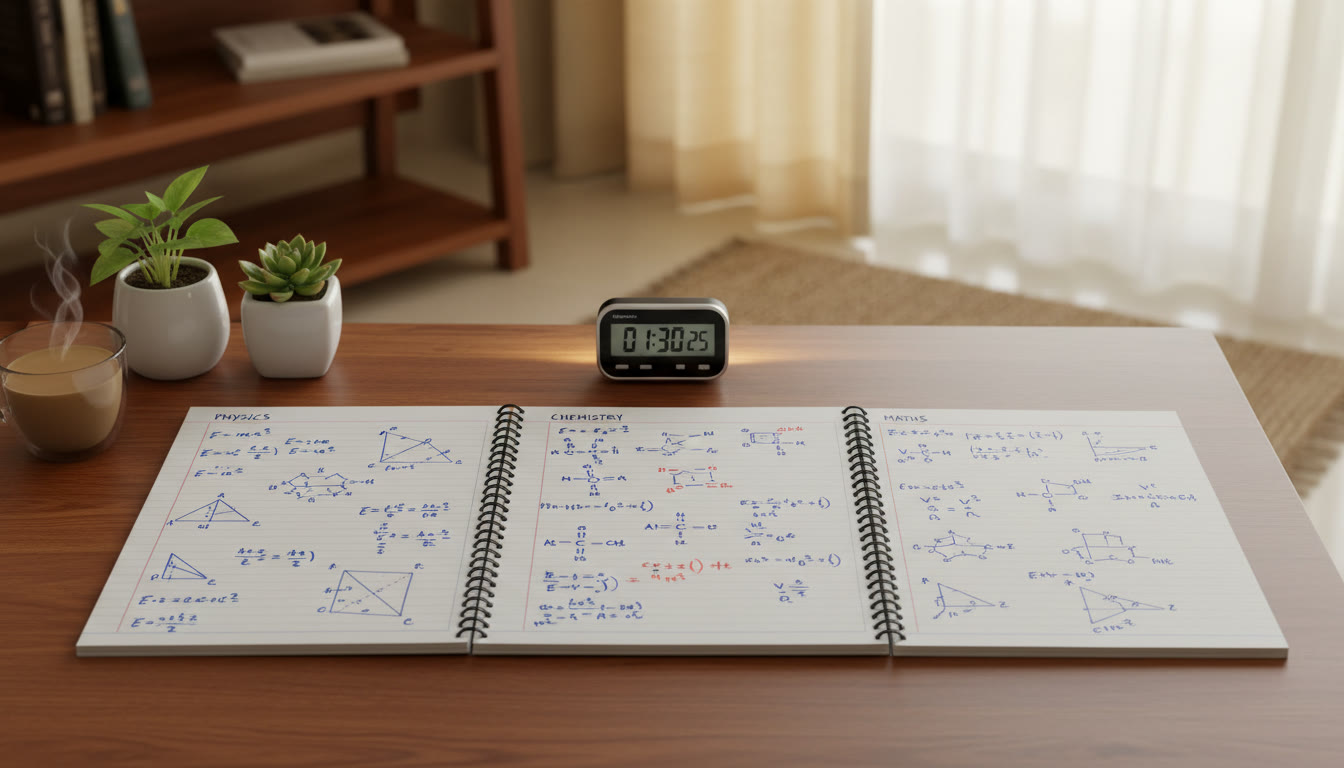
- Two-page cheat sheet per subject: a compact reference of formulas, reaction highlights, and one-line problem flags you can skim quickly.
How tutoring and technology can mend revision blind spots
When revision stalls, targeted help can accelerate recovery. Personalized tutoring focuses your micro-sessions on what actually moves the needle. For example, Sparkl‘s personalized tutoring approach — with one-on-one guidance, tailored study plans, and subject experts — can help transform repeated errors into durable learning. Tutors can show you the mental shortcuts for elimination, the smallest set of derivations worth memorizing, and how to practice OMR or CBT discipline under realistic constraints.
Advances in AI-driven insights make it easier to turn mock-score patterns into priorities. An analytics view that shows chapter-wise accuracy and time spent tells you exactly what your next two weeks of revision should look like. Use those metrics to allocate your weakness log time, and prioritize the high-payoff topics you are still missing.
Subject-specific revision reminders
Physics
Focus on principles and dimensional sense. Rather than memorizing isolated formulae, practice deriving the most frequent formulas quickly from base laws and identify unit mismatches as an elimination method on MCQs.
Chemistry
For physical chemistry, keep formula cards and practice calculations until conversions are second-nature. Organic chemistry needs reaction pattern recognition and reagent elimination. Inorganic chemistry benefits from grouped facts and mnemonic anchors. Make short reaction-flash sets for quick daily revisions.
Biology
If Biology is part of your testing path, treat it like a concept-and-fact subject: make quick flowcharts for pathways, and practice MCQs that test application of these processes rather than rote recall alone.
Common revision myths — busted
- Myth: Rewriting notes makes you learn them. Reality: Rewriting often creates comfort. Active testing is what builds retrieval.
- Myth: Doing more questions always equals better results. Reality: Quality over quantity — do fewer questions with focused reflection and variation.
- Myth: If you can follow steps once, you’ll be able to do it in the exam. Reality: Under pressure, you must be able to reconstruct steps from memory; practice that reconstruction.
Final checklist before any revision session
- Set a clear objective: a list of 3–5 concrete tasks you will complete in the session.
- Time-box the session and include a 5–10 minute active recall at the end.
- Log mistakes immediately and create one corrective action per mistake.
- Keep a compact revision sheet handy and update it at least once per week.
Closing thought
Revision is not an act of accumulation; it is a process of refinement. The difference between a hopeful student and a reliable performer is the ability to turn practice into predictable results through active recall, smart mock-test use, targeted correction, and steady recovery. Use realistic three-hour simulations to build endurance, respect negative-marking with disciplined guessing rules, align every session to the syllabus across Physics, Chemistry, and Biology where relevant, and keep your revision compact and test-focused. With focused habit changes, even persistent mistakes become predictable improvements.



















No Comments
Leave a comment Cancel