
Six Months to the Finish Line: A Tactical JEE Plan for Students Ranked Under 10,000
Take a steady breath — being below 10,000 is not a weakness, it’s a perfectly strong starting point. In these last six months the game changes: you’re no longer measuring progress by how many new chapters you open, but by how reliably you convert knowledge into accurate answers under time pressure. This plan treats the exam exactly as it is: an MCQ-driven, time-bound test with negative marking and strict answer-entry discipline. The calendar ahead should be built around mocks, focused corrections, and bulletproof execution.
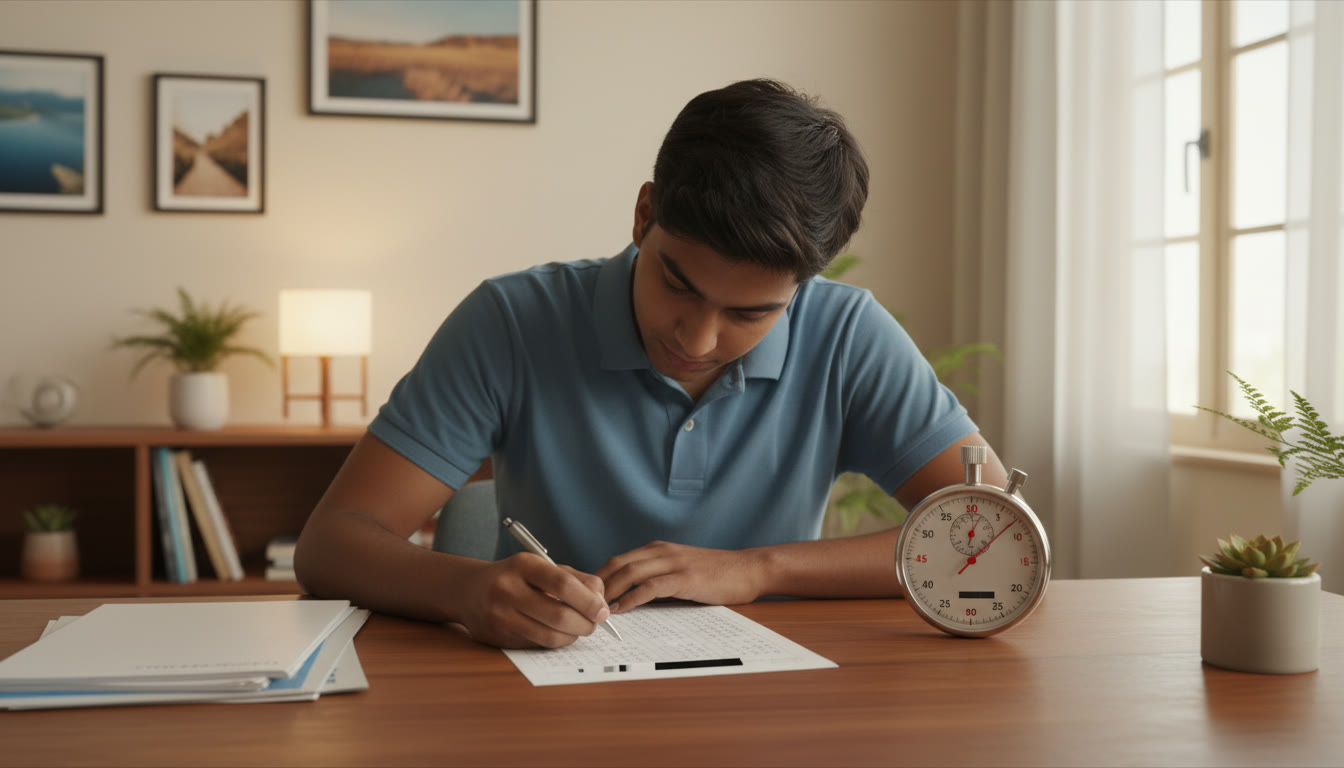
Where you are and what to aim for
If you are ranked under 10,000, you have more than content—you have feedback. Your past tests give you a roadmap of strengths and repeat mistakes. The target for the next six months should be practical and measurable: increase accuracy, stabilize your time-per-question, and reduce careless losses. Practice under full 3-hour conditions, follow strict OMR or answer-entry discipline, and refine a prioritized list of topics for Physics, Chemistry, Mathematics (and any interdisciplinary Biology you’re tracking). The aim is to be consistently in the range that allows safe, smart attempts rather than risky guesswork.
Core principles for this final phase
- Mock-first learning: Everything you learn should be validated by a timed test. Learn → Test → Analyze → Repair; repeat.
- Accuracy over volume: Because negative marking penalizes random attempts, fewer correct, confident attempts beat many reckless ones.
- Fix the leak: Track recurring error types (conceptual, calculation, reading error) and prioritize the leaks that cost most marks.
- OMR & entry discipline: Practice answer-entry under exam-like conditions so that no marks are lost to mis-shading or mis-clicking.
- Spaced revision: Use increasing intervals for formulae and core concepts so recall becomes automatic when under pressure.
- Measure everything: Track accuracy, attempts per mock, average time per question, and topic-wise error rates — decisions should be data-driven.
Month-by-month roadmap
Break the six months into phases: consolidate, intensify, simulate, and polish. Below is a compact roadmap you can adapt to fit your daily life and existing commitments.
| Month | Primary Focus | Weekly Hours (target) | Mock Frequency | Key Tasks |
|---|---|---|---|---|
| Month 1 | Consolidate fundamentals; close basic gaps | 35–45 | 1 full mock + 2 sectional tests | Create topic lists, formula sheets, begin error log |
| Month 2 | Target high-yield topics; timed practice | 40–50 | 1 full mock + 3 timed practice sessions | Speed drills, mixed sets, increase difficulty |
| Month 3 | Mock-anchored: increase full-length tests | 45–55 | 2 full mocks + sectional focus | Deep mock analysis, repair conceptual gaps |
| Month 4 | Fix recurring mistakes; build accuracy | 45–60 | 2–3 full mocks | Targeted drills, endurance practice |
| Month 5 | Peak practice: simulate exam weeks | 50–65 | 3 full mocks + daily short quizzes | Full simulations, formula pruning, review |
| Month 6 | Fine-tune; rest cycles; exam logistics | 30–45 | 2 full mocks + light revision | Confidence-building, light practice, exam routine |
Keep this table visible and review it weekly. If your analysis shows plateaus, reallocate hours from new learning to targeted practice and error correction.
Practical weekly and daily templates
Strong structure matters more than perfect hours. Below are adaptable weekday and weekend templates you can tune to your stamina and school/college timetables.
| Time | Weekday Plan | Weekend Plan |
|---|---|---|
| 5:30–7:00 AM | Quick revision: formula flash & 8–10 warm-up problems | Deep revision: 45–60 minute focused chapter review |
| 8:00–11:00 AM | Primary learning block (new problems/topics) | Primary study block (intense problem sets) |
| 11:30–1:00 PM | Alternate subject practice | Sectional mock or extended problem solving |
| 2:00–4:00 PM | Timed practice or small mock | Full sectional test |
| 5:00–7:00 PM | Mock analysis / error correction | Full mock (if scheduled) or review |
| 8:00–10:00 PM | Light study: flash cards, formula sheet | Reflection, planning, and relaxation window |
Weekly review: every Sunday take 1–2 hours to log progress, note two priorities for the week ahead, and schedule your full mocks. This small ritual keeps momentum and prevents accidental drift.
Subject-wise micro-plans
Physics
Physics rewards structured thinking. In the final months switch to problem-first learning: pick a challenging problem, attempt it, then study the compact set of concepts you need to solve it. Maintain a single-page “Physics Essentials” for quick recall of derivations and formulae.
- Practice ratio: 60% problems, 30% conceptual notes, 10% formula review.
- Daily drill: one timed set of 8–12 mixed problems; weekly focus on combined-topics questions.
- High-yield areas: mechanics, electricity & magnetism, optics, thermodynamics, and modern physics.
Chemistry
Chemistry is a mix of calculation and memory. Divide your time into Physical, Organic, and Inorganic and use different techniques for each.
- Physical: practice numerical problems and check conceptual assumptions behind equations.
- Organic: make skeletal reaction maps and focus on mechanism templates and typical transformations.
- Inorganic: build concise recall sheets of reactions, periodic trends, and properties; test by writing them down from memory weekly.
Mathematics
Speed and pattern recognition in Mathematics are earned, not gifted. Practice minimal-step solutions and cultivate the habit of quickly classifying a problem’s type (calculus, algebra, geometry). Time spent simplifying technique will pay off in the exam.
- Focused drills: 30–45 minute problem sets set by chapter, completed under strict time pressure.
- Technique card: for each chapter, maintain 2–3 standard solution tricks you can scan and recall in the exam.
- Avoid reinventing steps—work for the shortest, most robust path to answer.
Biology (if applicable)
If you’re reviewing Biology for interdisciplinary reasons, treat it as high-recall. Use labeled diagrams, spaced recall, and frequent mini-quizzes; focus on terminology, cycles, and high-frequency facts in short bursts.

Mock test strategy — how to learn faster
Mocks are not a scoreboard; they are the lab where you experiment. Take a 3-hour full-length mock exactly as the exam would be: no phone, real breaks, and timed sections. After the test, invest focused analysis time. Spend roughly three times the duration of the test analyzing it: classify each mistake, log the root cause, and design three micro-tasks to repair that specific weakness.
- Track not just score but attempt patterns: attempts per subject, accuracy, and time per question.
- Address the most frequent error type first — it often yields the fastest score lift.
- Gradually increase mock frequency as you close conceptual gaps: from weekly to twice-weekly to three times a week at peak.
Mock-analysis checklist (use after every full test)
- List incorrect answers and tag the root cause: conceptual, calculation, misread, or careless slip.
- Note skipped questions and why they were skipped.
- Write 3 concrete practice tasks to correct the top recurring mistake and schedule them before your next mock.
- Update your error log and review those topics in short daily drills.
| Metric | Target (example) | Why it matters |
|---|---|---|
| Accuracy | 70%+ of attempts | Reduces negative-mark impact and stabilizes score |
| Average time per question | ~1.5–2 minutes | Keeps pace consistent across 3 hours |
| Careless errors | < 10% of mistakes | Easy gains through discipline and calmness |
Turning a mock into a two-week action plan — an example
Say a mock shows accuracy 60% and frequent mistakes in electricity (Physics) and integration tricks (Mathematics). A clear two-week plan would be:
- Week 1: 4 targeted practice sessions on electricity problems (timed), plus a 30-problem integration drill on alternate days. After each session, log errors and correct them immediately.
- Week 2: Take a full mock early in the week, analyze mistakes in both topics, and then run two focused correction sessions for the most common mistakes. Add daily 20-minute formula recall for both subjects.
This converts a test result into measurable actions: time allocated, number of practice problems, and a repeat mock to measure improvement.
Exam day tactics and OMR discipline
In the final weeks, practice the tiny behaviors that cost marks: mis-shaded bubbles, misaligned rows, or accidental extra clicks. Simulate the exact entry mechanism you’ll use on exam day and practice it until it becomes automatic.
- Sequence: Start with your strongest subject to build confidence, then move to a mixed approach that balances safe marks and higher-value problems.
- Time limits: Keep mini-deadlines every 30–45 minutes to check pace; if you’re ahead, use extra time for a hard question, if behind, switch to safer attempts.
- Last 15 minutes: do a targeted sweep for careless errors and confirm all answers are entered correctly on the OMR/interface.
Health, rest, and psychological stamina
Performance is not only cognitive but biological. Regular sleep, short movement breaks, hydration, and steady meals protect clarity. Train your nervous system with mock pressure — practice breathing exercises before tests, and use one “mental reset” routine (two minutes of breathing or a short walk) when frustration builds. Keep social or hobby breaks brief but regular to avoid burnout.
Study groups, tutors, and one-on-one coaching
Group study can be useful for motivation and for explaining tricky problems to others, but it must be structured and time-limited. One-on-one tutoring is especially effective in this final window when the coach acts as a mirror for blind spots and a calibrator for pacing. If you choose tutoring, use it for precise tasks: a weekly mock review, focused correction of two problem areas, and refinement of your time-management strategy. For students who prefer structured personalization, Sparkl‘s personalized tutoring offers tailored study plans, 1-on-1 guidance, expert tutors, and AI-driven insights to convert mock data into an action calendar.
Common pitfalls and how to avoid them
- Collecting too many resources: pick a compact set of problem banks and a single notebook per subject for consolidated notes.
- Doing mocks without analysis: log mistakes immediately and plan corrections; otherwise mocks only inflate anxiety.
- Ignoring pacing in practice: practicing problems only in isolation won’t train your endurance for 3-hour performance.
- Last-minute cramming of new topics: final weeks are for consolidation and polishing, not experimental new chapters.
Exam-kit checklist and logistics
- Know the exact exam-time logistics and entry rules for the exam day; rehearse travel and morning routine once before the real day.
- Carry required documents, stationery that’s allowed, comfortable clothing, and a clean watch for pacing if permitted.
- On the desk: keep a small formula card for quick mental checks during breaks; do not use it as a primary study aid — it’s a last-minute safety net.
Final two-week ritual
The last 14 days are for calm repetition. Stop learning new major topics; reduce study hours slightly so your mind is fresh. Run full 3-hour simulations every 3–4 days and maintain a light revision rhythm between them. Practice your exact exam day routine including wake time, breakfast, travel time, and a 10-minute mental rehearsal right before you start. These small rituals remove surprises and anchor performance.
Success at the end of six months is rarely sudden. It is visible as steady improvements in accuracy, quieter test nerves, cleaner answer-entry, and the habit of turning every mock into a short, effective repair cycle. Keep your metrics honest, protect nightly sleep, and let small, consistent corrections compound into measurable rank improvement.
Closing academic thought
The last months are a laboratory: apply tests, diagnose mistakes, and implement small, targeted corrections. When mock-based learning is your curriculum, repeatable accuracy becomes the outcome and exam performance becomes predictable.



















No Comments
Leave a comment Cancel