
Two-Month JEE Rank Improvement Strategy: Focus, Plan, Execute
If you’re reading this in the final two months before the big JEE testing window, take a breath — this stretch is not about miracles, it’s about method. In the last eight weeks smart decisions beat desperate cramming every time. You will refine, simulate, and repeat: high-quality mock practice, targeted repairs of weak areas, disciplined time management, and conscious rest. This article gives you a compassionate, no-fluff plan you can actually follow and stick to.

Why these final two months matter more than raw hours
Raw study hours are useful early on; now the metric that moves ranks is effectiveness. Two months is when small improvements compound: a steadier exam temperament, 10–15 percent fewer silly mistakes, and smarter question selection can translate directly to hundreds of rank positions. This period is for converting knowledge into reliable performance under the exact pressures of a three-hour full-length mock, MCQ-style tests with negative marking, and the marking discipline that applies on exam day (OMR or computer-based as applicable).
Rule Zero: Mindset before methods
Start by deciding that these eight weeks are yours: fewer distractions, fewer new books, and more focused practice. Replace panic with a diagnostic mindset — treat every mock as a measurement, not a judgment. Keep two simple promises: (1) you will practice full-length, timed mocks at least weekly under exam-like conditions for the first half and increase smartly after that, and (2) you will analyze every mock with the same seriousness as you attempt it. That combination — realistic simulation plus ruthless analysis — is the engine for rank jumps.
Week 1: Diagnosis and Smart Prioritization
Begin with a calibrated baseline. Take a full-length 3-hour mock (paper or computer simulation) that mirrors the current exam style. Don’t study for it; treat it as a diagnostic snapshot. Record where you lose time, where you get stuck, and which topics consistently cause errors. Note the kinds of mistakes: conceptual gaps, calculation slips, careless reading, or time-pressure errors.
- Simulate exam discipline: follow the exact rules for filling answers, respect negative marking conventions, and replicate silence and timing.
- Use the mock to build a ‘weakness map’ across Physics, Chemistry, and Mathematics — not every topic is equal now.
- Do not assume partial marking for questions that do not explicitly provide it; treat each question’s marking scheme as binary unless stated otherwise.
8-Week Tactical Plan (Week-by-Week)
Below is a compact week-by-week framework you can adapt to your strengths and constraints. The schedule balances full-length mocks, focused topic repair, and incremental consolidation.
| Week | Primary Focus | Mock Schedule | Daily Target Hours | Key Actions |
|---|---|---|---|---|
| 1 | Full diagnostic + list weak zones | 1 full-length 3-hr mock | 5–7 | Mock → detailed error log → plan top 10 topics to fix |
| 2 | Core concept repair (top 5 weak topics) | 1 full mock + 2 sectional timed sessions | 6–8 | Daily targeted practice + short revision notes |
| 3 | Apply concepts to medium/hard problems | 1 full mock + topic tests | 6–8 | Mix problem sets and timed problem solving |
| 4 | Consolidation & pacing | 1 full mock; practice speed | 6–7 | Refine time allocation per section; error reduction |
| 5 | Increase mock frequency; simulate fatigue | 2 full mocks (spaced) + topic revision | 6–8 | Run two full exam simulations; practice recovery strategy |
| 6 | High-yield polishing & mixed problem drills | 2 full mocks + targeted tests | 6–7 | Focus on accuracy, elimination techniques |
| 7 | Final repairs & stamina maintenance | 2 full mocks + one light mock | 5–6 | Short, sharp revision; no new heavy topics |
| 8 | Light revision, formula checks, 48-hour prep | 1 short mock; no heavy sessions in last 48 hours | 3–5 | Rest, light practice, confidence routines |
How to use the table
This plan is intentionally flexible. If your mock analysis shows deep conceptual gaps in one subject, redistribute hours accordingly. The single constant: every week should include at least one test that replicates a 3-hour full-length experience. That test is your thermometer — it tells you whether your adjustments are working.
Daily Template: Maximum Efficiency in Limited Time
Every day should have a rhythm that repeats and improves. Routines create momentum; here’s a simple template you can adapt.
- Morning (2–3 hours): Fresh concept repair or short-topic revision with active recall (explain a concept aloud, solve 2–3 representative problems).
- Afternoon (2–3 hours): Practice session — timed problem sets focusing on the week’s priority topics.
- Evening (1–2 hours): Mistakes review and a short mixed set to preserve variety; end with a 20–30 minute light recap like flashcards or formula checks.
- Daily wind-down: 7–9 hours of sleep nightly; small physical activity and short breaks to keep cognitive energy high.
Three-Hour Full-Length Mock: How to run it perfectly
A mock is not just another test: it’s the rehearsal for the real performance. Run your full-length mock like an exam day, including the clock, the seating, and the answer marking routine. If the real test is computer-based, simulate the interface where possible; if it is OMR-style for some tests, practice bubble-filling technique so you don’t waste time or make marking errors.
- Before the mock: set a clear start time, prepare everything you will use, and warm up with a 15-minute light problem set.
- During the mock: strictly follow the time blocks you will use on exam day; if you plan to attempt sections sequentially or mix, stick to that plan.
- Negative marking discipline: keep an elimination checklist. For MCQs with negative marks, never randomly guess; use options-elimination and confidence thresholds.
- After the mock: spend at least 2× the mock duration in analysis during early weeks — the learning is in the review.
Mock analysis: not optional — mandatory
When you analyze a mock, be surgical: mark mistakes by type, estimate time lost, and list the immediate fix. Use a simple table or sheet to keep this process consistent across mocks: Mistake type, question ID, root cause, corrective action, verification problem. That last column — verification problem — is crucial: you must immediately attempt a similar question and get it right before moving on.
Topic Prioritization: Where to Spend Time Now
Not all topics are equal in the final stretch. Prioritize items you can fix with practice and that return consistent marks under timed conditions. Below is a practical, field-tested priority map for Physics, Chemistry, and Mathematics.
- Mathematics (high-yield): Calculus (limits, derivatives, integrals, application problems), Algebra (quadratic, complex numbers, sequences), Coordinate geometry (lines, circles, conics). These topics reward accuracy and repeated practice.
- Physics (high-yield): Mechanics (kinematics, dynamics, energy), Electricity & Magnetism (circuits, fields), Optics/Modern Physics for selective marks — focus on problem-solving speed and concept clarity.
- Chemistry (high-yield): Physical Chemistry (stoichiometry, equilibrium, thermodynamics problems), Organic reaction mechanisms and named reactions you can apply fast, Inorganic (focused rote facts but practice-based application).
Keep low-yield, high-effort topics to a minimum unless you are already strong there. The final two months are a pruning exercise: keep what increases reliability, drop what costs time with small return.
Smart problem selection
Choose problems that teach a reproducible technique. A good problem should either (a) teach a high-frequency trick, (b) clarify a conceptual gap, or (c) improve speed. In the last two months favor sets that replicate exam formatting: mixed topics, time pressure, and negative-marking style choices.
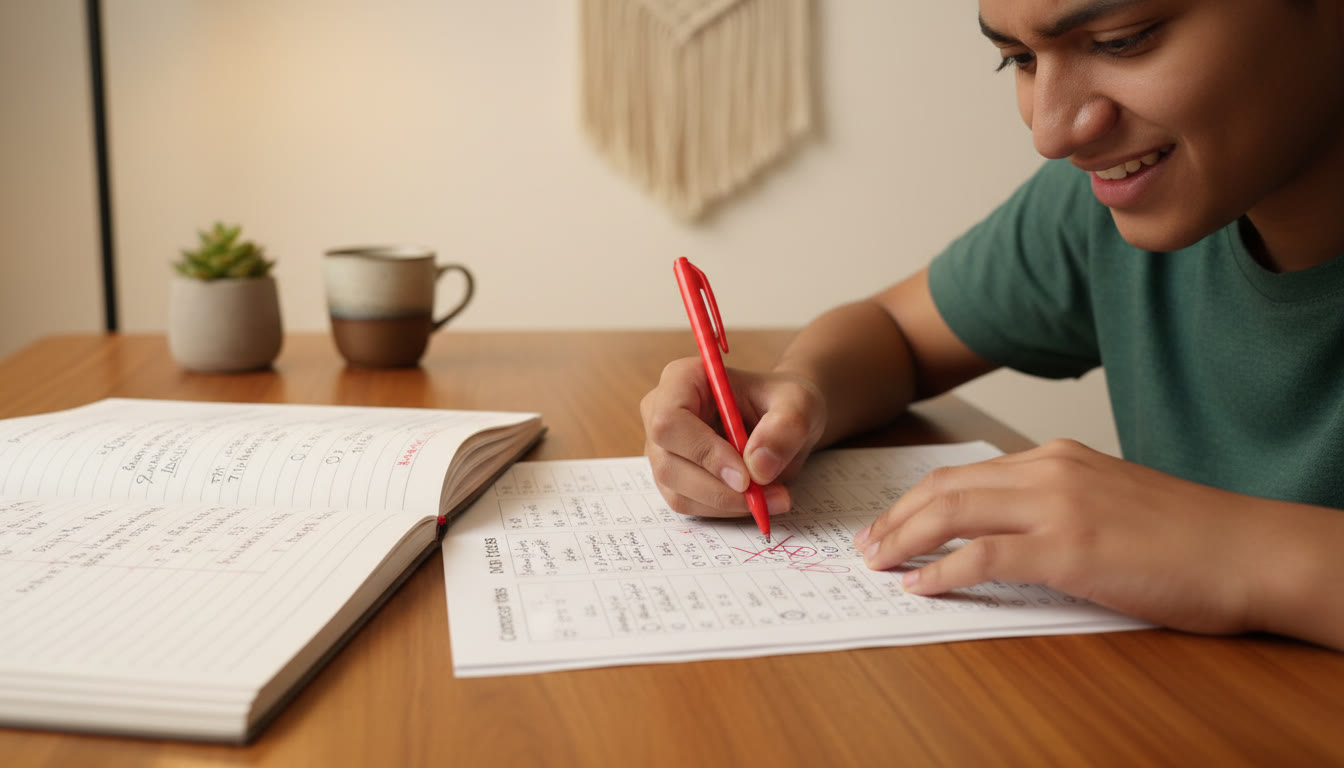
Error Analysis Framework: Turn Mistakes into Gains
Errors are data, not failure. Build a compact routine for every test:
- Catalog each mistake with a one-line cause: conceptual gap, careless, algebraic slip, misread question, or time pressure.
- Assign a corrective action: re-derive the concept, watch a focused explanation, or solve 5 targeted problems.
- Schedule immediate verification: within 48 hours solve a similar problem under timed conditions and get it right without help.
- Track repeated errors. If the same mistake type recurs across multiple mocks, escalate: short tutor session, peer explanation, or a mini-mastery day for that topic.
Tools & Techniques That Actually Help
Lean tools, heavy impact. In the last two months your focus should be on concise notes, a calibrated problem bank, and short formula sheets that you can mentally rehearse. Flashcards for key inorganic facts, one-page derivation sheets for core formulas, and a small set of 30–50 ‘must-do’ problems per subject are more valuable than skimming dozens of textbooks.
If you need targeted help, structured 1-on-1 guidance can be useful. For tailored study plans, individualized practice schedules, and AI-informed tracking that points to precisely which questions to attempt next, consider a personalized tutoring approach. A focused tutoring setup can provide one-on-one instruction, tailored study plans, and AI-driven insights that speed up weak-point resolution — all useful in this final stretch. For students who choose that route, look for a program that emphasizes mock analysis, timed practice, and personalized feedback rather than broad content coverage.
Exam-Day Simulations: OMR/CBT Discipline and Confidence
Practice the small exam-day rituals until they become automatic: exactly how you mark answers, your time checks, how you skip and return to questions, and how you handle a block of tough questions without panicking. If the real format involves OMR-like bubbling, rehearse bubble discipline (no stray marks, dark enough, erase cleanly). If it’s strictly CBT, practice using a timer and the interface where possible.
- Time-slice your three hours ahead of the exam. Decide how long to spend per section, how many passes you’ll do, and when to use marking for review.
- Use elimination techniques to manage negative marking: if you can exclude even one option confidently, the expected value of an educated guess changes.
- Do not expect partial marks unless explicitly allowed in the question type. Treat exact-value and numerical questions as requiring precision.
Common Final-Stage Pitfalls to Avoid
- New book syndrome: don’t chase new resources; deepen with what you already have.
- Mock hoarding: taking mocks without analysis is wasted time.
- Ignoring sleep and nutrition: cognitive performance drops sharply with chronic poor rest.
- Over-sanitizing scores: if you’re plateauing, tweak one variable at a time — change in study method, not everything at once.
Quick 48-Hour and Morning-of Checklist
Keep this as your final checklist. It is short, practical, and strictly about readiness.
- Last 48 hours: light revision only — formulas, one-page notes, and a couple of short timed sets. No new heavy topics.
- Night before: early sleep, lay out necessary documents and allowed items, plan journey and timing.
- Morning of: light breakfast, short warm-up (15–30 minutes) of simple problems, breathe, and arrive early.
- During the test: follow the time-slice plan, manage negative marking with elimination, and flag questions for a calm second pass.
Putting it together: a realistic mini-case
Imagine a student who begins week 1 with clear weakness in calculus and basic mechanics. By doing a full diagnostic mock, they identify two recurring error types: careless sign mistakes and rushed algebra. Weeks 2–4 focus on micro-drills for algebraic accuracy and scaffolded mechanics problems. Weekly full-length mocks are used to track improvement in time per question and to force strategy practice. By week 6 the student reduces careless mistakes by habit (writing intermediate steps in a controlled way) and converts medium-difficulty problems into quick scoring opportunities. The net result is a steady upward trend in mock scores and a calmer test temperament — the kind of progress that moves rank.
Final Notes on Execution
Two months is not a sprint in the usual sense; it’s a disciplined, surgical stretch of focused practice. Use mocks as your compass, fix the highest-return weaknesses first, build routines that preserve energy, and keep a tight error-analysis loop. Personal coaching or one-to-one guidance can accelerate this loop when it targets your specific weak points with tailored practice and quick corrective cycles. A program that offers targeted tutoring, personalized study plans, expert mentors, and AI-driven insights can be especially helpful if you need to compress fixes quickly.
Stay steady: consistent mocks, ruthless analysis, and calm, deliberate practice will carry you through. End each day with a short note of what improved and what you will correct tomorrow; this tiny habit converts chaotic effort into predictable progress.
Academic Conclusion
The last two months are an opportunity to convert preparation into reliable exam performance: simulate the exam precisely, prioritize high-yield repairs, use weekly three-hour full-length mocks for pacing and pressure training, analyze mistakes with a strict corrective loop, and tune your daily routine to favor clarity over volume. With disciplined execution of this plan, measurable rank improvement becomes an outcome of consistent, targeted practice rather than luck.















No Comments
Leave a comment Cancel