
Best Strategy to Crack NEET at Home
Preparing for NEET from home is completely doable — and for many students it becomes the most focused, efficient route. You don’t need fancy classrooms to build discipline; you need a plan that respects how the exam works, honest practice, and a rhythm you can sustain. This guide walks you through a realistic, human-friendly strategy that balances deep learning, targeted practice, and the small daily habits that add up to big performance gains in the current exam cycle.

Understand the game before you play
Know the exam format and rules
NEET is an objective, MCQ-based test covering Physics, Chemistry, and Biology. The exam is a strict timed session, and practicing under full exam conditions (a continuous three-hour simulation) is essential to train speed, stamina, and time allocation. There is negative marking for incorrect answers, and the test requires careful OMR discipline: filling bubbles clearly, marking only your final choice, and avoiding stray marks. Above all, remember that answers are evaluated objectively — there are no partial marks for descriptive or incomplete steps — so accuracy and clear selection are what count on test day.
Set realistic targets
Start by setting two types of targets: outcome-focused (for example, a score range that maps to your goal colleges or rank bracket) and process-focused (hours studied per week, number of mock tests per month). Process goals are especially powerful at home — they keep you accountable without being dependent on immediate results.
Plan first, then study — a weekly blueprint
Design a flexible study skeleton
At home you must be the planner and the executor. Create a weekly skeleton that allocates time to every subject, reserves longer slots for problem solving, and keeps frequent short sessions for memory work like Biology and inorganic Chemistry. Build a ‘core hours’ block — the hours each day that are sacrosanct for focused study — and protect that time from interruptions.
Here is a simple table to guide weekly allocation. Use it as a starting point and scale hours up or down based on your strengths and weaknesses.
| Subject | Weekly Hours (suggested) | Focus Areas | Practice Type |
|---|---|---|---|
| Biology | 12–16 | Core NCERT concepts, diagrams, classifications, physiology | MCQs, quick recall flashcards, diagram practice |
| Chemistry | 10–14 | Physical (numericals), Organic (reactions), Inorganic (facts & mnemonics) | Problem solving, reaction mapping, MCQs |
| Physics | 10–14 | Core derivations, formula application, problem sets | Timed numericals, concept-check MCQs |
| Revision & Tests | 6–10 | Mocks, analysis, weak-topic drills | Full-length mocks, topic tests, error log |
Turn the skeleton into days
A weekday might look like short morning review (active recall of yesterday’s flashcards), a long afternoon block for problem solving, and an evening session for light reading or Biology diagrams. Weekends should include one full-length three-hour mock or a simulated sectional marathon to practice exam rhythm and OMR discipline.
Daily habits that win the race
Bulletproof your daily routine
- Start with a 10–20 minute review of yesterday’s toughest problems — immediate recall cements learning.
- Use focused study blocks (60–90 minutes) with short breaks in between; keep the final hour of the day for low-friction tasks like flashcards or reading diagrams.
- Always end the day by noting down one small, clear goal for tomorrow — it makes starting simpler and reduces friction.
Sample daily rhythm
Mornings: Concept revision or difficult numerical practice when the mind is fresh. Afternoons: Dedicated problem solving and experiments with timed constraints. Evenings: Biology memorization, revision, and light question practice. Adjust to your personal peak times — some students do their best work late at night, others early in the morning.
Subject-by-subject tactics
Biology: Turn facts into stories
Biology rewards consistent, cumulative work. Convert long chapters into little stories, flowcharts, and diagrams. Instead of rote lists, organize facts into cause-effect chains (e.g., physiological pathways), and make one-page summary sheets for every major chapter. Practice objective-style questions often; MCQs on Biology reward pattern recognition and precise recall.
- Make labelled diagrams a habit — draw them, then cover the labels and recall.
- Build a ‘term bank’ for quick review: enzymes, hormones, cycles — words you should be able to recall instantly.
Chemistry: Balance concepts with memory work
Chemistry splits naturally into concept-heavy (Physical), mechanistic (Organic), and factual (Inorganic) parts. For Physical Chemistry, practicing numericals until formula application is second nature is crucial. For Organic, focus on mechanisms, reaction conditions and common variants. For Inorganic, mnemonics and repeated short reviews help solidify facts.
- Make reaction maps for organic chapters — treat them like mini flowcharts.
- Keep a one-page formula sheet for physical chemistry tricks and approximations.
Physics: Build a formula-first toolkit
Physics is problem-solving with conceptual anchors. Learn derivations not to reproduce pages, but to understand when and how to use formulas. Create a ‘formula toolkit’ you can review daily, and practice many short, varied problems to develop pattern recognition. Remember: neat derivations in your notes are study aids — the exam rewards a quick, correct final answer in the MCQ bubble.
- Work on timed problem sets to improve speed and accuracy.
- Group similar problems and practice them back-to-back to see underlying patterns.
Practice smart: mocks, analysis, and error logs
Treat mocks like experiments
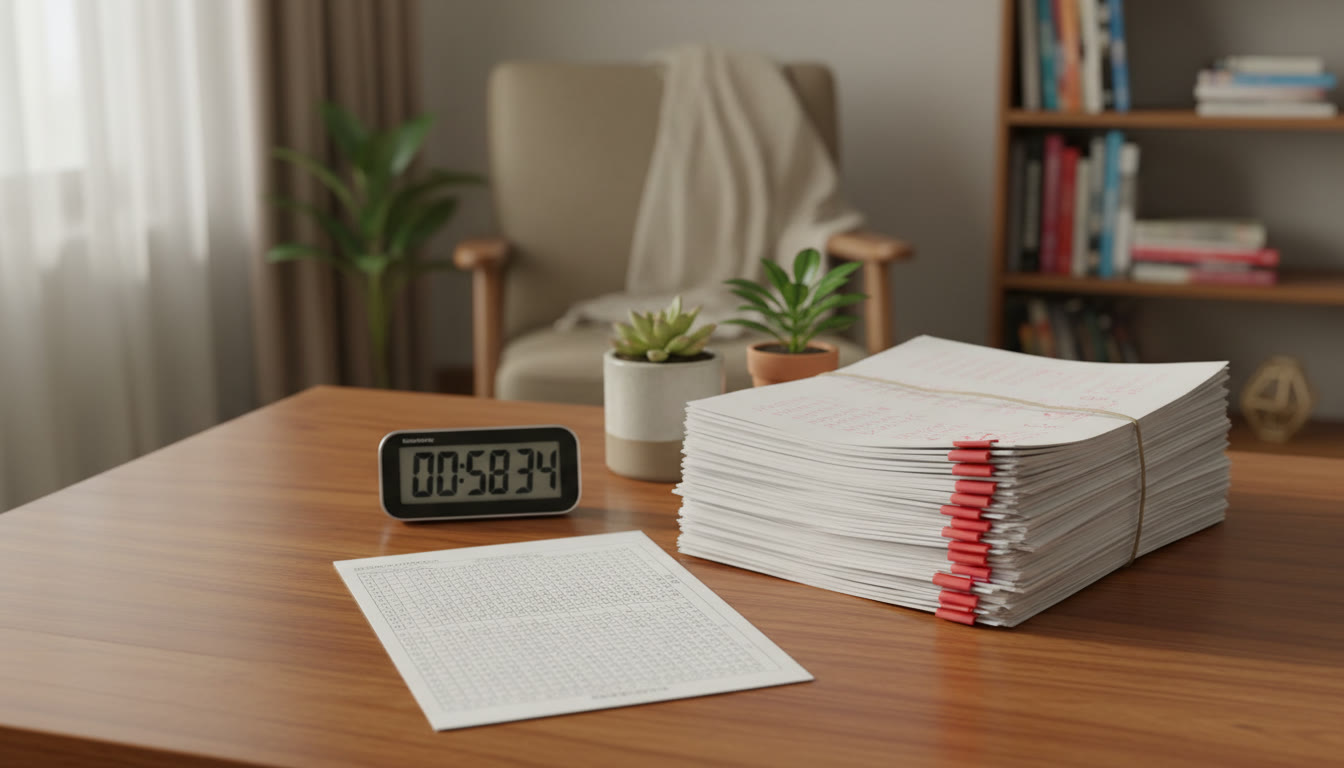
Full-length three-hour mocks are non-negotiable. They teach you endurance, pacing, and OMR discipline. Simulate exam conditions: quiet room, only allowed stationery, and strict timing. After every mock, do a disciplined postmortem — not just a score check, but an analysis of why mistakes happened.
Mock analysis checklist
- Mark each wrong question as: concept gap / careless error / time pressure.
- Create a ‘fix plan’ for the concept gaps: a 2–3 day focused revision to close that gap, then re-test similar questions.
- Track your time spent per section and per question type to identify pacing issues.
Notes, revision techniques, and memory systems
Active recall and spaced repetition
Passive re-reading is a time sink. Instead, convert content into recall prompts: flashcards, one-sentence summaries, and closed-book recitation. Revisit topics in increasing intervals — soon after learning, then after a few days, then a week, and so on. This is how memories move from fragile to durable.
Smart note-taking
Make notes that help you answer MCQs quickly: short definitions, one-line conditions for formula use, exception lists (that tricky exception everyone forgets), and small diagrams. Keep each chapter note to one or two pages if possible — shorter notes force clarity.
Mistakes to avoid and quick fixes
- Don’t ignore weak topics: the more you postpone, the more they compound into confusion.
- Avoid endless question collections without analysis — practicing without correcting mistakes is just repetition of errors.
- Don’t overdo study hours at the cost of sleep: consistent energy beats burst cramming.
Wellness, routine, and mindset
Sleep, nutrition, and small habits
Sleep is the unsung hero of learning. Aim for reliable sleep so your brain consolidates memory. Short physical activity breaks, a balanced diet, and hydration all contribute to sharper focus when you study. Breaks are not wasted time — they recharge concentration.
Dealing with pressure
When pressure rises, simplify: focus on one small, achievable goal for the next 48 hours rather than the whole syllabus. Use quick wins to build positive momentum. Keep an error log and see it as a map of where you are improving, not only as a list of failures.
Tools, technology, and targeted support
Use tech to accelerate, not distract
Leverage digital flashcard apps for spaced repetition, timers for focused study blocks, and online mock test platforms that mimic OMR behaviour. But strictly control distractions — use app blockers during deep study sessions and designate brief catch-up times for messages and social media.
When to reach for personalized help
Home study is powerful, but targeted support can be a force multiplier when: you have persistent conceptual gaps, you can’t convert practice into score, or you need a personalized plan to squeeze extra efficiency from limited hours. In those moments, structured one-on-one guidance can focus your effort where it matters most. For example, many students pair disciplined solo study with focused external support — Sparkl‘s personalized tutoring offers 1-on-1 guidance, tailored study plans, expert tutors, and AI-driven insights to highlight weak spots and track improvement. Later in preparation, a short series of targeted sessions can produce measurable gains when directed at your gap list.
Practical weekly checklist
Every week, tick off these items to keep momentum:
- One full-length three-hour mock under exam conditions.
- Daily review: 30 minutes of active recall for past material.
- Weekly topic test: at least one timed sectional test on your weakest subject.
- Update your error log and set micro-goals to fix the top three recurring mistake types.
Small examples that show the approach
Example: turning a Physics weakness into strength
If kinematics is costing you marks, stop doing random questions. Rebuild: (1) Re-derive key formulae until you understand assumptions; (2) solve 10 carefully chosen problems focusing on each type (uniform acceleration, relative motion, projectile); (3) after two days, retest only those question types to ensure retention. Quality-focused repetition beats volume without structure.
Example: an efficient Chemistry revision cycle
For a tough organic chapter, make a two-page reaction map. Spend one day memorizing mechanisms and conditions using small flashcards; the next day solve 15 related MCQs with a timer; then after three days, re-solve with increased time pressure. This spaced approach cements mechanisms and teaches you to spot trick answer choices.
Final checklist before exam simulation
- Familiarize yourself with OMR filling rules and practice with similar answer sheets.
- Practice at least one full mock under strict three-hour conditions each week in the later stages.
- Keep an exam kit ready (allowed stationery, water, snacks for before/after) and rehearse your travel and logistics for test day.
Closing thought
Home preparation is less about location and more about method. Structure your days, practice under real-exam conditions, analyze every mistake, and keep a steady revision rhythm. Targeted support can accelerate gains when used to address specific gaps; combine that support with disciplined self-study and consistent mock practice to build both accuracy and speed. With a clear plan, honest self-assessment, and steady daily effort, you can convert home hours into exam success.
























No Comments
Leave a comment Cancel