
How Meditation Helps NEET Students: A Practical, Exam-Focused Guide
If you’re deep into the NEET grind — juggling long study days, full-length mock tests, and the constant pressure of negative marking — meditation might sound like one more thing to fit into an already tight schedule. The surprising truth is that a small, consistent meditation practice is not an extra; it’s an efficiency tool. It directly improves the mental skills you need for a high-stakes, MCQ-based exam: attention, memory retrieval, stress regulation, decision-making under time pressure, and exam endurance across a 3-hour window.
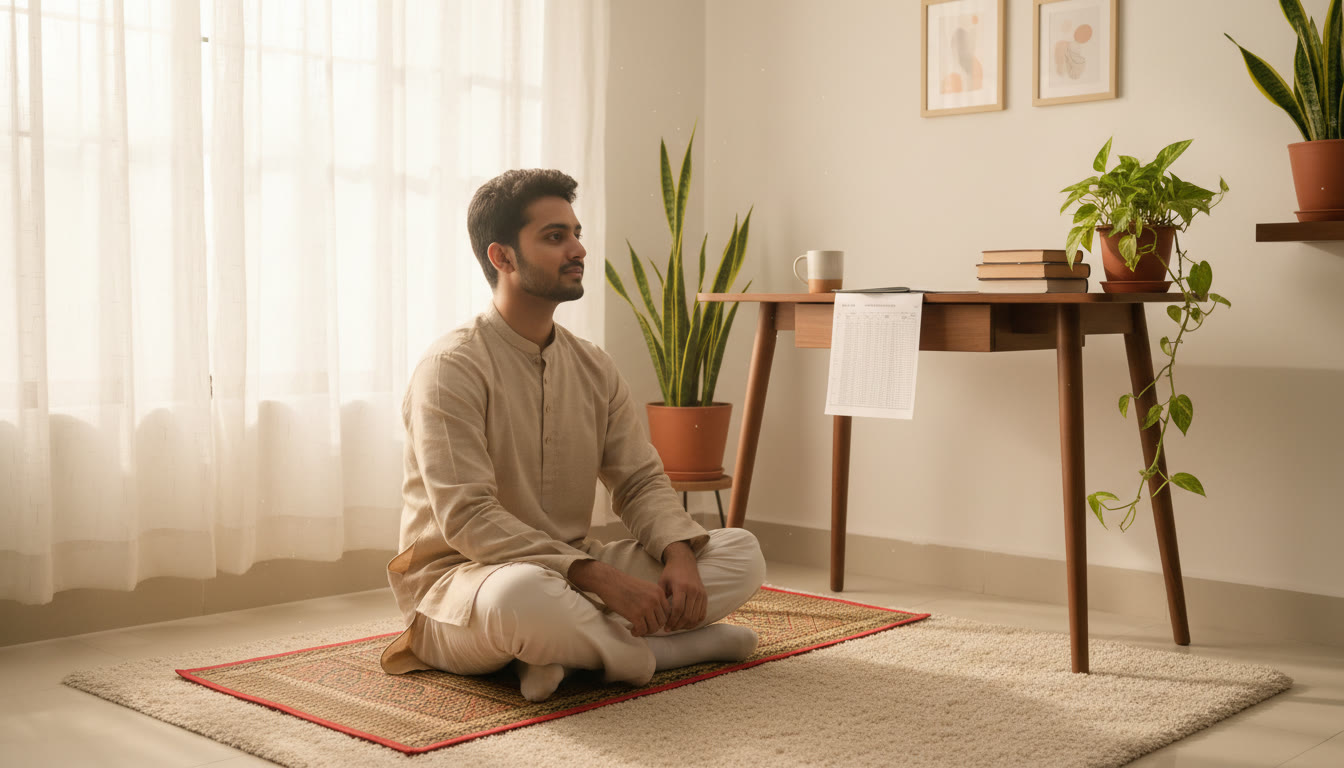
This article gives you exam-relevant, practical ways to use meditation so your study hours become cleaner, your mock-test scores more reliable, and your on-day performance steadier. No fluff, just techniques you can apply between chapters of Physics, Chemistry, and Biology, during the crucial pre-test warm-up, and on recovery days after full-length practice.
Why Mental Fitness Matters for NEET
NEET is an MCQ-based test where precision and timing are everything. You’ll face a three-hour, full-length challenge that rewards both knowledge and exam discipline. Negative marking punishes hasty guesses, and OMR handling demands steady hands and clear concentration. In this context, mental fitness — the ability to stay calm, focused, and mentally agile — becomes as important as factual preparation.
Meditation trains the same cognitive muscles you rely on during a mock test: sustained attention for long reading and problem-solving, working memory for holding formulas or multi-step reasoning, and emotional regulation to prevent anxiety from turning a small mistake into a cascade of errors. Think of meditation like conditioning for your mind: it builds the stamina to remain lucid and calm when your watch says 2 hours into the exam and questions are stacking up.
Core Benefits of Meditation for NEET Students
1. Sharper Attention and Reduced Mind-Wandering
Most MCQs require you to extract the right details from a stem and apply an analytical step or two. Meditation strengthens focused attention, so you read stems more cleanly and miss fewer keywords. Regular short sessions reduce mind-wandering, which directly lowers careless errors.
2. Improved Memory Retrieval and Learning Consolidation
Short meditative breaks after intense study sessions help memory consolidation. That means the formulas, reaction mechanisms, and biological pathways you revise are more likely to stick and be accessible during recall under pressure.
3. Better Emotional Regulation — Less Exam Panic
When negative marking is on the line, anxiety can push you into risky guessing. Meditation teaches physiological and mental tools — breath control, grounding, labeling thoughts — that reduce panic and create the calm needed to make measured choices.
4. Greater Exam Endurance and Stress Resilience
Training attention for 10–20 minutes daily increases your capacity to sustain focus through long mock tests and the three-hour exam itself. You’ll notice less mental fatigue in the later stages, which often separates consistent performers from those whose accuracy drops in the final hour.
5. Smoother OMR Discipline and Fine Motor Control
Simple centering practices before OMR filling calm shaky hands and slow rushed marking. A steady breath and a brief grounding routine minimize stray marks and the small mechanical errors that can cost you points.
Quick, Practical Meditation Exercises for NEET Prep
Below are short, exam-focused routines you can fold into your study day without disrupting momentum. Each exercise is tailored to moments you already have: between chapters, before a mock, during a half-hour break, and right before sitting for an actual attempt.
Micro Reset — 2 Minutes (Between Problems)
- Sit upright for 20–30 seconds. Close your eyes if it feels comfortable.
- Take 3 slow, deep breaths: inhale for 4, hold 1, exhale for 6.
- Scan your forehead and jaw; unclench. Feel the breath come and go.
- Open your eyes and read the next question anew.
Focused-Attention Session — 10 Minutes (Before a Study Block)
- Set a timer for 10 minutes. Sit comfortably with your spine straight.
- Choose breath as your anchor. Notice inhale/exhale sensations at the nostrils or chest.
- When the mind wanders, gently return to the breath; don’t judge the distraction.
- Finish with 2 deep grounding breaths and a short intention: “I will read clearly.”
Pre-Mock Warm-Up — 7–12 Minutes (Before a Full-Length Practice)
- Start with 3 minutes of relaxed breathing to lower heart rate.
- Use 3 rounds of box breathing (inhale 4 — hold 4 — exhale 4 — hold 4).
- Visualize the test room for 2 minutes: you arriving, filling the OMR calmly, reading the first question clearly.
- Finish with a quick body-scan to release tension in shoulders and hands.
How to Fit Meditation into a NEET Study Plan (No Extra Time Lost)
Effective meditation for exam prep is not about long retreats — it’s about tiny, consistent doses that compound. Treat these sessions like warm-ups for a workout: short before study, focused in the middle, restorative after a session. Pairing meditation with active study increases the return on both.
| Technique | Session Length | Frequency | Best Time | Primary Benefit |
|---|---|---|---|---|
| Micro Reset (breath) | 1–2 minutes | Multiple times daily | Between questions, after mistakes | Regains focus quickly |
| Focused Attention | 8–12 minutes | Daily | Before study blocks | Improves concentration span |
| Box Breathing + Visualization | 7–12 minutes | Before mocks/tests | Pre-test warm-up | Calms nerves, primes performance |
| Body-Scan / Sleep Prep | 10–20 minutes | Evening | Before sleep | Improves sleep, consolidates learning |
Sample Weekly Rhythm: Study + Meditation (Adapt to Your Timetable)
The idea is consistency, not rigidity. Here’s one way to structure a week so meditation supports learning without eating into study time.
| Day | Morning | Afternoon | Evening |
|---|---|---|---|
| Monday | 10-min focused attention before study | 2-min micro reset between topics | 10–15 min body-scan before sleep |
| Tuesday | 10-min visualization for mock performance | Short mindful walk after lunch | Flashcard review, 2-min reset |
| Wednesday | 10-min breath work + study block | Full-length mock simulation (warm-up med included) | Recovery: 15 min body awareness |
| Thursday | Focused attention + problem practice | Micro resets during revision | Sleep hygiene routine with meditation |
| Friday | 10-min attention practice | Group doubt session; 3-min centering before | Reflective journaling (2–5 min) + sleep prep |
| Weekend | Longer focused session (15–20 min) | Revision with micro breaks | Restorative meditation and light review |
Practical Exam-Day Routines Built on Meditation
Morning of the Exam
Start with 7–10 minutes of gentle breath work. Avoid cramming. The aim is to arrive with a steady mind. A brief visualization of calm OMR filling, stable hands, and measured reading reduces pre-test jitter.
During the Exam
- Use micro resets: 20–30 seconds of slow breathing after a tricky question or after a set of 10 questions.
- If a mental loop starts — you got a tough physics numerical wrong — label the emotion: “frustration.” Then exhale slowly and move on to the next item. Labeling de-escalates an emotional spiral.
- Remember negative marking: meditative clarity helps you decide when to eliminate options and when a cautious skip is wiser.
After the Exam
Do a brief grounding and allow the nervous energy to dissipate. Avoid immediate replaying of difficult questions; instead, use a 5–10 minute breathing practice to reset before analyzing performance later.

Addressing Common Concerns
“I don’t have time.”
Short practices (1–2 minutes) are highly effective for resetting attention. Building these into natural breaks costs minimal time and yields outsized benefits during long mock tests and real exams.
“Will meditation replace study?”
No — it amplifies study efficiency. Think of meditation as a multiplier: the same hours of revision become cleaner, with fewer careless mistakes and better long-term retention.
“I’m too restless.”
Start with movement-based mindfulness (a short walk, mindful stretching) and shift into stillness gradually. Restlessness often decreases as attention stamina grows.
How Guided Support Can Help (When You Need Structure)
Some students prefer a guided, structured approach so meditation becomes a seamless part of their NEET preparation. If you choose guided help, look for concise, exam-focused programs that pair short meditations with study routines and mock-test preparation. These programs often include one-on-one guidance and tailored plans that align meditation with your study priorities.
For example, using a service that offers Sparkl‘s personalized tutoring can connect meditation practice with tailored study plans: one-on-one guidance, expert tutors who integrate calm-performance routines into mock-test prep, and AI-driven insights that track how your focus and practice habits change across simulated tests. When meditation is paired with targeted feedback, improvement becomes measurable rather than vague.
Practical Tips to Combine Meditation with Subject-Specific Study
- Physics derivations: Do a 5-minute focused session before attempting a multi-step derivation to calm an overactive mind and reduce error-prone leaps.
- Chemistry mechanisms: Use visualization practice to mentally rehearse electron movements or reaction steps before writing them out during revision.
- Biology memorization: A short body-scan before bedtime helps consolidate complex pathways and systems into memory.
- Diagrams and derivations: Treat them as learning tools supported by visualization; don’t assume diagrams will earn partial marks on an MCQ. Practice mentally retrieving key steps, then test retrieval under time pressure.
Simple Metrics to Track Progress
Keep things measurable: note your average focus span (how many minutes before distraction), tally careless errors on mocks before and after adding meditation, and monitor sleep quality. Small, tracked improvements — fewer careless mistakes, steadier mock scores in the final hour, better sleep — indicate that meditation is doing its job.
Final Practice Checklist (Before Any Full-Length Mock or Exam)
- Warm-up: 7–12 minutes of box breathing + visualization.
- Set a calm intention: “My job is clear reading and steady answering.”
- During the test: micro resets every 20–30 minutes or after a challenging question.
- OMR discipline: slow your breath before filling bubbles; steady hands reduce mechanical errors.
- Recovery: 5–10 minutes of mindful breathing after the test before analysis.
Conclusion
Meditation is a practical, evidence-aligned skill that improves attention, memory retrieval, emotional regulation, and exam endurance — all qualities directly relevant to a three-hour, MCQ-based exam with negative marking and strict OMR discipline. When practiced consistently and paired with targeted study, meditation converts stress into steady performance and careless errors into manageable, correct decisions.




















No Comments
Leave a comment Cancel