
Can IGCSE Students Prepare for NEET/JEE? A Practical, Friendly Roadmap
Short answer: yes — absolutely. If you’re doing IGCSE and you dream of cracking NEET or JEE, you have many strengths to build on. At the same time, there are predictable gaps to bridge: exam format, depth of some topics, and test-taking rhythm. This guide walks you through what changes, what helps, and exactly how to plan — in plain language, step by step.

Quick reality check: what the entrance exams demand
Before anything else, understand the playing field. Entrance tests like NEET and JEE are competitive, MCQ-based testing environments that reward speed, accuracy and clear concept-application. Key facts to carry forward when you plan:
- They are MCQ-based tests — answers are selected, not written long-form.
- Practice should include 3-hour full-length mock practice to build stamina and timing.
- Negative marking applies for incorrect answers, so accuracy matters alongside speed.
- OMR discipline is important: neat, careful marking on answer sheets and time spent practicing OMR-type filling is a real advantage.
- NEET emphasizes Biology along with Physics and Chemistry; JEE emphasizes Physics, Chemistry and Mathematics. Syllabus alignment with these subjects is the anchor of your preparation.
- These exams do not give descriptive partial marks on long-answer work in the test room — treat diagrams, derivations and notes as learning tools rather than exam-answer requirements.
Why IGCSE students are well placed — and where they must adapt
IGCSE gives you a really useful base: conceptual clarity, experimental thinking, structured problem-solving and, often, a strong habit of independent study. That’s gold for competitive exams. But the exam-style and certain content emphases can be different.
- Strengths from IGCSE: clear fundamentals in science concepts, practice with application-style questions, and often good written reasoning.
- Common gaps: some advanced maths topics (for JEE) such as the calculus and coordinate-geometry depth expected by JEE; detailed human physiology and some taxonomy depth for NEET; the sheer volume of MCQ practice required; and the psychological rhythm of a three-hour negative-marking test.
- Actionable translation: you don’t have to discard your IGCSE approach — you need to add focused content and test-skill layers on top of it.
First practical steps: what to do in month 1
Begin with a calm mapping exercise. The first thirty days set the direction.
- Map the official exam syllabus (Physics, Chemistry, Biology or Maths) against your IGCSE topics. Create a one-page checklist for each subject: “Covered”, “Partially covered”, “Not covered”.
- Identify high-impact gaps — e.g., calculus, certain inorganic nomenclature, detailed human physiology units — and mark them as priority 1.
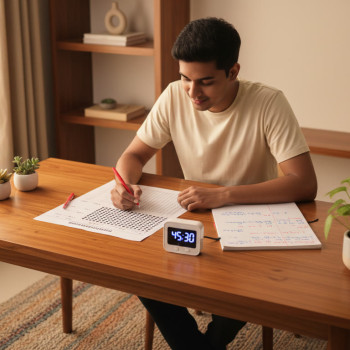
- Start a three-hour clock habit: once a week, sit for a timed session where you study without interruption for three hours to build stamina. This is not a mock yet — just a study-sprint to build endurance.
- Start MCQ drills: 30–50 mixed MCQs daily to attune your thinking to elimination strategies and to negative-marking caution.
Bridgework checklist (concrete items)
- Create a topic-map: list chapters in the entrance syllabus and note exact subtopics you need to learn or revise.
- Pick one reliable reference for each subject and add focused notes to reconcile terminology differences (IGCSE vs entrance exam wording).
- Practice OMR-style answer marking and time yourself on speed + accuracy, not just correctness.
- Record weak topics and revisit them every 7–10 days; use progressive revision combined with MCQ practice.
Sample 12-week roadmap (compact and practical)
Below is a compact roadmap you can adapt to your weekly availability. It balances content, problem practice, revision, and full-length mocks. Treat this as a modular plan: you can scale days or hours up or down depending on school load.
| Week | Main focus | Weekly targets |
|---|---|---|
| 1 | Syllabus mapping + baseline tests | Complete mapping; take subject-wise baseline MCQs; identify top 10 weak topics |
| 2 | Core concept revision: Physics basics | Cover 3–4 core chapters; daily 30 MCQs; two problem sessions |
| 3 | Chemistry foundation | Inorganic basics + reactions; practice balancing and mechanism sketches |
| 4 | Biology foundation (for NEET) | Cell biology, genetics basics, human physiology intro; diagrams for recall |
| 5 | Math reinforcement (for JEE) | Trigonometry, algebra, coordinate geometry basics; problem sets |
| 6 | Weak-topic attack | Intensive daily focus on top 3 weak topics; mini-tests |
| 7 | Full-length mock & analysis | Take a 3-hour full-length mock; spend equal time analyzing errors |
| 8 | Speed and accuracy drills | Timed MCQ packs; OMR simulation; negative-marking strategies |
| 9 | Higher-application topics | Advanced problems in physics/chemistry/math; long problem chains |
| 10 | Revision loop 1 | Cycle through all topics lightly; flashcards and active recall |
| 11 | Mock centre & exam-style simulation | Another full-length mock under strict conditions; time and OMR checks |
| 12 | Final consolidation | Polish weak areas, solidify revision notes, short MCQ sessions each day |
Daily and weekly routine ideas
You don’t need 12 hours a day to make progress — consistency and quality matter. Here are two template routines you can adapt depending on whether you study full-time or alongside school.
- Student with school (2–4 hours/day): 60–90 minutes focused content study, 30–45 minutes MCQ practice, 30 minutes revision/notes, alternate-day problem session (60–90 minutes) on weekends.
- Focused aspirant (6–8 hours/day): Two content blocks (2 hours each), one practice block (1.5–2 hours of mixed MCQs/problems), one revision/notes block (1 hour), 3-hour mock or test-simulation weekly.
Subject-by-subject tactics
Biology (NEET-focused)
Biology is memory-heavy but also rewards structured understanding. For IGCSE students, reinforce human physiology and system-level understanding. Use diagrams to remember processes, but memorize key terms and functions in short, repeatable notes.
- Convert long textbook paragraphs into one-line flashcards — systems, hormones, functions, and key cycles.
- Practice MCQs that force application (e.g., what happens to a physiological parameter if X changes?) rather than rote recall only.
- Use frequent spaced-recall sessions — biology facts stick with repetition.
Chemistry
Chemistry has three useful angles: conceptual understanding, reaction patterns and quick calculations. You’ll want to be fluent at reaction mechanisms in organic chemistry, stoichiometry and periodic trends.
- Make reaction maps (visual chains) to see patterns rather than memorizing isolated reactions.
- Practice numerical problems with a timer — stoichiometry and mole concept speed helps in both NEET and JEE.
- For inorganic parts, build tabular notes for trends, properties and reagents.
Physics
Physics is problem-solving. IGCSE often gives you strong conceptual grounding — now convert that into systematic physics problem routines:
- Master free-body diagrams, energy methods and basic equation derivations as study tools (derivations help you remember when to apply formulas, even though the exam is MCQ).
- Practice multi-step numerical problems under time pressure — speed is acquired by repetition plus careful analysis of common traps.
Mathematics (JEE-focused)
If your IGCSE math did not cover calculus in depth, make it a priority. Key JEE math topics often include calculus (differentiation and integration), limits, complex numbers, vectors, and advanced coordinate geometry. Start from the basics and layer difficulty systematically.
- Begin with conceptual clarity — understand what a derivative represents; then move to techniques and applications.
- Daily problem practice is non-negotiable. Math fluency comes from doing, not just reading.
Practice tests and mock strategy: make the 3-hour mock work for you
Mock tests are where preparation meets reality. Don’t just take tests — analyze them with discipline.
- Schedule at least one 3-hour full-length mock per week as you move deeper into preparation. Simulate exam-day conditions: no phone, exact time-keeping and OMR-style marking practice.
- Post-mock: spend twice the test time analyzing it. Note patterns in mistakes: careless errors, concept gaps, time management failures.
- Design targeted mini-sessions (30–60 minutes) to fix the top three recurring errors you saw in the mock.
Notes, diagrams and derivations: how to use them in an MCQ world
Many students worry that their neat diagrams won’t help in an MCQ exam. They will — but in a different way. Use diagrams and derivations as tools to build deep mental models. When a question appears in the exam, your mental model lets you eliminate wrong options quickly.
- Create a one-page cheat-sheet for each complex topic — use it for revision, not to carry into the exam.
- Use derivations during study to understand where formulas come from; you won’t write them in the test, but they make application faster and less error-prone.

How to analyze errors like a scientist
Tracking mistakes is as important as solving problems. Build a simple error log and categorize each mistake: conceptual, calculation, careless, misread question, or OMR-marking error. Over time, patterns will emerge and tell you where to focus your energy.
- Fix careless errors with micro-habits: underline data, rewrite units, and slow down at the start of each question.
- Fix conceptual errors with short targeted revision sessions and redoing the same style of question until it clicks.
Mindset, balance and energy management
Preparing from IGCSE while managing school life needs a realistic rhythm. Protect sleep, schedule short breaks, and include active recovery. A tired brain makes more careless mistakes — that’s the enemy of negative-marking exams.
- Sleep and consistent rest are performance multipliers; aim for steady sleep patterns rather than all-night cram sessions.
- Build small rewards and micro-goals so study becomes sustainable rather than punitive.
When personalized help makes sense (and how it should fit)
If mapping syllabus gaps and designing targeted practice feels overwhelming, personalized tutoring can speed up progress by giving focused direction. Look for help that offers one-on-one guidance, tailored study plans, expert tutors who diagnose gaps quickly, and tools that track improvement.
For example, Sparkl‘s approach — 1-on-1 guidance, tailored study plans, expert tutors and AI-driven insights — can be very helpful when you need a structured bridge from IGCSE concepts to the competitive-exam mindset. Use such support as a turbocharger, not a crutch: always keep responsibility for daily practice with you.
Common myths and quick debunks
- Myth: “IGCSE students can’t compete with board students.” Debunk: IGCSE gives transferable skills; you only need to fill specific content and exam-skill gaps.
- Myth: “More hours equals better results.” Debunk: Quality and deliberate practice beat raw hours. Focused, analyzed practice is king.
- Myth: “Diagrams don’t help in MCQ tests.” Debunk: They do — as study tools that build the mental shortcuts you need under time pressure.
Final pre-exam checklist
- Have concise revision notes for each topic: one page per major chapter.
- Do at least two full-length 3-hour mocks under strict conditions in the final phase and analyze both deeply.
- Practice OMR discipline and time allocation: mark, review and decide whether to attempt or skip carefully because of negative marking.
- Keep a light revision plan for the last few days: short, high-yield MCQ packs and rest.
Parting academic note
IGCSE students can absolutely prepare for NEET or JEE with a smart, disciplined approach: map the specific syllabus gaps, build MCQ and OMR habits through regular 3-hour full-length mock practice, sharpen accuracy because of negative marking, and use diagrams and derivations as study tools rather than expecting partial marks in the exam. With consistent practice, focused analysis of mistakes, and a study plan that balances depth and exam skills, the bridge from IGCSE to competitive exams is practical and achievable.
















No Comments
Leave a comment Cancel