

Why an Olympiad-to-NEET Foundation Works
If you’ve spent time preparing for Olympiads, you’ve already picked up a set of habits that can be priceless for medical and engineering entrance exams: deep curiosity, pattern-based problem solving, and the confidence to tackle unfamiliar questions. The good news is that Olympiad skills and NEET/JEE preparation are complementary rather than competing. With some thoughtful translation—shifting from ‘proof and depth’ modes to ‘accuracy and speed’ modes—you can convert conceptual advantage into high scores.

This guide walks you through a realistic, human-centered path: how to keep the best parts of Olympiad training (intense conceptual clarity, creative problem solving) while building the exam-ready habits NEET and JEE demand (MCQ strategy, timed full-length practice, strict OMR discipline, and syllabus alignment across Physics, Chemistry, and Biology). Think less ‘reinvent yourself’ and more ‘refine and re-channel’.
Core Principles: Mindset, Focus, and Efficiency
Mindset: Depth plus Practicality
Olympiad learners often prefer rigorous derivations and unusual problems. For NEET/JEE success, keep that thirst for depth—but pair it with practical constraints: time, negative marking, and standardized formats. Adopt a dual mindset:
- Curiosity-first: keep exploring derivations, analogies, and the ‘why’ behind concepts.
- Exam-ready: build the speed, accuracy, and selective practice needed to convert that understanding into marks.
Focus: Syllabus Alignment without Losing Breadth
Map your Olympiad topics onto the NEET/JEE syllabus: many olympiad-strength topics (logical reasoning, multi-step problem solving) boost performance in high-difficulty MCQs. But NEET also requires breadth—especially in biology—so balance depth with systematic coverage.
Efficiency: Work Smarter, Not Just Harder
Use time-blocking, error logs, and targeted revision cycles. When you discover a gap, decide whether it is a conceptual gap (solve with short derivations and concept exercises) or a practice gap (solve focused MCQs under timed conditions).
Designing a Practical Foundation Plan
Principles that guide each week
- Balance: split time among Physics, Chemistry, Biology according to your baseline strengths and syllabus weight.
- Two-speed study: deep-work sessions (concept-building, proofs, derivations) and sprint sessions (MCQ drills, timed sections).
- Active recall and spaced repetition: turn solutions into flash cards, concept maps, or one-page summaries.
- Quality over quantity: choose fewer, high-quality problems instead of many shallow ones.
Daily rhythm—an example you can tweak
- Morning (high-focus): 60–90 minutes of deep concept work (derivations, tricky theory, Olympiad-style problems translated to fundamentals).
- Afternoon (skill-building): 60 minutes of subject-specific MCQs and short problem sets.
- Evening (review and consolidation): 30–45 minutes of flashcards, error-log review, or quick past questions.
Translate Olympiad practice into exam wins
Olympiad problems teach you to notice hidden symmetries and to think across topics. To make that valuable for NEET/JEE:
- Convert a complex Olympiad solution into a 2–3 line ‘exam strategy’—a trick, a heuristic, or a quick derivation you can use under time pressure.
- After solving one deep problem, create 4–6 MCQs inspired by it; this trains transfer skills.
- Practice identifying the ‘minimum necessary step’ in a solution—NEET/JEE rewards concise, accurate reasoning more than long proofs.
Sample Mapping Table: How Olympiad Strengths Help Subject-wise
| Focus Area | Olympiad Strength | NEET/JEE Relevance | Practice Translation |
|---|---|---|---|
| Physics | Modeling, multi-step reasoning | Quick identification of underlying principles in complex MCQs | Reduce derivations to 2–3 key formulas; practice applying them in 10–15 minute sprints |
| Chemistry | Logical pattern recognition (reaction paths, mechanism thinking) | Predicting reaction outcomes and solving organic/physical chemistry MCQs | Summarize mechanisms as a flow-chart and convert into MCQ-style checks |
| Biology | Systematic reasoning, attention to detail | Understanding physiology and genetics problem-solving, data interpretation | Practice interpretation of diagrams and quick reasoning-based MCQs |
Putting Structure Around Preparation: A 4-Week Micro-Plan
Below is a compact micro-plan to build momentum. Repeat and adapt each cycle depending on your weak areas.
| Week | Primary Focus | Daily Target | Outcome |
|---|---|---|---|
| 1 | Concept consolidation (one subject deep) | 3–4 deep sessions + 30 MCQs/day | Solidify theory and note gaps |
| 2 | Application (mixed MCQs, short tests) | 2 timed sprints + 60 MCQs/day | Increase speed and accuracy |
| 3 | Weak-area remediation | Concept repair + targeted practice | Turn weaknesses into reliable scoring zones |
| 4 | Full-length simulation + analysis | One 3-hour full-length + detailed error log | Exam temperament and pacing |
Mock Tests and Exam-Day Discipline
Why full-length, timed practice matters
The exam is an MCQ-based, timed test with negative marking and OMR discipline — practicing the full 3-hour format under realistic conditions is indispensable. Full-length mocks build stamina, sharpen time management, and expose recurring error patterns that short practice cannot.
Smart timing strategy for a 3-hour paper
One reliable approach is to divide the 180 minutes into clear phases (adjust to personal speed):
- First pass (100 minutes): Attempt all high-confidence questions quickly; mark those you are sure about.
- Second pass (60 minutes): Work on medium-difficulty questions with careful calculation; avoid wild guessing.
- Final review (20 minutes): Revisit marked questions, check OMR filling, and correct any stray mistakes.
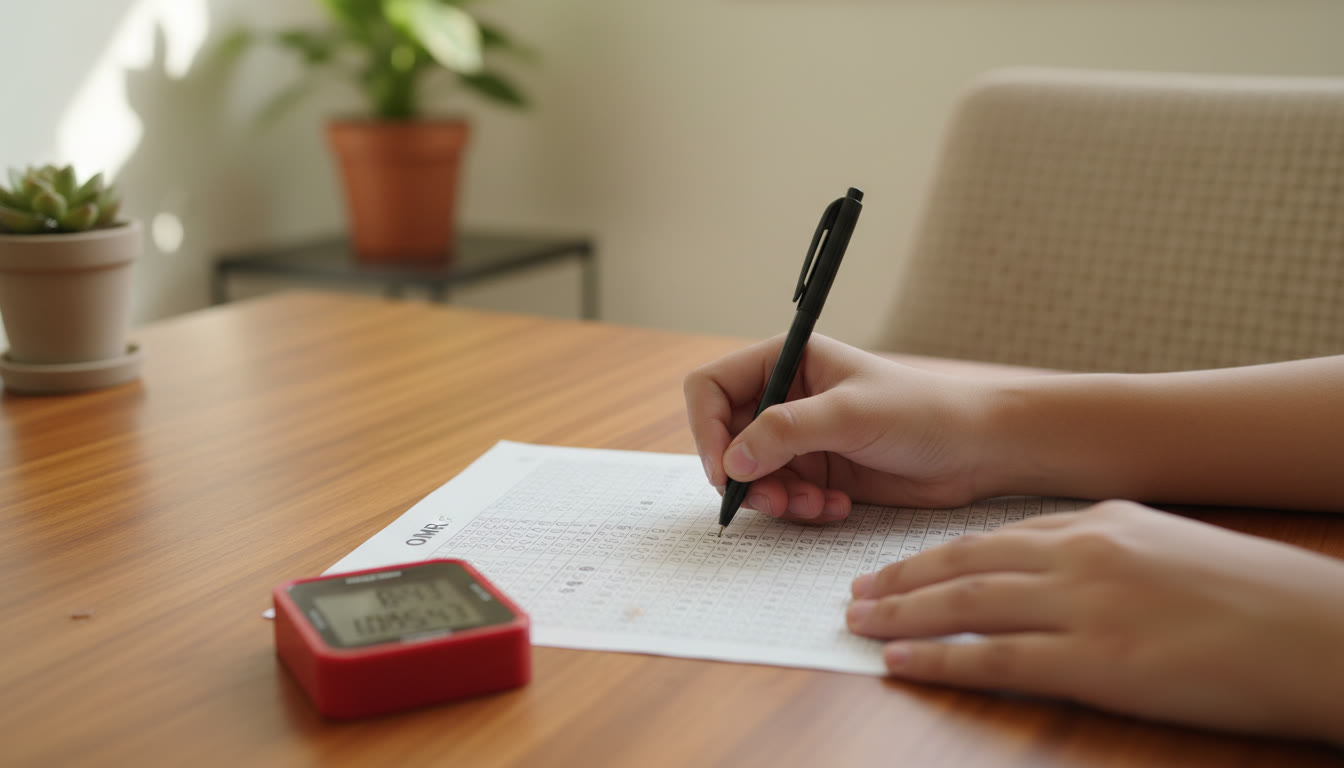
Simulate the OMR filling process during practice—mark answers on an answer sheet, not just on screen or paper. That builds discipline and reduces silly errors.
Negative marking and guessing
Respect negative marking by adopting a risk-managed guessing policy: if you can eliminate one or more options logically, consider an educated guess; otherwise, skip. Use the last review window to toggle answers only when additional reasoning reduces uncertainty.
Subject-Specific Translations: Biology, Physics, Chemistry
Biology—from memory to reasoning
Biology in NEET emphasizes a mix of factual recall and reasoning—diagram interpretation, physiological processes, and data-based questions. Olympiad-style training strengthens analytical reading and data interpretation, which are extremely helpful here. Practical tips:
- Create layered notes: quick-fact flashcards for rote recall and one-page conceptual maps for systems (e.g., endocrine, circulatory).
- Practice diagram-based MCQs—label, predict, and reason, instead of simply memorizing labels.
- Turn long descriptive topics into quick-answer checklists you can scan during the exam.
Physics—turn derivations into exam-ready tools
Olympiad derivations are powerful training. For NEET/JEE, condense those derivations into usable formulas and 10–20-second heuristics. For example, after you derive an expression in a deep session, write a one-line ‘exam summary’ that reminds you of assumptions and common pitfalls.
- Maintain a formula bank with one-line derivation reminders.
- Practice order-of-magnitude checks to weed out calculation errors quickly.
Chemistry—mechanisms and speed
Chemistry requires both conceptual clarity and speed, especially in organic reaction logic and physical chemistry numericals. Translate an Olympiad-style mechanism into a simple flow-chart and memorize key reagent–outcome pairs that often appear in MCQs.
- Use short mechanism cards and practice predicting products in 2–4 steps.
- For physical chemistry, practice approximation techniques that save time without losing accuracy.
Practice Tools: Error Logs, Checklists, and Mini-Projects
The error log
Create an error log that captures the question, why you missed it (conceptual gap, calculation mistake, silly oversight), and a one-line remedy. Review this log weekly. Over time you’ll notice patterns—topics that repeatedly cost marks deserve focused repair.
Checklists and pre-exam rituals
Develop quick checklists for different question types: conceptual, calculation, diagram interpretation, and assertion–reason formats. Before any mock or exam, run a short ritual: quick breathing, glance at key formulas, mental checklist of common traps.
Mini-projects
Turn a weak topic into a mini-project: one week of targeted notes, 50 focused MCQs, and a 30-minute test at week’s end. Mini-projects give you measurable wins and keep momentum high.
Tracking Progress and Using Personalization
Metrics that matter
- Accuracy by topic (not just subject).
- Average time per question type.
- Repeated error count from the error log.
- Coverage percentage of the official syllabus topics.
When to bring in personalized help
Personalized tutoring is most effective when it targets stubborn plateaus: recurring conceptual errors, inefficient problem strategies, or time-management blocks. One-on-one guidance helps convert diagnosis into a tailored plan—shorter, smarter sessions that target the specific levers that will raise your score.
For students wanting a structured bridge between deep conceptual work and exam habits, Sparkl’s personalized tutoring can offer 1-on-1 guidance, tailored study plans, expert tutors, and AI-driven insights that highlight precise gaps. Used selectively, such support accelerates weak-topic repair without replacing the essential self-driven practice.
Common Mistakes to Avoid
- Confusing depth for exam readiness—spending days on a single elegant proof while leaving multiple syllabus topics untouched.
- Ignoring OMR and time management until late in preparation—practicing filling OMR slips from day one prevents last-minute surprises.
- Overguessing on the basis of weak elimination—only guess when you can logically eliminate distractors.
- Neglecting biology breadth in favor of physics/chemistry depth—NEET requires both.
Putting It All Together: A Weekly Example (One Subject Focus)
| Day | Morning | Afternoon | Evening |
|---|---|---|---|
| Monday | Deep concept study (90 min) | MCQ practice (45 min) | Error-log review (30 min) |
| Wednesday | Problem set (derivation + short MCQs) | Timed 30-min quiz | Flashcards |
| Friday | Mixed-topic speed drills | Mini-project work | Summary notes |
| Sunday | Full-length mock (once a week during cycles) | Detailed analysis | Fix one repeated error |
Real-World Context and Examples
Imagine a student who aced an Olympiad problem using an elegant substitution trick. For NEET/JEE, the student reframes that trick: reduce the substitution to a one-line observation and practice applying it to simpler MCQs until it becomes a reflex. Another example: an Olympiad-trained student used to multi-layer reasoning applies that habit to interpret a biology figure quickly, spotting the experimental variable and deducing the outcome—an advantage that shows up in data-interpretation MCQs.
How to Keep Motivation and Avoid Burnout
Long preparation is a marathon. Use these small but effective practices to stay steady:
- Micro-rests: 5–10 minute breaks between sprints keep focus sharp.
- Celebrate small wins: a week of consistent mocks, a corrected weakness, or a solid error-log week.
- Rotate focus: switch subjects or study modes to keep novelty and energy high.
Final Checklist Before an Exam Cycle
- Have a prioritized topic list and a plan for the final 6–8 weeks focused on high-yield topics.
- Practice multiple full-length timed mocks with strict OMR simulations.
- Maintain an error log and ensure core concepts are condensed into one-page summaries for last-minute revision.
- Use targeted one-on-one sessions if certain topics repeatedly cost marks.
Conclusion
Combining Olympiad-honed depth with exam-specific habits creates a powerful foundation for NEET/JEE success. Keep the curiosity that made you an Olympiad-level thinker, but pair it with disciplined, timed practice, careful error analysis, and strategic coverage of the NEET/JEE syllabus across Physics, Chemistry, and Biology. With consistent cycles of deep work and realistic mock exams under OMR-like conditions, the conceptual edge you already have can become reliable, repeatable score gains.



















No Comments
Leave a comment Cancel