

How to Avoid Panic Attacks During NEET
There’s a moment almost every serious aspirant knows: the paper is placed face-down on the desk, you sit down, and suddenly your stomach tightens. That rush—heart racing, thoughts splintering—can feel like it arrived out of nowhere. If that sounds familiar, you’re not broken or alone. Panic is a bodily response designed to protect you, but during a high-stakes, MCQ-based exam like the NEET-style testing environment it’s the last thing you want. This article walks you through calm, research-aligned and practical steps to recognize panic early, handle it in the exam hall, and reduce its chance of happening in the first place.

Know the Exam Context—and Why it Matters for Anxiety
NEET-style exams are MCQ-based, rely on disciplined OMR or standardized response formats, include negative marking for incorrect answers, and demand a sustained three-hour full-length effort in Physics, Chemistry and Biology. That context creates predictable stressors: time pressure, the need to manage guessing strategies under negative marking, and the endurance required for a long, uninterrupted exam. When you align your preparation to those realities—especially through simulated three-hour mock practice with exact exam mechanics—you convert uncertainty into controllable practice. Control reduces anxiety.
Quick note about study tools
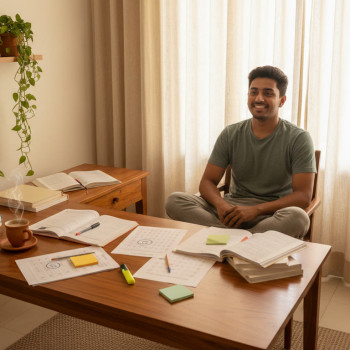
Diagrams, derivations and hand-written notes are powerful learning tools; treat them as ways to build quick recall, not as something you have to recreate on the paper during the exam. Remember: the test rewards the right option for MCQs, not long written explanations.
Understand Panic: Signals and Triggers
What a panic attack can feel like
- Sudden racing heart, shortness of breath, dizziness or trembling.
- A sense of detachment, tunnel vision, racing “catastrophic” thoughts (e.g., “I’ll fail everything”).
- Inability to focus on the question in front of you, or compulsive checking of the watch and OMR sheet.
Those symptoms are intense, but often short-lived if you use immediate grounding tools and a simple recovery plan.
Common NEET-specific triggers
- Time pressure on a long exam and the need to distribute attention across three subjects.
- Fear of negative marking and the “what if I guessed wrong” spiral.
- Earlier poor mock performance or last-minute cramming that undermines confidence.
- OMR confusion—worrying about bubbles, filling mistakes, or running out of time to transfer answers accurately.
Immediate Actions: The First 0–10 Minutes When Panic Hits
When panic arrives, slow and simple works better than big decisions. The goal in the first few minutes is to reduce physiological arousal so that your thinking clears and you can return to the paper.
Five-step emergency routine
- Stop the runaway loop: Put your pencil down for a second. Pausing doesn’t cost points, panicked mistakes do.
- Box breathing: Inhale 4 seconds — hold 4 — exhale 4 — hold 4. Repeat 3–6 times. The rhythm calms heart rate and attention.
- Ground with senses (5-4-3-2-1): Name 5 things you see, 4 you can touch, 3 you hear, 2 you smell (or remember), 1 you can taste (or recall). This pulls attention back to the present.
- Short cognitive anchor: Quietly say one sentence to yourself like “Breathe. Read. Answer.” Keep it factual and action-oriented.
- Return with a micro-goal: Don’t attempt to finish a whole section—aim to solve the very next question you can complete in under 2 minutes to rebuild momentum.
How to handle panic if it happens during a three-hour mock or the real exam
If this happens during a mock, stop the clock for a full recovery and resume when calm—one purpose of mocks is to practice recovery. In an exam, use the permitted time and environment: a short pause, breathing, ground, then pick a low-risk question (one you’re confident about) to reinstate decision-making. If you need to mark and move on, follow your practice habit: answer what you know, mark uncertain items for review, and manage guessing with your negative-marking strategy.
Prevention: Habits That Reduce Panic Risk
Daily anchors that build resilience
- Consistent sleep: Aim for regular sleep-wake times and wind down 60–90 minutes before bed. Cognitive performance and emotion regulation depend on sleep.
- Movement and breath: 20–40 minutes of exercise most days—brisk walk, yoga, or light cardio—reduces baseline anxiety.
- Small wins each study day: Break the syllabus into focused, bite-sized targets. Every few days, check off a concept you’ve mastered; the sense of progress neutralizes catastrophic thinking.
- Micro-meditations: Two five-minute breathing or mindfulness sessions daily train attention to return when your mind wanders during an exam.
Study habits that prevent panic on test day
Align practice with how the exam is actually assessed: MCQ format, negative marking, OMR discipline, and three-hour stamina. That means regular full-length practice under exact exam conditions, including timed sections and an OMR-style answer sheet. Build a habit of reviewing wrong answers analytically (not emotionally): log the mistake, find the root cause—concept gap, careless reading, or time pressure—and fix that specific weakness.
Mock Tests and Simulation: Confidence Built in Repetition
There’s no substitute for realistic simulation. Weekly or twice-weekly full-length practice turns the unfamiliar into familiar. Use a mock to rehearse both cognitive skills and the small rituals that keep you calm—what to eat before the test, when to take a bathroom break, how to move between sections, and how to fill OMR answers with steady focus.
| Simulation Item | Why it Matters | How to Practice |
|---|---|---|
| 3-hour full-length run | Builds endurance and concentration | Do at least 6–10 mocks under timed conditions before the current cycle exam window. |
| OMR-style response practice | Reduces filler mistakes and confusion | Use a separate sheet for answers and practice transferring; time the transfer step. |
| Negative-marking strategy | Teaches safe guessing and time allocation | Practice decision rules: when to attempt, when to mark for review, when to skip. |
Exam Hall Moves: Practical Habits That Save You in the Moment
Before the question paper is opened
- Take three deep, measured breaths when the exam begins. Read instructions first—OMR rules, permitted materials, and any special instructions.
- Check your writing tools and OMR bubble alignment—this simple ritual prevents later panic about avoidable mistakes.
How to proceed with the paper
- Do a quick scan of the entire paper (or section) to allocate time. Mark easy questions first—rapid early wins lower anxiety.
- Use time blocks: e.g., attempt Biology in X minutes, Chemistry in Y minutes, Physics in Z minutes (practice these blocks in mocks).
- If a question triggers panic, close the book for a breath or two, use your 5-step emergency routine, then return to a simpler question.
- Follow disciplined OMR filling: after every 10–15 answers, pause 10–20 seconds to verify your answer-to-bubble mapping. That small investment prevents catastrophe later.
Longer-Term Cognitive and Behavioral Strategies
Basic cognitive reframing
Swap “I must ace every question” for “I will do my best on each question and use strategy where needed.” Practicing short, factual self-statements limits catastrophic thinking. A small thought record helps: identify an anxious thought, write down the factual evidence for and against it, then choose a balanced response.
Exposure and graded practice
Gradual exposure trains your nervous system. Start with 20-minute timed quizzes, then 60-minute sectional runs, and finally three-hour full mocks. Each progressively longer session weakens the panic association so the long exam feels familiar, not frightening.
Therapies and professional models
Techniques from cognitive-behavioral models—thought challenging, behavioral experiments, and structured breathing—are practical and learnable. If you combine these with consistent exam-simulation practice, you often achieve measurable reductions in panic frequency and intensity.
When Academic Support Helps (and Where to Look)
Sometimes panic is tightly connected to academic uncertainty—uncertain strategy for negative marking, lack of a tailored study plan, or inconsistent feedback on mocks. Academic coaching that gives 1-on-1 guidance, tailored study plans, expert tutors, and data-driven insights can cut the academic anxiety that fuels panic. For example, if you want personalized routine-building and clearer mock analysis, Sparkl‘s tutoring and AI-driven insights can help shape focused practice without overwhelming you. Remember, academic support complements mental health care; for persistent panic disorder or panic that impairs daily function, seek a mental health professional.
Red Flags: When to See a Mental Health Professional
- Panic that happens outside exam situations or that becomes more frequent despite practice.
- Severe sleep disruption, appetite changes, or avoidance of study because of fear.
- Substance use to blunt anxiety or thoughts of self-harm.
In those cases, a trained professional—counsellor, psychologist or psychiatrist—can offer targeted therapy or medication when appropriate. Academic coaching and therapy can work in parallel: one addresses exam mechanics and study structure, the other addresses the underlying anxiety response.

Five-minute Toolbox: Quick Actions That Work Under Pressure
| When | Action | Effect |
|---|---|---|
| Heart racing during a question | 4-4-4 box breaths × 4 | Slows heart rate, brightens focus |
| Mind spiralling to worst-case | 5-4-3-2-1 grounding | Returns attention to present task |
| Blank mind after a difficult section | Pick an easy question and solve in under 2 minutes | Restores momentum and confidence |
Sample 7-Day Micro-Plan to Build Exam Calm (A Practical Template)
Use this template in any phase of preparation; adjust intensity based on where you are in the cycle.
| Day | Focus | Practice |
|---|---|---|
| Day 1 | Sleep & Routine | Set sleep schedule; 20-minute light exercise; 20-min concept revision |
| Day 2 | Short timed practice | 40-min mixed MCQs; 10-min box breathing practice |
| Day 3 | Exposure step up | One 90-min sectional mock; review mistakes |
| Day 4 | Recovery and reflection | Light study; journaling about anxious thoughts (5–10 minutes) |
| Day 5 | Full-length simulation | 3-hour timed mock with OMR-style practice; post-mock 30-min calm-down |
| Day 6 | Skill sharpening | Target weak topics; guided problem-solving with a tutor or peer |
| Day 7 | Consolidation | Active recall session and light breathing routine |
Common Myths and Clear Facts
- Myth: Panic means you aren’t cut out for the exam. Fact: Panic is a teachable response; many high-performers manage it with practice.
- Myth: You must answer every question to pass. Fact: Smart strategy beats random attempts—use your negative-marking plan and time management.
- Myth: Resting is wasted study time. Fact: Rest and recovery improve consolidation and reduce panic risk.
Putting It Together: A Calm-First Strategy
Start with simulation: make three-hour, MCQ-style practice non-negotiable. Pair that with short daily mental-health anchors (sleep, breath, movement). Build a predictable OMR habit and a simple negative-marking decision rule. Learn one emergency routine for the first 10 minutes of panic and rehearse it until it becomes natural. Use analytic mock-review to fix the specific causes of past panic—one mistake at a time. If you need tailored academic structure to make this plan practical, Sparkl offers one-on-one guidance, tailored study plans, expert tutors and AI-driven insights to turn general advice into a day-by-day routine.
Conclusion
Reducing panic during the NEET-style exam is about practice, predictable rituals, and small, repeatable habits: simulate the exam until the environment feels familiar; use short breathing and grounding tools to interrupt panic when it appears; and fix the root causes revealed by focused mock review. Over time, these steps rewire the automatic response from freeze or panic to clear, calm decision-making—so you can apply knowledge with steadier hands and clearer judgement.


























No Comments
Leave a comment Cancel