
How to Crack NEET in Your First Attempt: A Proven, Step-by-Step Strategy
If you’re aiming to clear NEET in your very first attempt, first—breathe. The goal is ambitious but entirely achievable with a plan that balances clarity of concepts, relentless practice, and exam-smart habits. This guide lays out a human, no-nonsense road map: what to focus on, how to practice, how to manage time and stress, and how to make small daily choices that add up to big results. It keeps the current NEET-style context in mind — MCQ-based testing, strict OMR discipline, negative marking, and the value of doing 3-hour full-length mock practice under exam conditions. Diagrams, derivations, and neat notes are your learning tools — remember that the exam rewards correct, quick answers, not partial descriptions.

1. Start With the Right Mindset: Plan, Don’t Panic
Clearing NEET in one go is less about genius and more about design. Top performers often follow the same principles: a realistic plan, disciplined execution, regular feedback, and steady physical and mental care. Replace “I must know everything” with “I will prioritize what matters, practice smartly, and fix weak spots quickly.” That mindset shift will save time and keep motivation steady through long study blocks.
2. Understand the Exam Blueprint — Be Exam-Smart
Before you start cramming chapters, get comfortable with how the exam tests knowledge. NEET-style testing focuses on multiple-choice questions across Physics, Chemistry, and Biology. Important practice realities to accept:
- Questions are objective (MCQs) and require both accuracy and speed.
- Negative marking penalizes random guessing; eliminate wrong options first.
- Strict OMR discipline: practice filling bubbles cleanly and within time limits so you don’t lose avoidable marks.
- Full-length, timed mocks—three-hour simulations—are essential to mimic test pressure and pacing.
Keep your preparation aligned with the official syllabus for the current cycle and treat diagrams and derivations as tools to strengthen conceptual recall — they help you solve MCQs, but they won’t earn partial credit in an MCQ exam.
3. Build a Realistic Roadmap: Daily Consistency Beats Last-Minute Overdrive
A plan without follow-through is just wishful thinking. Build a weekly and monthly roadmap that balances learning new concepts, revision, and active practice.
Here’s a practical sample weekly template you can tailor to your routine. It balances concept study, problem practice, and mock/test time.
| Day | Morning (Deep Focus) | Afternoon (Practice) | Evening (Revision/Light Practice) |
|---|---|---|---|
| Monday | Physics: Core concepts + worked examples | Physics MCQs (timed sets) | Short Biology revision notes |
| Tuesday | Chemistry: Theory + reaction mechanisms | Chemistry numericals & MCQs | Organic reactions summary (flashcards) |
| Wednesday | Biology: Concept chains (physiology/genetics) | Biology MCQs (practice test) | Sketch/diagram practice |
| Thursday | Mixed concept revision (weak areas) | Past-paper-style questions | Light reading + formula revision |
| Friday | Timed full-length sectional test | Detailed analysis of mistakes | Short break + conceptual flash review |
| Saturday | Full-length mock (3-hour simulation) | Mock analysis & doubt clearing | Planning for next week |
| Sunday | Restory: Light revision, weak topic recap | One-hour mixed MCQ practice | Rest & family time |
4. Subject-Wise Strategy: What to Do for Physics, Chemistry and Biology
Treat each subject with a slightly different method — the same approach doesn’t fit all.
Physics — Build Problem-Solving Muscle
Physics rewards understanding of fundamental laws and consistent practice. Steps to follow:
- Start with clear concept maps: mechanics, electricity, optics and modern physics — understand when and why a formula applies.
- Solve representative problems: derive formulas yourself occasionally to internalize assumptions; derive once for learning, then practice direct problem patterns for speed.
- Practice numerical accuracy: get comfortable with unit handling and approximation — small mistakes add up under time pressure.
- Make a short formula sheet for each chapter and keep it handy for quick weekly revision.
Chemistry — Balance Theory with Reactions and Numericals
Chemistry splits into physical numericals, organic mechanisms, and inorganic facts. Strategy:
- For physical chemistry, practice numerical problems until the approach becomes second nature.
- For organic chemistry, focus on recognizing reaction patterns and mechanism logic rather than memorizing pages of reactions.
- For inorganic topics, use smart notes and frequent quick revisions — retention comes from regular recall, not re-reading.
Biology — Read Smart, Recall Faster
Biology is large but predictable. You win by building reliable recall techniques:
- Use concept chains for physiology and genetics; link cause and effect rather than rote points.
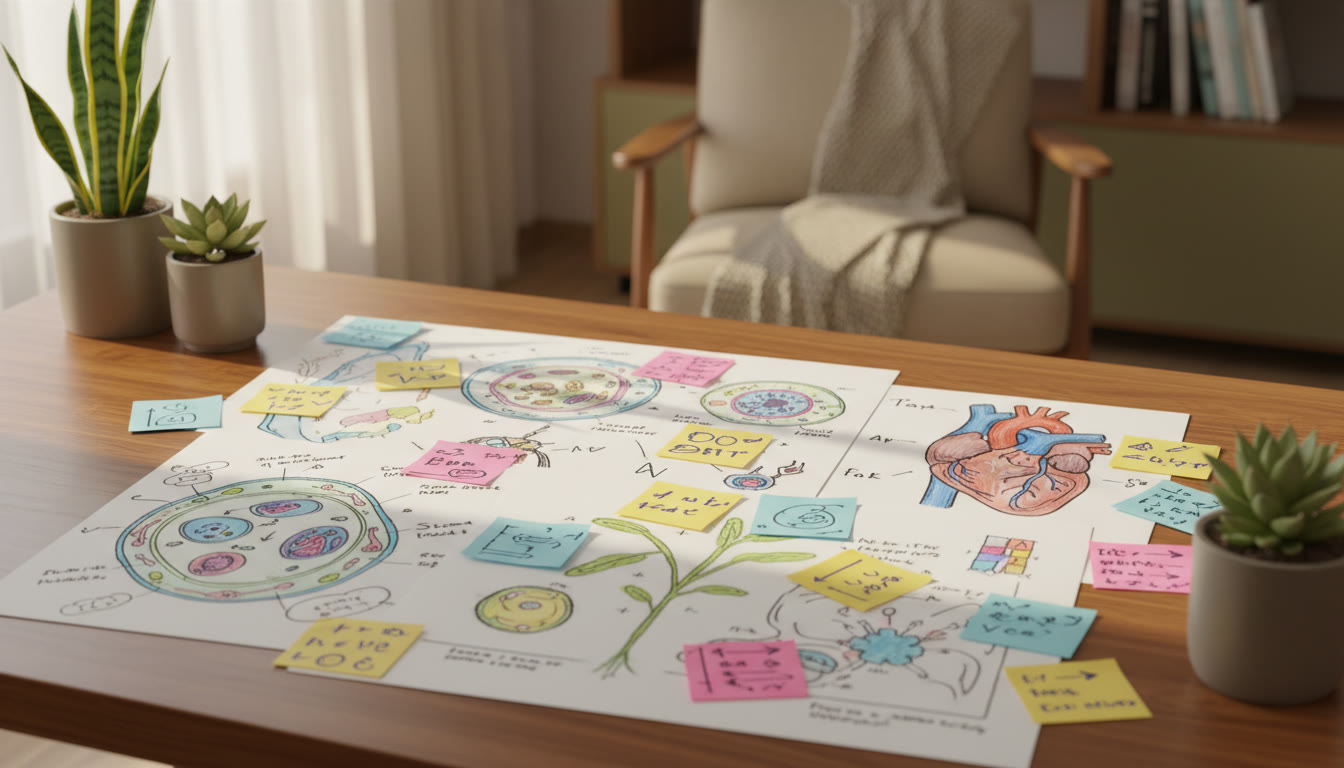
- Create labeled diagrams and practice sketching them — diagrams help anchor complex processes in your memory.
- Convert long passages into micro-flashcards or quick Q&A; frequent short revisions beat one long reread.
5. Active Practice: MCQs, Mock Tests and OMR Discipline
Active practice is the backbone of MCQ exams. Reading theory must quickly be followed by solving questions:
- Sectional practice: after finishing a topic, attempt 30–50 targeted MCQs to test application of concepts.
- Full-length mocks: simulate three-hour test conditions frequently so your stamina and pacing are contest-ready. Treat the mock’s timing and environment as sacred practice — sit uninterrupted, replicate OMR behavior, and practice marking questions for review.
- OMR discipline: practice filling bubbles carefully. Time lost due to smudged bubbles or wrong alignment is preventable; make clean marks and use the practice to build that habit.
- Negative marking tactics: only attempt an answer if you can logically eliminate at least one option or have reasonable confidence. Blind guessing is risky when penalties apply.
After each mock, spend at least as much time analyzing mistakes as you spent taking the test. Identify recurring weak topics and convert weakness into micro-goals for the next week.
6. Smart Revision: Spaced Repetition and Active Recall
Revision isn’t re-reading — it’s retrieval. These are the few techniques that actually change memory:
- Spaced repetition: time your revisits to a topic at increasing intervals so you move knowledge from short-term to long-term memory.
- Active recall: close the book and write what you remember — test yourself and immediately correct gaps.
- Micro-notes and one-page summaries: condense chapters into 1–2 pages of essentials you can revise quickly before sleep or on travel.
- Group similar concepts to reduce confusion: e.g., list differences and similarities together rather than scattered notes.
7. Common Pitfalls, and How to Avoid Them
- Overdoing new content in the last month: prioritize revision and mock analysis instead.
- Neglecting weak topics: small, daily micro-sessions on weak areas beat occasional marathon sessions.
- Ignoring exam strategy: accuracy with pacing and proper OMR practice beats faster but careless attempts.
- Burnout cycles: consistent rest and short breaks are performance multipliers — not luxuries.
8. How Personalized Tutoring Can Accelerate Progress
One-on-one guidance can shorten the path from confusion to clarity. For many students, tailored support helps in three concrete ways:
- Targeted gap analysis — focused sessions on exactly what you need to fix, rather than generic coverage.
- Customized study plans that fit your pace, strengths and weak spots — the plan adapts, not the student.
- Regular accountability and feedback loops to keep you on track and correct mistakes early.
If you look for structured personalized help, Sparkl‘s approach combines 1-on-1 guidance, tailored study plans, expert tutors, and AI-driven insights to identify weak spots and suggest focused practice. A targeted tutor can help translate mock-test analytics into precise action steps, so every hour you spend yields better returns.
9. Tools and Techniques: Make Practice Work Harder
Small technique improvements often yield big score jumps:
- Timed problem blocks: do 20–30 minutes of uninterrupted MCQs and then analyze mistakes for 20 minutes.
- Error logs: maintain a running list of mistakes (concept, careless, calculation) and revisit them weekly until they stop recurring.
- Mini-teach: explain a concept aloud to an imaginary student; if you can teach it, you have command over it.
- Use a mix of sectional tests and full-length mocks — both have distinct training value.
10. Final 30-Day Plan: Focused Revision and Confidence Building
The last 30 days are not for learning new vast topics; they are for consolidation, targeted practice, and stress management. Here’s a compact, practical focus map.
| Phase | Focus | Daily Routine |
|---|---|---|
| Days 30–21 | Full syllabus quick revision + sectional tests | 2–3 hours of revision + 1 sectional mock + error analysis |
| Days 20–11 | Topic polishing + timed full-length mocks | 1 full mock (3-hour) every 3–4 days + focused correction sessions |
| Days 10–4 | Light revision of micro-notes and weak facts | Short revision sessions, minimal new study, sleep priority |
| Last 72 hours | Rest, confidence-building, logistics check | Short light reviews only, avoid cramming, plan travel and OMR practice |
11. Health, Sleep and Exam-Day Logistics
Academic preparation matters most, but on the final day small avoidable mistakes can cost marks. A few non-negotiables:
- Sleep: aim for consistent, restful sleep during the final month. Cognitive sharpness declines rapidly when you burn out.
- Food and hydration: light, familiar meals on exam day — no experiments with heavy or spicy foods.
- Exam kit: practice with the same pen/pencil and rough sheet style you will use; on test day, arrive early with required ID and stationery and follow OMR instructions strictly.
- Mental rehearsal: spend a few minutes before the test centering your breath and anchoring attention — simple breathing resets are powerful.
12. A Realistic Example: Turning One Weak Topic Around in Two Weeks
Imagine you struggle with a chunk of Physics — say a set of mechanics problems. A focused two-week plan might look like this:
- Day 1–3: Rebuild core concepts and re-derive one or two central formulas to understand assumptions.
- Day 4–9: Do 30–40 targeted MCQs and worked problems; keep an error log for each mistake.
- Day 10–12: Take timed mixed-question sets where mechanics appears alongside other topics to practice retrieval under pressure.
- Day 13–14: Quick revision of error log, one full mock, and consolidation of the top 5 trickiest question types.
This concentrated loop (learn → practice → analyze → revise) is the same pattern you can apply to any weak topic.
Conclusion
Cracking NEET in a single attempt is a structured, disciplined process that combines concept clarity, regular targeted practice, full-length mock discipline, strategic revision, and steady self-care. Focus on small, measurable improvements — a tighter error log, a faster OMR routine, a clearer concept map — and turn each mock test into a diagnostic tool rather than a verdict. With a consistent plan, smart practice, and focused correction, you can steadily convert weaknesses into strengths and walk into the exam room calm, prepared, and ready to perform.

















No Comments
Leave a comment Cancel