
NEET Mistakes in Long-Term Planning — Why this matters more than you’ll admit
Long-term planning for NEET often sounds like a spreadsheet, a timeline, or a solemn promise you make to yourself on a study table at midnight. But plans are fragile: they break when a mock goes badly, when a topic refuses to click, or when life interrupts. The deeper issue isn’t the slip itself — it’s how you interpret and respond to it. Mistake analysis is the bridge between a one-off failure and consistent improvement. When done well, it turns each wrong answer into a targeted step forward; when done poorly, it becomes a ledger of anxiety.

This guide walks you through the most common long-term planning mistakes NEET students make, shows how to perform meaningful mistake analysis, and gives practical templates and schedules you can adapt. It keeps exam realities front and center: MCQ-style assessment, strict OMR discipline, a full-length timed mock practice of three hours, negative marking for incorrect answers, and a syllabus split across Physics, Chemistry, and Biology. Treat diagrams, derivations, and notes as study tools — not as exam-answer crutches.
How a “small” planning error becomes a giant obstacle
Students often assume errors are isolated: a slipped question here, a bad day there. But repeated small errors compound. A single skipped revision session reduces retention; a small conceptual gap in optics reappears as a pattern of mistakes during mocks; a habit of guessing without disciplined negative-marker strategy costs raw score steadily. The key is to stop treating mistakes like transactions and start treating them like data: diagnose, categorize, and build corrective loops into your long-term plan.
What good mistake analysis looks like
- Specific: each error is logged by topic, question-type, and reason (careless/knowledge gap/time pressure/misread).
- Actionable: every logged mistake has a one-week and one-month corrective action.
- Quantified: track frequency, not just severity — frequency reveals weak habits.
- Integrated: your study calendar reflects lessons from the analysis (revision slots, targeted practice, concept re-teaching).
Common long-term planning mistakes and how to fix them
Mistake 1 — Treating the plan as a contract, not a living document
Why it happens: Students set an ambitious plan and feel guilty when real life interferes. The consequence is inertia: no updates, no re-prioritization.
Fix: Create weekly checkpoints. At each checkpoint, ask: what worked, what didn’t, and what changes are evidence-based? Small, frequent adjustments beat giant, rare overhauls.
Mistake 2 — Not documenting mistakes systematically
Why it happens: You solve a question, get it wrong, and move on. Sound familiar? Ignored errors repeat.
Fix: Use an error log with three columns: ‘Question/Topic’, ‘Root Cause’ (conceptual / careless / time), and ‘Correction Action’ (re-derive, flashcard, timed practice). Review this log during every weekly checkpoint.
Mistake 3 — Doing mocks without purpose
Why it happens: Mocks become endurance tests without post-test reflection. Students often treat score alone as the verdict rather than the starting point for targeted improvement.
Fix: Always run a three-hour mock under exam-like OMR discipline. After the mock, perform a two-phase review: immediate (same day) — mark careless errors and time-management failures; deep (within 48–72 hours) — rebuild solutions, re-study topics, and add targeted questions to the next week’s plan.
Mistake 4 — Overemphasizing speed early on
Why it happens: Speed feels like mastery. But speed without accuracy is a fragile victory in a negative-marking exam.
Fix: Prioritize conceptual clarity in early cycles, then add timed practice. During mocks, practice strategic skipping and disciplined marking for review — this preserves score while developing speed.
Mistake 5 — Narrow “high-yield only” focus
Why it happens: It’s tempting to chase short lists of topics. The risk is uneven preparedness — surprising questions in less-visited topics cause panic.
Fix: Build a balanced syllabus grid: core topics get regular cycles; low-frequency topics get periodic refreshers so they never become blind spots.
Mistake 6 — Ignoring exam mechanics (OMR, negative marking, reading time)
Why it happens: Students obsess over content and neglect the test as a system. Mistakes like marking the wrong OMR bubble or losing track of negative-marking impact are solvable but costly.
Fix: Simulate full exam conditions monthly. Practice marking OMR sheets, tracking time, and applying a negative-marking decision rule: answer only when confidence exceeds a personal threshold or the question can be eliminated sufficiently.
Mistake 7 — Treating derivations and diagrams as optional
Why it happens: Some think diagrams or derivations are purely academic. In reality, many biology diagrams and physics derivations are anchors for deeper understanding and appear in tricky MCQs.
Fix: Convert key diagrams and derivations into mini-questions: label parts, explain each step in one sentence, and make a 2-minute revision card for quick recall.
A simple table to visualise problem → impact → corrective action
| Mistake | How it shows up | Short-term fix | Long-term prevention |
|---|---|---|---|
| Unrecorded errors | Same mistakes in successive mocks | Log error, re-solve question immediately | Weekly error-review ritual |
| Poor mock review | Score swings, no skill gains | Two-phase review (immediate + deep) | Customize weekly plan from mock insights |
| Uneven syllabus coverage | Weak pockets that cause panic | Targeted revision session | Balanced syllabus grid with rotations |
| Time mismanagement | Unattempted questions or rushed answers | Practice sectional timing in mocks | Timed question banks + conscious skipping strategy |
Constructing an effective mistake-analysis routine
Turn error analysis into a compact discipline you can do consistently. The routine below is low-overhead but high-impact.
Daily — The micro habit (10–20 minutes)
- Record each wrong answer in an ‘error line’ (topic, why, immediate fix).
- Flag if it’s a repeat error — frequency is your most reliable signal.
Weekly — The maintenance session (45–90 minutes)
- Run through the week’s error lines. Group them into categories: conceptual, careless, time, or strategy.
- Create two weekly tasks from the analysis (e.g., re-teach thermodynamics; 15 targeted timed questions on diagram interpretation).
- Schedule one focused revision slot for repeat errors.
Monthly — The calibration checkpoint (2–3 hours)
- Do one full-length timed mock under strict OMR discipline and real exam conditions.
- Perform the two-phase mock review and update your study calendar for the next month based on the patterns you see.
What to track — metrics that actually help
Avoid tracking raw hours alone. Track signal-rich metrics:
- Repeat error rate (percentage of mistakes that are repeats within the last 4 weeks).
- Time-leakage (minutes lost per mock to difficult questions before skipping).
- Subject-balance index (proportion of study time across Physics, Chemistry, Biology).
- Confidence vs. correctness chart (confidence on a question vs actual result — identifies guessing patterns).
Sample error-log structure you can copy
| Date | Topic | Question Type | Root Cause | Immediate Fix | Follow-up (1 week / 4 weeks) |
|---|---|---|---|---|---|
| — | Electrostatics | Calculation MCQ | Conceptual gap in field superposition | Re-derive examples; 5 practice problems | 1-week: re-attempt; 4-week: include in mock |
How personalized help fits into long-term planning
Not every student needs the same help at every stage. Sometimes you need focused 1-on-1 guidance to convert insight into habit faster. Tools that combine expert tutors with adaptive analytics speed up the loop: they identify the error pattern, prescribe a tailored practice block, and help you implement the correction with accountability. If you choose to use structured support, look for features like tailored study plans, expert feedback, and AI-driven insights that highlight repeat mistakes and suggest targeted practice.
For example, Sparkl’s personalized tutoring model pairs focused, subject-level coaching with targeted practice that mirrors your error profile, which makes each correction cycle measurable and shortens the time between diagnosis and improvement.
Practical weekly plan template (flexible)
Below is a sample flexible weekly template you can scale to your available hours. The point is balance: content + practice + review.
| Day | Main Focus | Secondary Focus | Micro-goal |
|---|---|---|---|
| Monday | Physics (theory + derivations) | Chemistry (numericals) | 2 concept re-derivations |
| Tuesday | Biology (diagrams & facts) | Previous mistakes review | Revise 20 flashcards |
| Wednesday | Chemistry (organic mechanisms) | Mock-style MCQ practice | 30 timed MCQs |
| Thursday | Mixed practice (one full subject set) | Error-log update | Identify 3 repeat errors |
| Friday | Problem-solving session | Revision of weak topics | Redo 5 past mistakes |
| Saturday | Mini-mock (timed 90–120 min) | OMR practice | Strict timing + OMR discipline |
| Sunday | Deep review + rest | Plan next week | Weekly checkpoint |
Two student snapshots: how small changes yield big gains
Snapshot A — The “Speed-First” student: Constantly rushed and scoring inconsistently. Fix: the student restructured practice to alternate accuracy and speed weeks, added a personal threshold for guessing during mocks, and logged careless mistakes. Over time, accuracy and final mock scores stabilized.
Snapshot B — The “Random Revision” student: Covered topics ad-hoc and found surprises on mock day. Fix: the student implemented a rotating syllabus grid and weekly checkpoints. Surprise topics became manageable because smaller exposures prevented blind spots.
Both students benefited when a targeted system replaced hope and adrenaline. The system: record → analyze → correct → test → repeat.
Using analytics and feedback without losing agency
Analytics can feel like magic: they show patterns and highlight repeats. But remember: tools are only as good as the actions you take from their output. Raw analytics tell you what went wrong; you still need to choose the corrective action and practice it.
If you work with a tutor or platform, ask for a clear action plan after each mock: three concrete tasks to implement in the next two weeks, and one measurable metric to judge improvement (repeat error rate falls below X%, minutes saved per mock increases by Y, etc.). Small measurable targets keep momentum high.
Recovering from a major setback—practical plan
Everyone faces a scramble: a poor mock, a string of mistakes, a personal issue. The recovery plan should be calm and structured.
- Step 1 — Pause and accept. One poor performance is data, not destiny.
- Step 2 — Triage the errors. Identify three things to fix this week, and three things to monitor this month.
- Step 3 — Use accountable practice: timed blocks plus immediate error logging.
- Step 4 — Re-run a focused mock in two weeks and compare the chosen metrics.
Two practical habits that save time and marks
Habit 1 — The one-change rule: when you identify a pattern, make precisely one change to address it that week. Too many changes dilute impact.
Habit 2 — The five-minute debrief: immediately after each practice or mock, spend five minutes noting the single biggest insight and one action for tomorrow. This tiny habit prevents paperwork from piling up and keeps your plan adaptive.
Final checklist for a mistake-resistant long-term plan
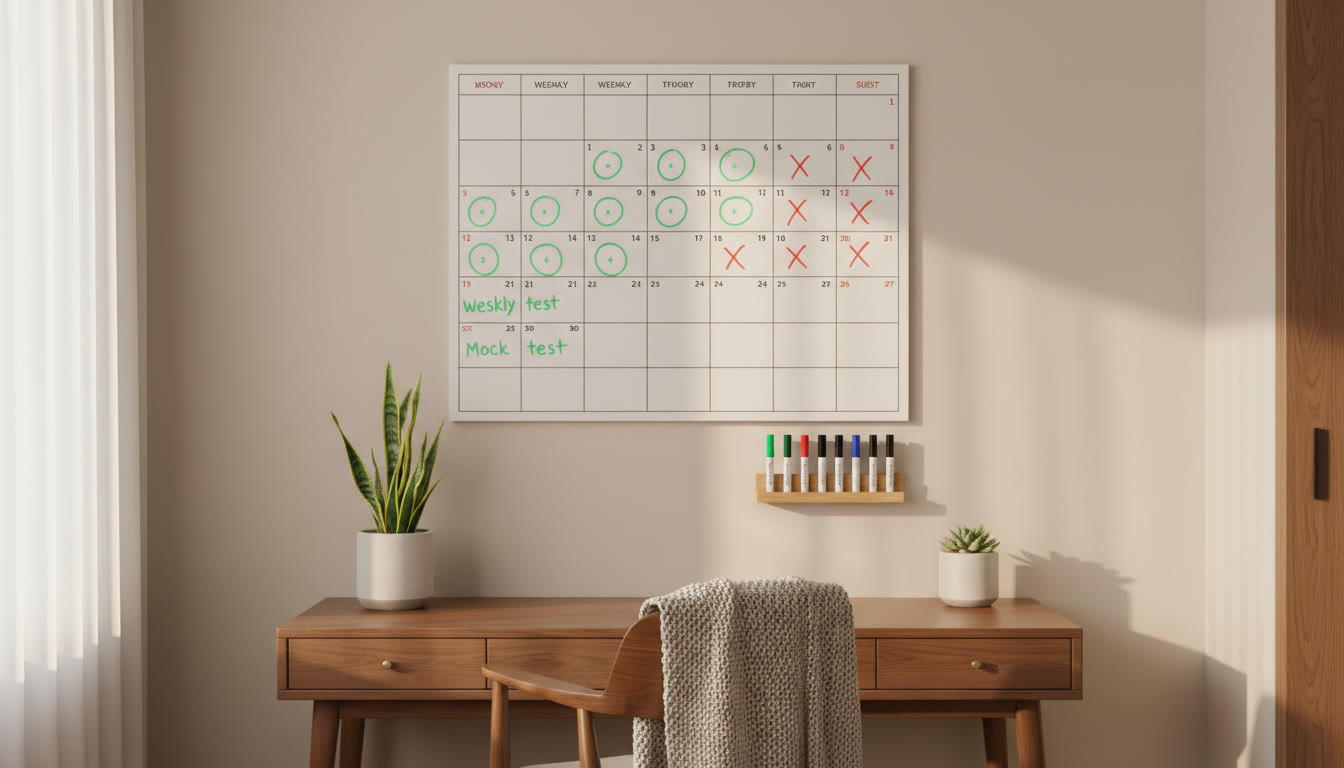
- Is your plan a living document with weekly checkpoints?
- Do you log every mistake with a root-cause and a follow-up?
- Are you doing full-length timed mocks under strict OMR discipline regularly?
- Do your weekly actions come from your error log, not from random impulse?
- Is your revision balanced across Physics, Chemistry, and Biology?
- Are you using targeted help when patterns persist (1-on-1 tutoring or focused feedback)?
Closing thought
Long-term planning for NEET isn’t a one-time blueprint. It’s a disciplined loop of studying, testing, analyzing, and adapting. When you treat mistakes as structured data rather than as moral failures, each error becomes a roadmap toward better accuracy, stronger concepts, and steadier test-day performance.
Conclusion
Consistent progress is the product of honest mistake analysis and deliberate corrective practice. By recording errors, running disciplined mock simulations, balancing syllabus coverage, and using focused help where patterns persist, you convert setbacks into measurable gains and build a long-term plan that adapts with you.















No Comments
Leave a comment Cancel