
NEET Mistakes in Practice Questions: How to Analyze, Learn, and Convert Errors into Marks
Making mistakes in practice is not a sign of failure — it’s the raw material of smarter preparation. If you treat every error as bad luck, you’ll repeat the same pattern under pressure. If you treat every error as data, you’ll transform fragile knowledge into dependable exam performance. This piece is written for the student who wants practical, human strategies to analyze practice-question mistakes for NEET-style exams (MCQ format, three-hour full-length timing, OMR discipline and a penalty for incorrect responses). Read it as a coach in your pocket: clear steps, subject-aware tactics, and concrete templates you can use right away.

Why focused mistake analysis beats more random practice
Repeatedly doing full-length tests is useful — but repetition without reflection is busywork. Mistake analysis turns repetition into learning by forcing you to identify: what went wrong, why it went wrong, and what exact micro-skill will prevent it next time. In short: mistakes reveal weak links in your chain of reasoning. Fix those links and the chain becomes reliable.
How to think about mistakes (three quick principles)
- Classify, don’t just catalog: Not every wrong answer is the same. Classify into categories like conceptual, careless, calculation, timing, OMR/marking, and comprehension errors.
- Quantify the pain: Track frequency and marks lost — some mistakes are frequent but low-cost, others rare but catastrophic. Prioritize the high-cost patterns.
- Force corrective rehearsal: Re-doing the question once is not enough. Reattempt it without notes after 24–72 hours and again after a week to ensure the correction stuck.
Common mistake categories and what they really mean
Below are typical categories you’ll see in practice tests and what each category signals about your preparation.
- Conceptual error: You didn’t understand the idea behind the question — fix with targeted concept review and simple re-derivations.
- Calculation error: An arithmetic or algebra slip — audit your working, use estimation checks, and practice faster, clean calculations.
- Careless/attention error: You misread a value, sign, unit, or ignored a clause like “except” — slow down on reading practice and mark key words.
- Time-pressure error: Rushed decisions because timing was off — practice pacing and teach yourself time checkpoints during mocks.
- OMR/marking error: Wrong bubbles, double-marked circles, misaligned rows — treat OMR practice as a skill and simulate strict OMR discipline in every mock.
- Exam-strategy error: Poor selection of questions — choosing high-risk problems early or failing to reserve easy marks.
- Memory lapse: You knew it in revision but failed to recall — convert facts into spaced-repetition flashcards and concept maps.
Subject flavor: how mistakes look in Physics, Chemistry and Biology
Mistakes wear different faces in each subject. Here are subject-specific signals to watch for so your corrections are precise.
- Physics: Wrong formula application, sign errors, unit mismatches, or skipping a diagram step. Often the root cause is not memorization but incomplete derivation practice.
- Chemistry: Mechanism confusion in organic, stoichiometry slips, or overlooking physical chemistry approximations. Mistakes here are often procedural — make short, repeatable checklists for reaction types and calculations.
- Biology: Confused processes, rote errors in facts, or misreading assertion–reason style stems. Convert these into cause-effect maps and repeated diagram labeling drills.
Step-by-step routine for analyzing a practice question
Make this a ritual after every mock or practice set — it should take you 20–45 minutes after each full mock and 5–10 minutes after a short set.
- Cooldown: Don’t analyze immediately if you’re emotional. Take 15–30 minutes, breathe, then start.
- Initial pass — mark truthfully: Mark correct, incorrect, and guessed answers. Note which incorrect ones were educated guesses vs. blind guesses.
- Classify each wrong answer: Put one of the categories from above next to each question.
- Find the root cause: Ask: did I lack concept, mess up calculation, misread, or choose a poor strategy? The root cause is usually one level deeper than the surface error.
- Correct and annotate: Write the correct solution path in 2–4 lines. Highlight the exact step where you erred.
- Create a micro-drill: For that specific error, design 3–5 short questions to practice the corrected skill within 48 hours.
- Log it: Add the mistake to your mistake log (digital or paper) and tag by subject, topic, and mistake type.
- Re-test: Reattempt the same problem and the micro-drill after 24–72 hours, and again after a week.
Practical mistake-log template (use this every test)
Below is a compact table you can copy into a notebook or spreadsheet. It forces clarity about cause and corrective action.
| Q No. | Subject | Topic | Mistake Type | Root Cause | Correct Answer / Key Step | Time Spent | Fix / Drill |
|---|---|---|---|---|---|---|---|
| 12 | Physics | Electrostatics | Calculation | Unit mix-up: used cm, answer in m | Recompute with SI units: E = kq/r^2 (units checked) | 12 min | 3 SI unit conversion drills; re-derive formula |
| 45 | Chemistry | Stoichiometry | Careless | Missed limiting reagent step | List reagents, compute moles, identify limiter | 8 min | 2 stoichiometry exercises; checklist while solving |
| 76 | Biology | Genetics | Conceptual | Confused dominance types | Make Punnett square, list phenotype ratios | 10 min | Create 5 quick inheritance problems |
How to prioritize which mistakes to fix first
When your mistake log grows, triage becomes essential. Use this simple three-tier method:
- Tier A (Immediate): Repeated mistakes or errors that cost multiple marks in a single test — fix these first.
- Tier B (Important): Conceptual gaps in core topics of Biology, core chapters of Chemistry, or fundamental Physics laws.
- Tier C (Low frequency): One-off careless slips that cost 1–2 marks occasionally; track them but address after Tier A/B.
Measuring improvement: simple metrics that matter
Don’t chase vanity metrics. Track a few clear numbers each mock:
- Accuracy (%) = Correct / Attempted
- Net score change after accounting for wrong-answer penalty
- Marks lost to careless or OMR errors
- Average time per question and questions left unanswered
Plot these over several mocks. If accuracy improves while net score remains flat, look for time or marking errors. If net score improves but careless errors spike, you may be over-risking time for marginal gains.
Subject-by-subject corrective drills (examples you can start today)
Micro-drills beat vague promises. Here are discipline-specific drills tied to common mistake types.
- Physics drill: Pick 5 problems on one concept (e.g., kinematics). Solve each with full derivation, then condense into a 3-line solution you can reproduce in 3 minutes. Repeat across 3 days.
- Chemistry drill: For a tricky mechanism or calculation type, write a two-column sheet: left = common mistakes, right = checklist to avoid them (units, mole concept, reagent order). Run through 10 practice sets using the checklist.
- Biology drill: Convert dense pages into diagrams and teach them aloud for five minutes to an imaginary student. Record yourself; if phrased wrong, you’ll find gaps.
Time management, OMR discipline and negative marking — practical rules
NEET-style exams reward careful speed. Keep these rules in your ritual:
- Practice full three-hour timed mocks to condition your pacing muscles; simulate the exact OMR behavior (use a printed OMR sheet if possible).
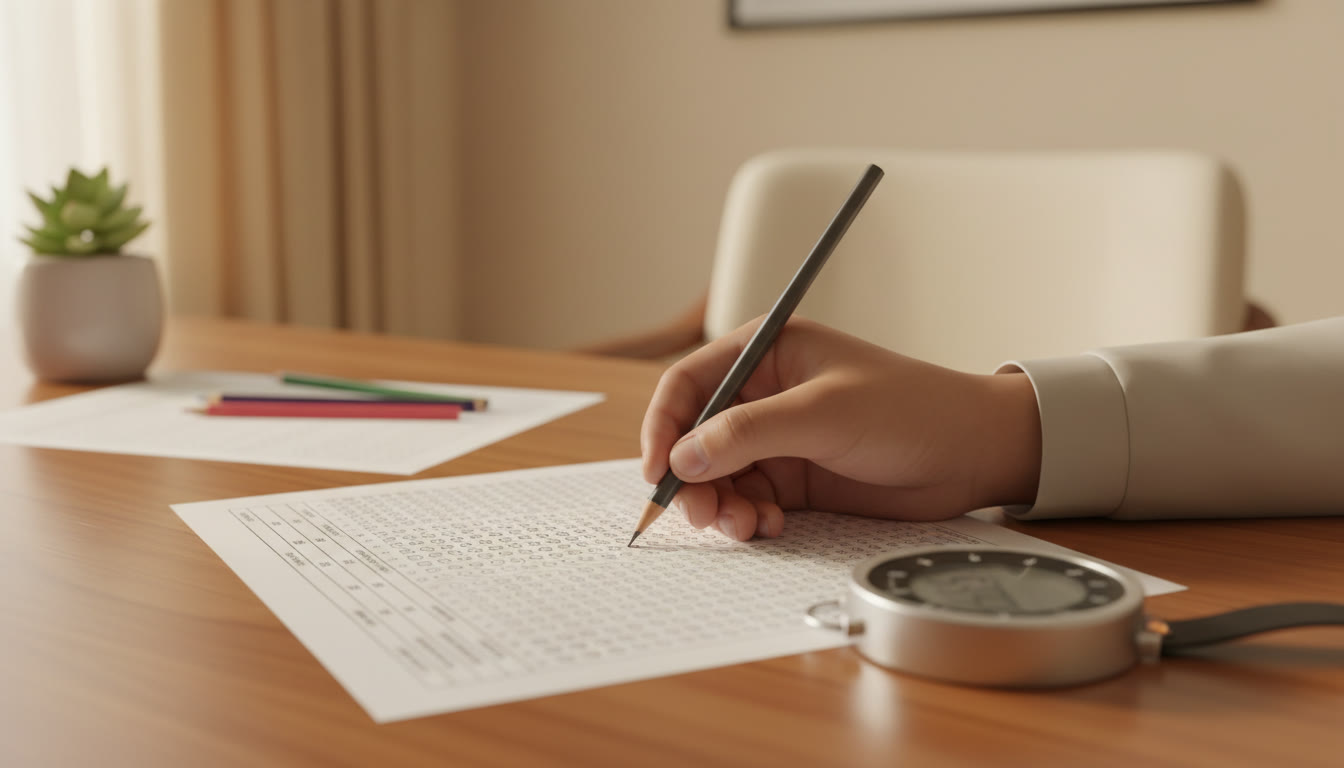
- Treat OMR marking as a separate skill: always fill bubbles cleanly, watch row alignment, avoid stray marks, and double-check your last answer on each page before flipping it in a timed checkpoint.
- Respect negative marking: if the penalty exists in your current cycle, avoid random guessing. Use elimination-based educated guessing when you can eliminate at least one or two options.
Top 10 checklist to run before you submit a mock or leave the exam hall
- Did I bubble the intended answer for every attempted question?
- Are there stray marks near bubbles that could confuse OMR readers?
- Have I flagged questions I will revisit in the remaining time?
- Did I re-check units, signs and approximations for calculation questions?
- Have I re-read multi-clause stems for hidden qualifiers (except, not, nearest)?
- Did I avoid performing long derivations when a simpler approach existed?
- Have I allocated at least one short block to re-check easy questions?
- Did I manage time to attempt high-yield short questions first?
- Have I kept my cool — deep breaths reduce careless mistakes.
- Did I log all mistakes immediately after the test for accurate recall?
How technology and tutoring fit into mistake analysis
Technology can accelerate mistake analysis if used with discipline: an error-tracking spreadsheet, spaced-repetition apps for flashcards, and timed mock platforms are helpful. For students who want guided correction, Sparkl’s personalized tutoring can provide one-on-one guidance, tailored study plans, expert tutors, and AI-driven insights to highlight recurring weak areas and suggest targeted micro-drills. Use technology to enforce the routine — not to skip the reflection step.
Sample weekly cycle to reduce errors steadily
Design a routine that alternates practice, analysis, and corrective drills. Here is an evergreen example you can adapt:
- Day 1: Full-length timed mock (simulate OMR). Immediately mark correct/incorrect, then rest.
- Day 2: Deep analysis of all mistakes (use the mistake-log table). Create 5 micro-drills for Tier A issues.
- Day 3–4: Focused drills and topic revision for Tier A and B mistakes. Short timed sets.
- Day 5: Mixed-topic timed practice (60–90 minutes) with strict OMR behavior.
- Day 6: Re-test micro-drills and reattempt corrected questions without notes.
- Day 7: Light review, flashcards, and consolidation.
Common traps and how to avoid them
Here are a few psychological and procedural traps students fall into and practical fixes:
- Trap: Overcorrecting one subject. Fix: Maintain balanced weekly rotations so one subject’s gains don’t cost another’s fundamentals.
- Trap: Blaming “stupid mistakes.” Fix: Every careless error has a cause (fatigue, rushing, wrong habit). Trace and fix the cause rather than scolding yourself.
- Trap: Fixing yesterday’s mistakes only to create new ones. Fix: Use spaced repetition and periodic re-testing to ensure transfer to exam conditions.
Example: turning one mistake into long-term gain (a short case study)
Suppose you missed three biology MCQs in a mock, all related to the same physiological pathway. Instead of reading the chapter again, follow this micro-plan: (1) write a one-page flowchart of the pathway, (2) create three 2-minute explanation videos to yourself, (3) design five new MCQs around subtle variants, (4) add the pathway as high-priority flashcards, and (5) re-test next week. This converts a transient error cluster into durable mastery.
When to seek external help
Some patterns need an expert eye. If after several cycles your Tier A mistakes persist — particularly conceptual errors in core topics — structured personalized guidance can speed recovery. A short series of one-on-one sessions focused solely on your mistake-log, with explicit drill plans and progress markers, is more effective than more untargeted hours of study.
Final checklist to turn analysis into exam-day habits
- Always log mistakes immediately after a mock.
- Classify and prioritize by frequency and marks lost.
- Create micro-drills and re-test in spaced intervals.
- Practice strict OMR discipline every timed session.
- Monitor a few metrics (accuracy, net score, careless marks lost) across mocks.
- When needed, get focused guidance to convert stubborn mistakes into strengths.
Errors in practice are predictable, traceable, and fixable. If you move from blaming yourself to diagnosing specific causes, you change the exam’s outcome: mistakes become the map that leads you to higher accuracy and steadier performance. Apply the routines here — classify, quantify, rehearse, and re-test — and your practice will stop being a series of flukes and start being a reliable pathway to improvement.
Academic conclusion
Mistake analysis is a structured skill: a repeatable cycle of classification, root-cause identification, targeted correction, and spaced re-testing. When applied consistently within an MCQ-based, timed exam framework that enforces OMR discipline and penalizes incorrect responses, this cycle converts transient errors into long-term competence and higher net scores.



















No Comments
Leave a comment Cancel