
Intro: Why this matters — and who this guide is for
If you’re a student (or a parent of one) knee‑deep in college application season, the question of “How do I link my SAT score to the Common App?” is both common and important. The short answer is that the Common App itself doesn’t transmit your official SAT scores to colleges — College Board does. But the two systems talk to each other in ways that matter, and understanding when to self‑report, when to send official scores, how Score Choice works, and how timing and costs affect your decisions will make the process far less stressful.

The big picture: Self‑reporting vs official reporting
Colleges typically see two things during the admissions process:
- Your Common App application, where many schools let you self‑report test scores (you type them in).
- Your official score reports, which you or your counselor must send from the College Board to the colleges you apply to.
Why two lists? Because colleges often let you self‑report early (to save money and time), but they require official, College Board–sent scores later — usually after you enroll — to verify what you reported. Always check each college’s written policy on the Common App or the school’s admissions pages: some are test‑optional, some accept self‑reported scores through decision, and many require official reports before enrollment.
Key rule of thumb
- Self‑report on the Common App if a college permits it — it’s fast and free.
- When a college requires official scores (for admission, scholarships, or placement), order them from College Board so the school receives them directly.
Step‑by‑step: How to include SAT scores on the Common App
Here’s a straightforward workflow you can follow. Treat it like a checklist you can tick off with confidence.
Step 1 — Fill out the Testing section in Common App
On the Common App, go to the “Testing” section and enter the SAT details you want to report: test date(s), section scores (Evidence‑Based Reading & Writing and Math), and total score. If you took the digital SAT, the content is the same — just ensure you select the correct test date and that your scores are accurate.
Step 2 — Decide whether to self‑report or wait
Many colleges accept self‑reported scores for the initial review. If you’re applying early decision/action or your score improves after you submit, weigh the timing: sometimes sending a stronger, later score makes sense. Remember: self‑reporting doesn’t replace official reporting unless the school explicitly says it does.
Step 3 — Use College Board to send official scores
When a school requires official verification, order official score reports through your College Board account. You can choose recipients by searching school names or using college codes. If you registered for the SAT on a weekend and selected free score recipients at registration, those sends are handled automatically; otherwise you can send scores later for a fee (or free with eligible fee waivers).
Step 4 — Understand Score Choice and school policies
Score Choice lets you select which test dates to send to colleges. That gives you control — but it’s only helpful if the college accepts Score Choice. Some schools ask for all test dates; others superscore (combine best section scores across dates). Always check each college’s testing policy before assuming Score Choice will benefit you.
Practical timeline and timing tips
Timing matters more than people expect. Deadlines for college applications, scholarship consideration, and placement testing often vary. Use this simplified timeline as a guide:
| When | What to do | Why it matters |
|---|---|---|
| Before applying | Decide which SAT test dates to report on Common App (self‑reported) and prepare to send official scores when required. | Ensures accurate application and avoids rushed score sends near deadlines. |
| At application submission | Self‑report your scores if allowed. Note which colleges require official scores. | Keeps your application complete while you save time/money. |
| After admission decision | If admitted and the college requires official verification before enrollment, send scores from College Board immediately. | Official scores are often required to finalize admission and placement. |
| Urgent / Early deadlines | Use College Board rush reporting if you need faster delivery. | Meets early action/decision or scholarship deadlines; incurs extra fee. |
Pro tip
If you’re applying early (November/December deadlines), aim to have official score orders placed at least 2–3 weeks before the deadline unless you pay for rush reporting. Also check your preferred college’s policy on whether they accept scores posted after the application deadline — sometimes they will, sometimes they won’t.
How to actually send official scores from College Board
Here’s what you (or your student) will do inside College Board.
- Sign in to the College Board account associated with the SAT registration.
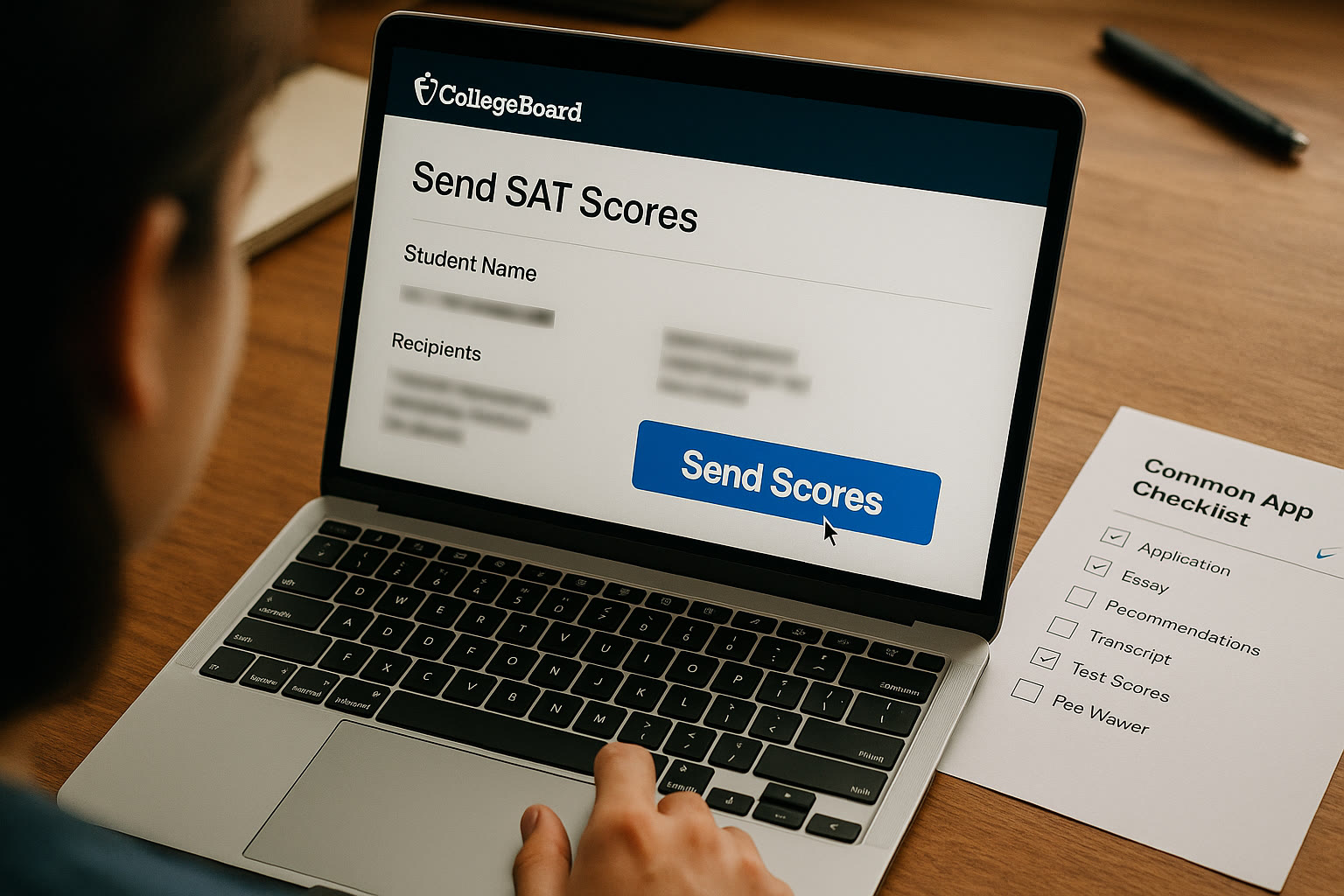
- Go to the Send SAT Scores page.
- Search for colleges by name or college code; add them to your recipients list.
- Choose which test date(s) to send if you have multiple dates (Score Choice).
- Review and pay (if a fee applies) or confirm free sends if within the free send window.
- For faster delivery, select the rush reporting option for an additional fee.
Remember that many students can select up to four free score recipients when they register for a weekend SAT test or within a short free window after the test — so use those free sends wisely.
Score Choice: Friend or foe?
Score Choice is a tool that helps you present your strongest performance, but it’s not universally advantageous. Think of it this way:
- Use Score Choice if a college allows it and you have a clear ‘best’ test date that shows your potential.
- Don’t rely on Score Choice if the college requires all scores — they’ll want to see the full record.
- If a college superscores (combines best section scores across dates) and you’ve improved sectionally across different dates, sending all scores might help.
Investigate each college’s test policy in the Common App or the school’s admissions page before making this choice.
Common pitfalls and how to avoid them
Pitfall: Assuming the Common App sends scores
Don’t assume that checking the box on Common App automatically prompts College Board to send your official scores. Common App is the application platform; College Board is the official score sender. Verify your College Board orders to ensure official reports reach the colleges that require them.
Pitfall: Missing deadlines for official verification
Colleges may accept self‑reported scores during application review but require official reporting later. If you wait too long, you risk missing verification or scholarship deadlines. If needed, use rush reporting — but plan around it so you don’t pay more than necessary.
Pitfall: Incorrect account or test date
Make sure the College Board account you use is the one associated with the test registration and that you select the correct test date(s) when ordering. Sending scores from the wrong account or the wrong date creates delays and extra fees.
How to coordinate with your school counselor
Your counselor can be a powerful ally in this process. They often:
- Help verify which schools listed in the Common App expect official scores from the College Board.
- Send school reports or transcripts that are required alongside or after score verification.
- Advise on scholarship deadlines and placement testing tied to official scores.
Invite your counselor into the loop early — a quick meeting can avoid confusion and last‑minute scrambling.
Cost considerations and fee waivers
Sending official scores usually carries a fee if you’re past the free send window. However, College Board provides fee waivers for eligible students that can cover score sending. If you qualify for a fee waiver, you can send as many scores as needed without paying. Make sure you understand your free send allowance and whether your upcoming sends fall inside it.
Digital SAT specifics you should know
The Digital SAT changed the delivery format of the test, but the score reporting process remains fundamentally the same: scores are reported by College Board and must be sent officially when schools request them. Keep these practical notes in mind:
- Your digital test date will appear on your College Board score report the same way as a paper test date did before.
- When selecting test dates to send, look for the correct digital test date to avoid accidentally sending the wrong session.
- BigFuture School and College Board apps may give you faster notifications about score availability if you registered with a mobile number.
What to write on the Common App when you’re unsure
Sometimes you’re still waiting on a score when you submit your application. Here’s how to handle that elegantly:
- If a college allows self‑reporting, enter your most recent scores and add a note in the Additional Information section explaining that a later official score is pending and will be sent as soon as it’s available.
- If you expect an updated score before decisions, indicate the test date you expect to send and make sure College Board is prepared to send official scores when they’re released.
Real‑world example: A student timeline
Here’s a realistic scenario that ties the pieces together.
- Junior year spring: Student takes the digital SAT and gets a decent score. They self‑report that score when starting Common App in the summer.
- Senior year October: Student retakes the SAT and improves sectionally. The student decides to send only the October test to colleges that accept Score Choice and all scores to colleges that require them.
- Application deadlines pass with self‑reported scores. Student is admitted to a school that requires official verification. After admission, the student orders official score reports from College Board for the admitted school and any scholarship programs.
This flow keeps the application on time, uses self‑reporting to save costs up front, and meets official verification requirements when they matter most.
How tutoring and targeted prep can affect your reporting choices
Test strategy isn’t only about studying — it’s also about when and how you report. Personalized tutoring (for example, Sparkl’s 1‑on‑1 guidance and tailored study plans) can help you decide whether to retest, which test dates to present, and whether to rely on Score Choice or report all scores.
Good tutoring clarifies tradeoffs: if your practice shows consistent improvement in Math but inconsistent EBRW, a tutor can help you decide to focus on test strategies that raise both sections versus concentrating on one test date for a high total. Sparkl’s tutors, combined with AI‑driven insights and a tailored plan, can give you the confidence to make these reporting decisions strategically rather than reactively.
Checklist before you hit submit
Run through this short checklist the day you submit your Common App.
- Have you correctly self‑reported test dates and scores (if the college allows it)?
- Do you know which colleges require official score reports and when they need to receive them?
- Is your College Board account ready to send official scores (correct login, payment method, or fee waiver)?
- Have you considered Score Choice vs. sending all scores according to each college’s policy?
- Did you tell your counselor about your score‑send plan if they need to coordinate anything?
Quick FAQ: Common questions answered
Q: Does the Common App ever accept official scores directly?
No. The Common App is an application portal; it doesn’t replace the College Board’s official score reporting. Colleges generally expect official reports to come directly from College Board when they need verification.
Q: Can I send different sections from different dates?
No. When you send a score, you send the entire SAT score for that test date. Some colleges will superscore and combine your best section scores, but College Board itself sends whole test results by date.
Q: What if my scores arrive after my application deadline?
Policies vary. If a score is late, contact the admissions office immediately — sometimes late scores are accepted for consideration, sometimes not. When deadlines are tight, rush reporting can help bridge the gap.
Final thoughts: Strategy, calm, and clarity
Linking your SAT score to the Common App isn’t a technical problem so much as a planning problem. If you know the difference between self‑reporting and official reporting, you understand Score Choice and each college’s policy, and you plan your timeline carefully, you’ll reduce stress and present your academic record clearly and confidently.
Lean on trusted adults — a school counselor, a tutor, or a platform that offers personalized guidance. Sparkl’s personalized tutoring, for example, can help you not only raise scores but also design a smart reporting strategy that aligns with your application goals. The result is less guesswork and more time for the parts of your application that show who you really are.
One last reminder: double‑check each college’s testing policy on their official admissions page or on the Common App for the current application cycle. Policies evolve, and a quick verification will keep you from surprises. With planning, a clear checklist, and a calm approach, you’ll be able to link your SAT experience to your Common App in a way that supports your best application.
Good luck — and remember, the score is one part of a much larger story. Tell that story well.






















No Comments
Leave a comment Cancel