
How Many Books Are Enough for JEE Main?
If your desk looks like a mini bookstore and your goals feel buried under a tower of textbooks, you’re not alone. The question “How many books are enough?” is one of the most common, yet most misunderstood questions in JEE preparation. The short truth: fewer, well-chosen resources used thoroughly beat a dozen partially-read books every time. This guide gives a practical, subject-wise approach to build a compact, powerful shelf that keeps your learning focused and exam-ready.

The concise answer (without the jargon)
For most students, a practical range is: 2–4 books per subject, making an overall total of roughly 6–12 books. That range covers minimal-to-ideal setups: the minimal set covers core concepts and basic practice; the ideal set adds depth and targeted problem practice. Your final number depends on where you are in preparation: the earlier the stage, the more conceptual books you might temporarily need; closer to the exam, you should trim and focus on practice and revision material.
What we mean by a “book”
When I say “book” I mean any substantial printed module you use as a primary study resource: a concept textbook, a focused practice book, a past-year compilation, or a topic-wise workbook. Condensed notes, photocopied chapters, or short printed sheets can form your formula/reference “book” but count them practically—two small guides can be as effective as one thick volume.
Why quality beats quantity
Stacking up books can feel productive, but it often dilutes study time and attention. Each new book introduces slightly different notations, problem styles, and approaches — switching between them breaks momentum. Mastery requires repetition, reflection, and analysis of mistakes. You get those only by thoroughly using a limited, high-quality set.
- Focused depth helps long-term retention; skim-reading many books does not.
- Mistake analysis (not the number of questions attempted) drives improvement.
- Too many books create decision fatigue—wasting time deciding what to study next.
Signs you already have too many books
- You start several chapters in different books but finish none.
- You keep buying new books after a few weeks of study.
- You can’t recall where a topic was explained because it lives in multiple sources.
- You frequently jump to a “different method” instead of mastering a single reliable method.
Subject-wise roadmap: what each subject really needs
Physics
Physics needs clear conceptual grounding and consistent problem practice. Typical compact set:
- One clear conceptual book that explains fundamentals and derivations.
- One problem book focused on graded practice: straightforward to challenging problems.
- An optional topic-specific set (like mechanics or E&M problem collections) if you need depth in weak areas.
How to use them: read a chapter for concepts, solve core examples, then attempt 75% of the practice problems—mark the rest for a second pass. Use timed 3-hour mocks to translate conceptual speed into exam rhythm.
Chemistry
Chemistry is three parts in one: conceptual inorganic patterns, reaction logic in organic, and numericals in physical. A compact chemistry shelf often looks like:
- One balanced book covering the three branches at a conceptual level.
- One practice book with numerical problems and reaction-based MCQs.
- A concise formula/reaction sheet or pocket notebook for quick revision.
Use the concept book to build clarity, then drill reactions and numericals through regular timed practice. Learn to convert long reaction mechanisms into short recallable keys for exam time.
Mathematics
Maths rewards structured practice and concept clarity. A practical maths set is:
- One theory-and-examples book that explains methods and standard techniques.
- One intensive problem book with graded questions (from routine to challenge).
- An optional advanced problem collection if you’re targeting top percentiles or need more competition-style practice.
Math demands repeated problem cycles—attempt, analyze, reattempt. Keep a small “error book” with solved mistakes and key tricks.
Quick planning table: books per subject at a glance
| Subject | Minimum books | Ideal books | Typical composition |
|---|---|---|---|
| Physics | 2 | 3–4 | Concept book + Problem book (+ topic collection) |
| Chemistry | 2 | 3–4 | Balanced conceptual book + Practice book + Formula sheet |
| Mathematics | 2 | 3–4 | Theory & examples + Graded problem book (+ advanced set) |
| Total | 6 | 9–12 | Core concept + practice + revision material |
How to use each book effectively (strategy, not busywork)
Owning the right books is only half the battle. The other half is a disciplined approach to learning from them:
- Active reading: turn chapter headings into questions before you read, and answer them after.
- Immediate practice: after concept reading, solve related problems within the same session.
- Error logs: maintain a small notebook where every mistake lives with the reason and the correct approach.
- Timed practice: do full 3-hour simulated papers under exam conditions to adapt to time pressure and negative marking.
- Spaced revision: revisit a chapter after 3–7 days, then after 2–3 weeks, to convert short-term recall into durable memory.
Mock tests, negative marking, and OMR/CBT discipline
The real exam tests not just knowledge but execution under constraints. Key realities to practice for:
- MCQ format — answers are final, and there is no partial credit for lengthy derivations shown on paper.
- Negative marking — avoid random guessing; practice intelligent elimination techniques.
- 3-hour full-length mock practice — simulate the exact time block to tune stamina and time allocation.
- OMR/CBT discipline — even if the official test is computer-based, practicing with an OMR sheet or a mock CBT interface trains you to mark answers cleanly and manage review flags.
Practice a clear marking strategy: attempt the straightforward questions first, flag time-consuming ones, and come back with remaining time. Most progress comes from analyzing mocks to close repeatable error patterns.
Sample weekly rhythm for using your bookset
| Day | Morning | Afternoon | Evening |
|---|---|---|---|
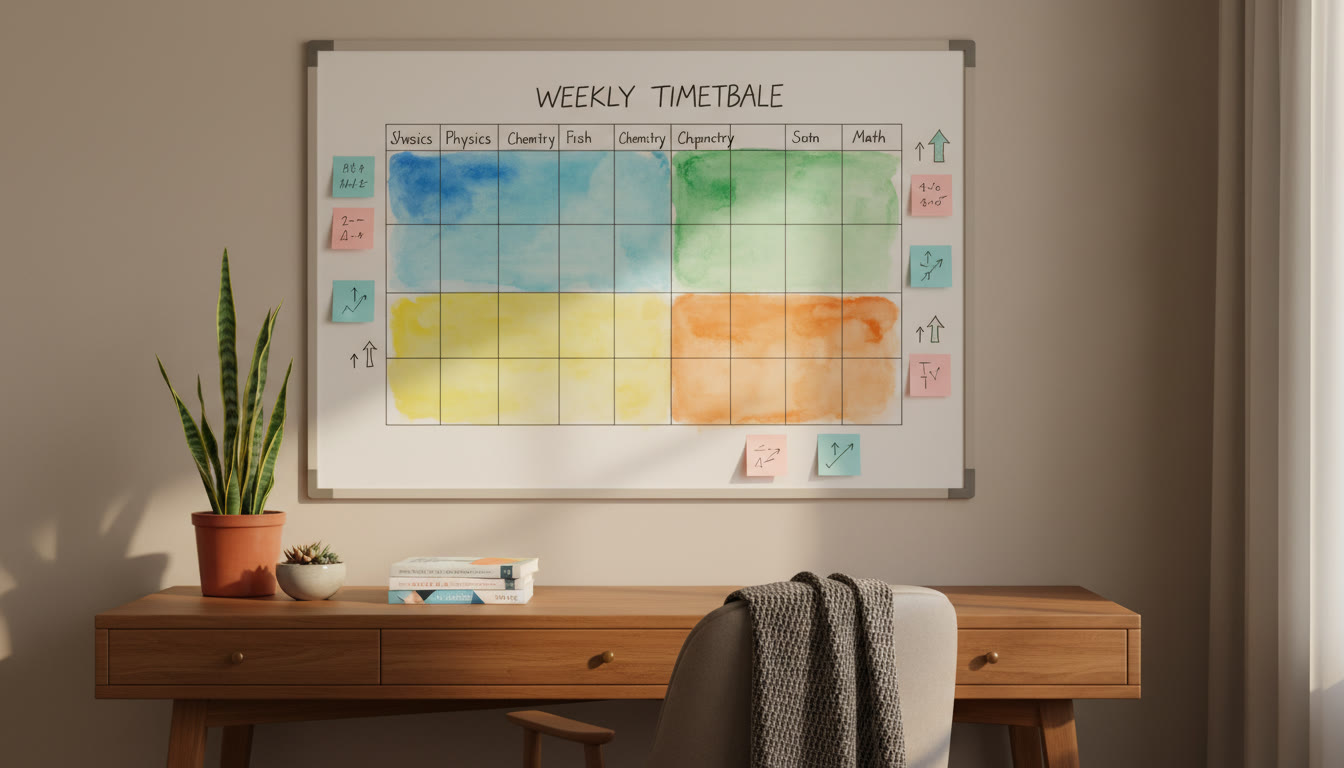
| Mon–Wed | Concept study (book 1) | Problem practice (book 2) | Review mistakes + short revision |
| Thu | Timed sectional practice | Topic revision (weak points) | Light problem-solving |
| Fri | Concept study (other subject) | Problem practice | Formula sheet update |
| Sat | Full-length mock (3-hour) | Mock analysis | Plan corrections |
| Sun | Light revision & doubts | Targeted problem drills | Rest & mental reset |
When to add more books (and when to resist)
Additional books are useful in two clear situations:
- You’ve exhausted your current practice and need fresh, higher-difficulty problems to push percentile.
- You have a focused weak area — a topic-wise book can accelerate catching up.
Resist impulse buys if you’re still in the learning phase for existing resources. Adding a book to “start tomorrow” often becomes a permanent distraction.
Building a minimalist, effective shelf — step-by-step
- Start with one good conceptual book per subject. If you’re new to a topic, spend more time here.
- Add one reliable problem/practice book for each subject and commit to finish a set number of questions each week.
- Keep one compact revision book or a personal formula/summary notebook for last-minute refreshers.
- Keep a small set of full-length mock tests (printed or digital) and take one every week as you approach the final months.
Budget-smart tactics and study hacks
High-quality studying doesn’t require breaking the bank. Try these practical tips:
- Borrow or buy second-hand core books; only invest in new purchases for specialized or rarely available problem sets.
- Photocopy essential chapters and create a compact binder for daily revision rather than lugging multiple heavy books.
- Create a personal “top 50 problems” file from all sources — solving these repeatedly is worth more than skimming many books.
When personalized help makes sense
If you’re stuck on persistent score plateaus or need structured accountability, targeted tutoring can accelerate the transition from knowledge to performance. For example, Sparkl‘s personalized tutoring offers 1-on-1 guidance, tailored study plans, expert tutors, and AI-driven insights that help prioritize topics from your chosen booklist and convert study hours into score improvements. Personalized feedback helps you know exactly which chapter or book to prune or deepen, saving weeks of trial-and-error.
Common myths about books and preparation
- Myth: “The more books, the higher the score.” Reality: Focused mastery drives scores, not an inventory of titles.
- Myth: “You must finish every book cover-to-cover.” Reality: Read selectively—master the syllabus areas and practice representative questions deeply.
- Myth: “Newer books always mean better content.” Reality: Consistency and systematic revision beat novelty.
Checklist before you buy another book
- Have I completed the most relevant chapters of my current core books?
- Will this new book solve a specific, current weakness?
- Am I buying it to help practice or to procrastinate facing my weak topics?
- Can I achieve the same benefit by creating a targeted problem set from existing books?
Final practical notes on exam-style realities
Remember: the exam rewards accurate, timely answers. It uses objective MCQs, enforces negative marking for incorrect responses, and requires disciplined marking behavior whether you practice on OMR sheets or computer-based mocks. Do not expect partial credit for algebraic derivations or lengthy workings in MCQ formats; the correct final option is what counts. Your preparation must therefore be a combination of concept clarity, timed problem practice, and repeated full-length mock simulations to build mental stamina and error-awareness.
Conclusion
Choose a compact set of high-utility books, use them deeply with disciplined practice and mock-test analysis, and add resources only to solve specific, demonstrated weaknesses. Consistency, mock-driven correction, and focused revision deliver reliable score gains; an overflowing shelf rarely does.























No Comments
Leave a comment Cancel