
JEE Main PYQ Strategy for Final Revision
If you’re in the last stretch before the big exam window, previous-year questions (PYQs) are one of the clearest, most honest mirrors you can use. They show what examiners value, which formats trip up students, and where marks repeatedly come from. This article is written like a calm coach by your side: practical, punchy and full of small, repeatable moves you can use in the final revision weeks. You’ll get a tested schedule, precise drills, an exam-simulation guide for a three-hour run, and simple templates (including a sample table) to organize PYQs so they convert directly into points on the day.

Why PYQs are the highest-value study resource right now
PYQs do three things better than anything else in the last phase: they reveal repeat topics, calibrate difficulty, and teach answer management. They are not a replacement for concept work, but they are the fastest way to close the gap between what you know and what the exam demands.
- Pattern recognition: Questions on certain subtopics tend to recur. Identifying these gives you outsized returns.
- Time calibration: PYQs teach you how long real exam problems take—vital for pacing a 3‑hour mock.
- Error mapping: Mistakes on PYQs show the same conceptual holes that will show up in the real paper.
Core exam context to keep in mind
Keep fundamentals of the current testing style at the front of your prep: the exam is largely MCQ-based, there is negative marking that penalizes incorrect MCQ answers, and final sessions should simulate a full three‑hour test. Maintain strict answer‑sheet discipline—whether you’re doing a computer-based mock or practicing on an OMR-style sheet, behave as if that single mark is your score. Also align PYQ practice with the three core subjects relevant for most engineering entry paths: Physics, Chemistry and Mathematics (adapt if your program needs biology-related revision). Remember: there is no partial credit for half-explained answers in objective tests—answers are evaluated as correct or incorrect, and that changes how you practice solutions.
How to organize your PYQs so they actually boost scores
Good organization turns chaotic practice into focused improvement. Use a structured, minimal system:
- Create a single master spreadsheet with columns: Year, Paper/Session, Subject, Topic, Question ID, Difficulty (E/M/H), Time taken, Correct/Incorrect, Mistake type, Short note, Reattempt date.
- Tag each question by concept (e.g., ‘Conservation of Energy’, ‘Organic Mechanisms’, ‘Limits & Continuity’). Tags let you pull 10–15 targeted drills in minutes.
- Keep a running “error log” outside the spreadsheet: just one line per mistake that shows cause (careless, concept, formula gap, calculation, misread). Revisit the error log twice a week.
- Use color codes: green for mastered, amber for shaky, red for needs teaching-level review.
Sample two‑week revision table (use this as a template)
The table below is a sample schedule focused on intense PYQ practice plus realistic mock simulations. Adjust the balance depending on your strengths—more mocks if you’re fast but make careless errors; more targeted PYQs if you have concept gaps.
| Day | Morning (3‑hr) | Midday (Analysis) | Afternoon (Targeted PYQs) | Evening (Light Revision) | PYQs Solved |
|---|---|---|---|---|---|
| Day 1 | Full-length mock (strict timing) | Score + error log (1.5–2 hr) | Physics: Mechanic PYQs (10–12) | Quick formula sheet (45 min) | 25–30 |
| Day 2 | Light warm-up (1 hr MCQ set) | Redo top 5 mistakes | Chemistry: Physical + Inorganic PYQs (12–15) | Mental math drills (30 min) | 20–25 |
| Day 3 | Full-length mock | In-depth analysis | Math: Calculus/Algebra PYQs | Short revision notes | 25–35 |
| Day 4 | Timed sectional focus (90 min subject) | Discuss ‘why’ behind errors | Mistake reattempts | Rest & light reading | 20 |
| Day 5 | Full-length mock | Score + trend log | Mixed PYQ set (all subjects) | Formula recall | 30–40 |
| Day 6 | Topic deep-dive (weak area) | Targeted practice | Past 5 years: repeated Qs | Flashcard review | 20–30 |
| Day 7 | Restful review (short test) | Organize week’s log | Plan next week | Sleep early | 10–15 |
Repeat the pattern for week two, increasing the density of full‑length mocks and reducing new material intake. The goal is mastery, not new learning.
How to run a true 3‑hour mock (simulate, don’t just time)
Mocks done casually are a waste. For the final weeks, every full-length mock should be a rehearsal for the real thing:
- Set the environment: quiet room, no phone, clock visible, same start time as your actual exam slot when possible.
- Follow seat rules: one device if it’s a CBT mock, or a printed question booklet and answer sheet if you’re practicing OMR discipline. Treat the answer interface like an OMR: mark deliberately, avoid extra marks, and confirm every answer before moving on.
- Pacing plan: first pass — secure 40–50% of the paper within 90 minutes (easy + medium). Second pass — attack higher-value questions. Final pass — make an intelligent choice list of remaining attempts.
- Post-mock routine: analyze immediately while the paper is fresh—note careless mistakes first, then concept gaps, then calculation errors. Update your error log and re-schedule those PYQs for reattempt.
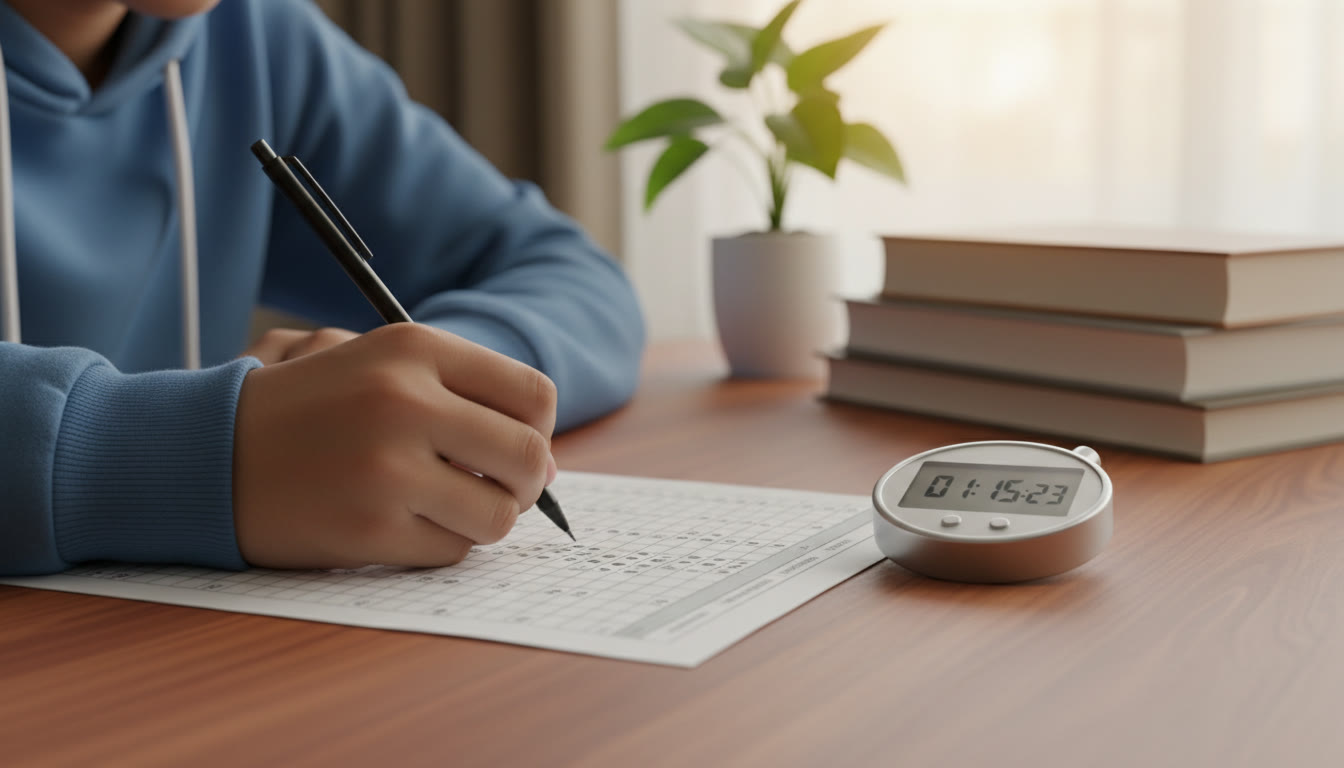
Negative marking: smarter guessing and elimination
Negative marking changes the math of guessing. You’re not penalized for thoughtful elimination: if you can eliminate one or more choices and increase your chance of correctness above the risk threshold, it becomes worth attempting. But blind guessing on MCQs is rarely a good bet in the final weeks.
- Use elimination aggressively: cross out options you can disprove logically before selecting.
- If you don’t know anything about a question, mark it for review and move on—your first pass is for scoring and momentum.
- When practicing PYQs, log whether your errors were from guessing. If so, reduce guessing in that topic and practice similar PYQs until elimination becomes reliable.
Topic-wise PYQ prioritization — where to spend time
Not all topics are equal in final revision. PYQs help you see what’s consistently tested. Below is a sensible priority list, but always tailor it to your own PYQ error profile.
- Physics: Mechanics, Electricity & Magnetism, Modern Physics and Waves & Optics often reward direct conceptual clarity. Solve PYQs that test multiple-concept integration (e.g., mechanics + energy) to sharpen your approach.
- Chemistry: Physical chemistry problems (chemical equilibrium, thermodynamics), core inorganic facts and reaction patterns in organic are quick wins. PYQs often favor problem solving in physical chemistry and rote recall in inorganic.
- Mathematics: Calculus, Algebra (series, complex numbers basics), Coordinate geometry and Vectors/3D typically recur. PYQs here reveal typical shortcuts and common traps—learn them.
Use your spreadsheet tags to pull all PYQs from these topics and practice them in mixed sets. If a previously solved PYQ becomes an error on reattempt, flag it as ‘needs teaching-level review’ and plan a deep-dive.
Drill formula: how many PYQs per day really helps?
Quality beats quantity. For the final phase, aim for:
- One full-length mock every 2–3 days.
- Two to three targeted PYQ sets per day (20–40 PYQs) focused on one or two topics.
- Immediate reattempts of every missed PYQ until you clear the concept or can solve it reliably in under 3–5 minutes.
If you try to blast through hundreds of questions without analysis, efficiency collapses. Keep each PYQ session short, focused and analytical.
Smart error analysis — the 5-minute post-mortem
After any test or PYQ set, do a five minute post-mortem per mistake. The goal is to convert each error into a micro-plan:
- Write the cause in one word (careless, concept, formula, calculation, language).
- If it’s a concept gap, note the resource or short method to fix it—one formula, one sketch, one short proof.
- Schedule a reattempt within 48 hours. If you still fail the reattempt, escalate: teach the problem to a peer, tutor, or explain it aloud to yourself.
How to make PYQs work with 1-on-1 support
Targeted help can compress weeks of unproductive effort into a few efficient sessions. Personalized tutors can quickly diagnose repeating error patterns and give bespoke drills that align with PYQs. If you choose guided help, use it to:
- Turn your error log into a scheduled re-teaching plan.
- Get one-on-one explanation of the 10–15 most stubborn PYQs in each subject.
- Use AI-driven insights and tailored study plans to optimize which PYQs to prioritize in the final weeks.
For example, Sparkl‘s approach to personalized tutoring pairs rapid PYQ analysis with one-to-one guidance and tailored practice paths, helping students turn repeating mistakes into mastered items quickly.
Practical tips for the last 48 hours
In the last two days, stop adding new topics. Switch to consolidation mode:
- Run a single, calm full-length mock early on one day and focus the rest of the time on error-log items only.
- Review a one-page formula sheet for each subject—this is your quick memory anchor.
- Practice the mechanics of answering: the way you flag, the way you mark, and how you move between sections to preserve momentum.
- Sleep and nutrition matter; a steady mind beats a last-minute crammed brain every time.
Example: turning one PYQ mistake into a micro-plan
Say you missed a Physics question on rotational dynamics because you forgot a sign convention. Your micro-plan would be:
- Note mistake type: ‘concept — sign convention’.
- Create one-line rule: ‘direction of angular acceleration positive when torque and angular velocity signs align as defined by right-hand rule.’
- Find two PYQs that test the same sign convention and solve them in the next 24 hours.
- If still shaky, produce a one-minute verbal explanation and record it on your phone; listen once before bed.
Rinse and repeat for other errors. This habit beats passive re-reading.
Last-minute practical checks for test day
- Confirm the test center/slot and travel time; have backups for travel and ID copies.
- Pack a small checklist: admit card printout (or digital confirmation), ID, water, light snack, and a comfortable shirt. Keep digital devices off while testing.
- Practice one calm breathing routine for 60 seconds to reset focus between sections during the mock.
Closing academic thought
Previous‑year questions are not magic, but they are the clearest diagnostic tool you have in final revision: they reveal patterns, test stamina, and train you to answer the exact kind of objective questions you’ll face. Organize them, analyze every error, simulate the three‑hour test environment, and keep your revision measured and intentional. With disciplined PYQ work focused on elimination, pattern recognition and targeted re-teaching, you convert uncertainty into reliable exam performance.




















No Comments
Leave a comment Cancel