
Why NCERT Notes Matter for JEE Main
NCERT books are the bedrock of a clear, mistake-free foundation. For JEE Main, where questions test understanding more than rote detail, NCERT offers concise explanations, canonical definitions, and carefully chosen examples that reveal the core ideas behind every topic. But reading NCERT is only the first step — turning it into active, exam-ready notes is what converts knowledge into marks.

Good notes do three things: capture the idea, show how to apply it, and make review fast. When crafted with the exam context in mind — MCQ mindset, 3-hour full-length mock practice, negative marking awareness, and disciplined simulation of exam conditions (including OMR practice for pen-paper mocks or CBT answer strategies) — NCERT notes become your best revision tool.
The Right Mindset: Notes for Understanding, Not Copying
Notes are not a photocopy of the book. They are a translation: long paragraphs become crisp definitions; multi-step derivations become a checklist of the key transforms; examples become templates you can reuse in exam conditions. Keep the focus on concept-to-question mapping: how does this definition lead to a JEE-style question?
Three quick rules to follow
- Be selective: capture definitions, assumptions, final formulas, units, and typical tricks. Don’t transcribe everything.
- Be actionable: for every concept, write how it can appear as a question and one quick method to attack it.
- Be test-aware: add a small “time-to-solve” estimate and a “guess/skip” flag where negative marking matters.
A Practical, Step-by-Step System to Make NCERT Notes
This system is a repeatable workflow you can use for any chapter in Physics, Chemistry, or Mathematics.
Step 1 — First read: understand the flow
- Skim the chapter to see headings, boxed facts, and examples.
- Underline definitions and key sentences (one color for definitions, another for formulas).
- Mark examples that look like they can be generalized into templates.
Step 2 — Make a one-page chapter summary
On a fresh page, write a one-line objective: what this chapter *lets you do* (for example, “use kinematics to connect motion graphs and equations”). Then capture:
- Key definitions (short — one line each).
- Core formulas (with units and conditions of validity).
- Three representative problem archetypes and a one-line solution hint for each.
Step 3 — Build a formula and concept sheet
Separate from chapter summaries, maintain a running formula sheet for each subject. Keep columns: Formula, When to use, Limitation/Assumption, Quick derivation step (if needed). This is the page you should be able to scan in 5 minutes before a mock.
Step 4 — Convert examples into exam-ready skeletons
Every worked example in NCERT can be turned into a skeleton you use during a test: Given | Known relations | Key substitutions | Calculation steps | Final check. Practice solving the same skeleton under time pressure (aim for the 3-hour full-length mock rhythm).
Quick Table: What to Copy, What to Rephrase, What to Skip
| NCERT Element | What to Note | How to Format | Why It Helps |
|---|---|---|---|
| Definitions and precise statements | Write verbatim (short) | One-line with keyword bolded | Avoids conceptual slip-ups in MCQs |
| Key formulas | Write formula + units + caveats | Formula line + small note | Speeds recall during timed tests |
| Worked examples | Extract skeleton and highlight trick | Given / Method / Remarks | Transforms book examples into JEE patterns |
| Long illustrative text | Summarize into a conceptual sentence | 1–2 lines | Retains idea without clutter |
Subject-by-Subject: How to Structure NCERT Notes
Physics — Derivations, Diagrams, Decisions
Physics notes should separate idea from calculation. For each important derivation write three blocks:
- Conceptual map: what’s being assumed and why the approach is chosen.
- Derivation checklist: 4–6 key algebraic steps — write only the transform names (e.g., “use conservation of momentum → substitute v = dx/dt → integrate limits”).
- Result & usage: final formula, limiting cases, and quick sample question showing when it applies.
Make diagrams twice: a clean version for understanding and a compact annotated version for quick recall. In timed practice, redrawing compact diagrams should take under 30 seconds.
Chemistry — Memory with Logic
Chemistry needs layered notes because it mixes factual recall with reasoning.
- Inorganic: convert tables into 2-line cards: trend | important exception | representative reaction.
- Physical: keep formula cards plus one-line derivation hints and units; also write sample numerical set-ups from NCERT and tweak them to create harder practice.
- Organic: reaction maps: reagents on arrows, mechanism hint, typical exam trap (e.g., rearrangement), and an example question skeleton.
Mathematics — Theorem, Proof Sketch, Problem Skeleton
Mathematics notes should make the skeleton of argument visible. For each theorem write:
- Statement (one line).
- Proof sketch (3–6 bullets highlighting the main idea).
- Application notes: when to apply, common substitutions, and one classic problem injected with a short hint.
Note Templates You Can Copy (Exactly How They Look)
Here are small templates to paste into your notebook or note app. Keep each template to one page at most.
| Template | Structure | Example Snippet |
|---|---|---|
| Formula Card | Formula — Units — When to use — Limitations | F = ma — N — For point mass with net force — Not for extended bodies without torque |
| Problem Skeleton | Given | To find | Key eqns | Steps | Check | Given: block mass m, slope θ. To find: acceleration. Use: mg sinθ = ma. Steps: write F = ma → solve → check units |
| Concept Flash | Term — One-line meaning — Quick test question | Limiting reagent — reagent consumed first — Q: which reagent limits product in this equation? |
How to Use Your Notes During Practice and Mocks
Notes are most powerful when they are integrated with practice.
- Before a full-length 3-hour mock: do a 10-minute scan of chapter one-pagers for the subjects you’ll face that day.
- During timed practice: refer to your problem skeletons to speed up set-up; train yourself to read the skeleton and translate to equations in under 60 seconds.
- After the mock: annotate your mistakes directly in the chapter note. Replace a failed approach with the corrected skeleton so the next revision is targeted.
Simulating Exam Discipline
Whether you practice on-screen or on paper, mimic the exam rules. Practice negative marking discipline: avoid guessing unless elimination raises probability significantly. If you practice OMR sheets for offline tests, add a small “OMR checklist” in your notes for each mock: fill one bubble cleanly, watch for double-fill, mark review questions lightly so you can revisit them within the allotted time.
Digital vs Handwritten: Which Is Better?
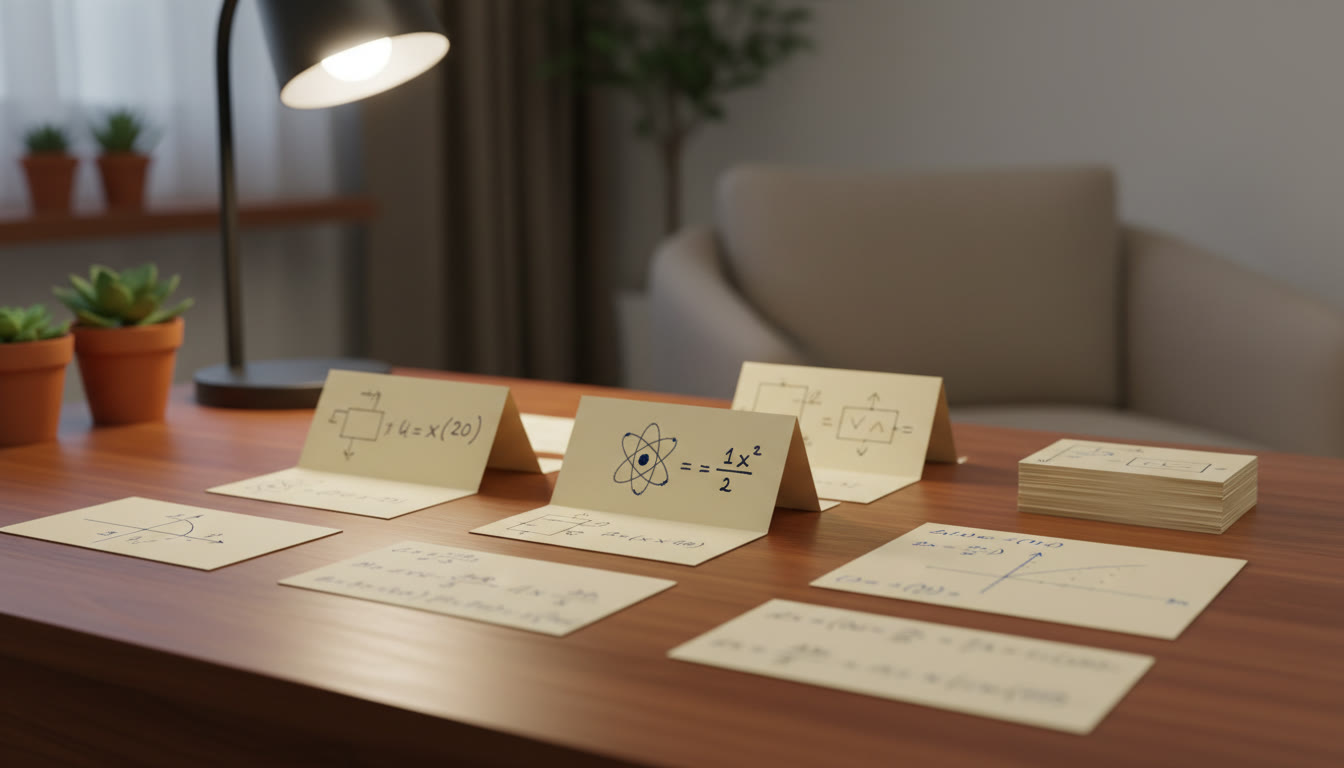
Both have pros. Handwritten notes improve memory and are fast for sketches and derivations. Digital notes are searchable and easy to version. A hybrid works well: handwritten derivations and diagrams scanned or photographed into a digital folder; formula sheets and flashcards kept digitally for quick spaced-repetition practice.
Spaced Revision and Active Recall
Notes lose value if they sit unread. Use active recall: close the book and try to reproduce the one-page summary for a chapter. Schedule revisions at increasing intervals. Pair your notes with quick 20–30 minute problem sets that target the archetypes you identified in the chapter.
Real-World Tip: Convert NCERT Examples into Two JEE Levels
Take each NCERT example and practice it at two levels:
- Level A — replicate the example exactly, while timing yourself.
- Level B — tweak one parameter or add an extra constraint so you must adapt the skeleton (this is how most JEE questions evolve from textbook examples).
Annotate the Level B variant directly into your notes as a “stretch” problem — it’s often the best predictor of exam-style thinking.
When to Use External Help While Making Notes
If you ever feel unsure whether a line in NCERT is JEE-relevant or how to compress an idea into a testable skeleton, get targeted guidance — ideally 1-on-1. For example, Sparkl‘s mentors can help you prune chapters into high-utility notes, and Sparkl‘s AI-driven insights can highlight which NCERT examples turn into typical exam items.
Common Pitfalls and How to Avoid Them
- Over-copying: If your note page reads like an extra textbook, it’s too long. Trim until only the essence remains.
- Ignoring units and signs: JEE MCQs love unit traps — always write units on formula cards.
- Not practicing mock discipline: Notes without 3-hour mock rehearsal are theory — simulate timed tests to see what notes are actually usable.
- Assuming partial marks: JEE Main is objective; design your notes to reach the answer cleanly and check it fast.
Sample Weekly Revision Plan Using NCERT Notes
| Day | Activity | Time |
|---|---|---|
| Mon | Revise 2 chapter one-pagers (Physics + Chemistry) + 30 min problems | 3 hours |
| Wed | Mathematics theorem cards + 1-hour mixed problem set | 3 hours |
| Fri | Full mock-style session (3-hour practice) using notes for 15-min warm-up only | 3 hours |
| Sun | Mock review: annotate notes, convert errors into new skeletons | 2–3 hours |
Final Checks Before an Exam-Day Mock
- Try a 5-minute scan of formula cards for high-yield chapters.
- Ensure your problem skeletons are truly one glance readable.
- Practice OMR or CBT answering discipline: deliberate marking, no stray pencil marks, and clean erasing if paper-based.
Closing Thought
NCERT is powerful because it gives clarity; your job is to turn clarity into speed. Produce short, test-minded notes that answer three questions for every idea: what is it, when do I use it, and how do I apply it under time pressure. Use active recall, simulate full-length 3-hour mocks with negative-marking discipline, and keep refining your templates after every practice session so your notes evolve with your skill level. With disciplined note-making, focused practice, and occasional targeted mentorship, you can make NCERT the backbone of efficient, exam-ready preparation.



















No Comments
Leave a comment Cancel