
What No One Tells You About Mock Tests
Mock tests are the heartbeat of serious JEE preparation — but most students treat them like contests for bragging rights: a high score, a celebratory screenshot, and then back to usual study. That’s a lovely snapshot, but it’s not the picture you want to keep. The truth is quieter, more important, and a little inconvenient: the real value of a mock test is not only the score it gives you, but the habits, insights, and decision-making it quietly builds.

The Mock Test Myth: It’s Not Just a Number
When you sit a three-hour full-length mock, the exam is doing three things at once: testing concepts, testing stamina, and testing strategy. A single score hides what you learned about your approach. Two students with identical scores can be worlds apart in the way they reached that number — one by steady, accurate attempts, the other by risky guessing with low accuracy. Which of the two are you? A mock is most useful when you peek behind that one-line score and ask: What decisions produced those marks?
Why the Invisible Skills Matter
- Decision-making under time pressure: Mocks force you to decide which questions to attempt now, mark for review, or abandon — and that judgment is what separates a reactive student from a strategic one.
- Stamina and stress management: A three-hour session is as much physical as mental. Your pace, small breaks (if allowed in practice), hydration, and ability to refocus after a hard problem all show up in your last 30 minutes.
- Error taxonomy: Not all errors are equal. Careless arithmetic mistakes cost you time and confidence; conceptual gaps cost you future marks. Tracking the type trains corrective action.
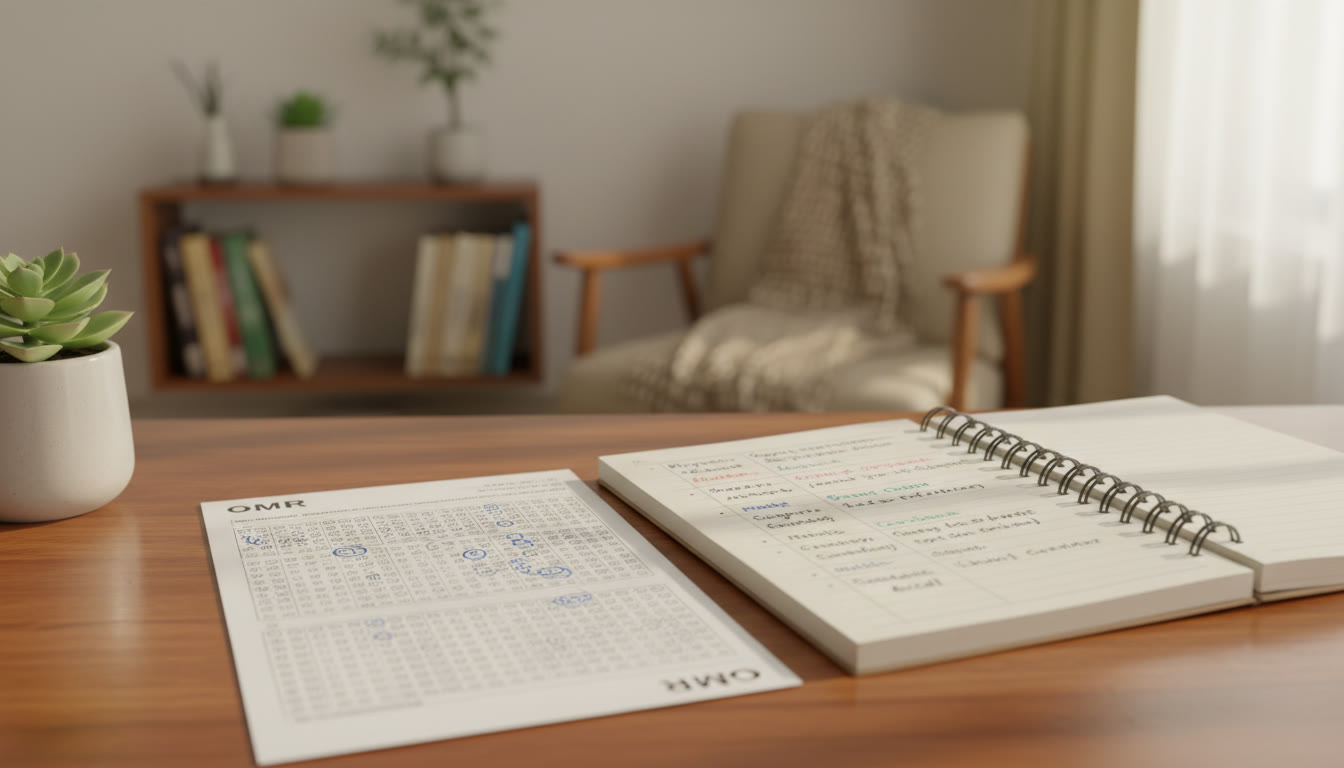
- OMR (or answer-selection) discipline: Whether you practice on paper-based OMR or a computer-based interface, the habit of systematic answer marking — double-checking bubbles, avoiding stray marks, and confirming the correct question number — prevents avoidable negative marking losses.
Designing a Mock That Teaches
Prep the Environment Like Exam Day
Don’t make the mistake of treating a mock as casual practice. If you want accurate feedback, simulate exam conditions: 3 hours, minimal interruptions, exam-room posture, and the same materials you’ll use on the actual day. If the real exam is computer-based, do most of your timed mocks on a laptop or desktop in test mode. If you’re working with paper mocks, use OMR-style answer recording and replicate the “no rough work” etiquette by using a single sheet for rough calculations, then transferring answers carefully.
Respect the Marking Rules
Most JEE-style mocks have negative marking for wrong answers on MCQs; the rule is there to discourage blind guessing. Treat the marking scheme as sacred during mocks. Practicing with the real penalty in place trains you to balance accuracy and attempts. Also, do not assume partial credit for partially solved descriptive reasoning — mock test scoring mirrors the exam mindset: either the answer meets the mark criteria or it doesn’t. Use that to train clarity and precision in your thinking.
OMR Discipline — Old Word, New Meaning
Even though many entrance tests are now computer-based, ‘OMR discipline’ stands for meticulous answer selection. Practically, that means: read the question number twice, confirm the selected option, avoid multiple markings, and maintain a calm, rhythmic pace rather than frantic jumping. These habits reduce dumb losses — the ones you remember for months because they feel so avoidable.
On the Day: A Practical 3-Hour Mock Routine
Before the Mock
- Prepare your desk, water, and stationary. Keep a watch in view.
- Do a 5–10 minute warm-up: quick mental math or a short conceptual review to prime attention.
- Set a clear goal: is this mock for time trial, accuracy building, or full simulation?
During the Mock
- Start with a calm sweep: glance at every question in a section to gauge difficulty and decide an initial attempt order.
- Use a time-allocation plan: aim for broad coverage early and deeper focus on selective questions later.
- Respect the negative-marking rule: skip questions you can’t solve in 3–4 minutes on first pass.
- Use clear markings for review questions so you can come back efficiently.
Immediately After
Resist the urge to check solutions publicly or to rant about a single question. Take a 10–15 minute break to reset, then do a calm, structured analysis. The immediate post-mock moments are when your impressions are freshest and most reliable — use them to record first reactions and emotional triggers (like a question type that throws you off), and then move to the objective scoring phase.
How to Analyze a Mock — The Work That Really Counts
Four Layers of Post-Mock Analysis
- Quantitative layer: Raw score, attempts, correct/incorrect counts, accuracy percentage, time per question distribution.
- Qualitative layer: Type of errors — careless, conceptual, misread question, calculation slip, or time-out.
- Pattern layer: Recurrent weak topics across multiple mocks — these are high-impact repair zones.
- Strategy layer: Did you pick the right attempt pattern? Were you too conservative or overly aggressive?
These layers together create an action map. For example, if your quantitative data shows poor accuracy but healthy attempts, your focus must be on precision and checking habits. If attempts are low but accuracy high, you should work on speed and triage.
Example Mock Metrics Table
| Metric | What It Reveals | Actionable Target |
|---|---|---|
| Attempts | Risk appetite and time usage | Balance attempts to maintain 70–85% accuracy |
| Accuracy (%) | Quality of attempts | Aim to improve by 5–8 percentage points every few mocks |
| Time per question (avg) | Speed and depth trade-off | Reduce by 10–20 seconds for routine questions |
| Error categories | Careless vs conceptual vs calculation | Convert recurring conceptual errors into focused revision topics |
Turning Mistakes into a Revision Roadmap
Build an Error Log — The Single Most Powerful Tool
After every mock, maintain an error log with columns: question ID, topic, error type (careless/conceptual/calculation), time spent on the question, and what you’ll do next (short revision, chapter rework, or cumulative practice). This log is not punitive; it is diagnostic. When you review it weekly, patterns emerge and you can convert ad-hoc study into targeted practice.
Micro-revisions and Macro-revisions
- Micro-revisions: Short, focused corrections — a 20-minute fix for a formula you forgot, 10 minutes practicing sign conventions, or redrawing a key diagram.
- Macro-revisions: When the error log shows clusters across a topic column, schedule a block of time to rebuild foundations: rework the textbook derivations, do curated problem sets, and then return to mini-mocks within that topic.
Sample Eight-Week Mock Training Rhythm
Here’s a compact week-by-week rhythm you can adapt. The idea is progressive overload: gradually increase frequency/intensity of mocks while keeping targeted repair cycles.
| Phase | Focus | Mock Frequency | Primary Goal |
|---|---|---|---|
| Weeks 1–2 | Baseline assessment | 1 full mock, 2 short sectional tests | Identify major gaps and habits |
| Weeks 3–4 | Repair weak topics | 1 full mock, targeted practice 3–4 times a week | Raise accuracy in weak chapters |
| Weeks 5–6 | Speed development | 2 full mocks, sectional time-trials | Improve attempts without sacrificing accuracy |
| Weeks 7–8 | Simulation & consolidation | 2–3 full mocks, timed revisions | Exam temperament and final polish |
Why this rhythm works
Early mocks pinpoint structural weaknesses, mid-phase practice repairs them, and the end-phase consolidates the decision-making muscle. The goal is not to chase a single number, but to move reliably from learning to performance under pressure.
Common Pitfalls Students Don’t Talk About
- Overtraining on one format: Practicing only sectional tests and ignoring full-length simulations ruins your endurance for the final hour.
- Analysis paralysis: Spending hours analyzing a single mock without actionable next steps — your error log must translate to a to-do list.
- Copying someone else’s attempt pattern: If a generic strategy works for another student, it may not fit your strengths. Use mocks to personalize your approach.
- Ignoring emotional responses: Anxiety, irritation, or overconfidence after a mock are data. Note them and practice simple regulation techniques — breathing, micro-breaks, or a short walk.
Where Personalized Help Makes a Difference
When you have targeted problems — repeated conceptual lapses, inconsistent scoring patterns, or difficulty translating preparation into exam-room performance — one-on-one guidance speeds repair. Sparkl’s personalized tutoring can help by mapping your mock-test analytics to a custom study plan, assigning focused practice, and offering expert tutor feedback. Tutors can point out subtle strategy shifts (for example, a refined triage order of topics during the first pass) that can produce higher net gains than additional solo study hours.
Beyond human mentoring, AI-driven insights can surface non-obvious trends from your mock history: recurring time-wasting question types, section-specific slowing patterns, or mistake clusters across similar concept families. Combining human judgment with such analytics accelerates the loop from mock to mastery.
Small, Practical Habits to Boost Mock Value
- Keep a single-line note next to each wrong question: the immediate diagnosis. Later, expand it into the error log.
- Time-box your analysis sessions — 45–60 minutes after each full mock — and follow a checklist so analysis doesn’t become procrastination.
- Practice an “exam warm-up” routine you repeat before every mock: 2 minutes of focused breathing, 3 quick formula checks, and a confident starting mantra.
- Once per week, do a mock with one experimental strategy: perhaps a faster first pass, or intentionally skipping an entire sub-section. Compare outcomes to see what fits your temperament.
Examples and Comparisons That Clarify
Imagine two students, A and B, both scoring the same net marks on a mock. Student A attempted 85 questions with 72% accuracy; Student B attempted 55 questions with 95% accuracy. Which student is in a better long-term position? The answer depends on the exam profile and the student’s consistency: A has demonstrated speed but needs accuracy work; B has precision but must expand attempt breadth. The mock’s feedback shows the path for each — targeted speed drills for B, focused checking routines for A. The mock didn’t merely give a number; it drew two roadmaps.
Final Checklist: What to Do After Every Full-Length Mock
- Record raw score, attempts, and accuracy.
- Log every mistake with a concise diagnosis.
- Schedule a 20–60 minute repair session for the top three recurring errors.
- Adjust your next week’s study plan to prioritize repair cycles and timed practice.
- Once a fortnight, review the error log trends and revise the macro plan accordingly.
Conclusion
Mock tests are mirror and microscope combined: they reflect where you stand and magnify what needs work. Treat them as experiments—set a hypothesis about your strategy, run the test under realistic conditions, analyze the outcome across multiple dimensions, and iterate. That disciplined loop—simulate, analyze, repair, and repeat—is the real engine of progress in JEE preparation.



















No Comments
Leave a comment Cancel