

How to Practice PYQs Chapter‑Wise for JEE Main
There’s something quietly magical about a well‑solved previous‑year question (PYQ). It’s not just the correct answer that teaches you — it’s the question’s shape, the trap it sets, and the shorthand route that experienced problem‑solvers take. If you want focused, exam‑ready mastery, chapter‑wise PYQ practice is the bridge between passive reading and confident performance.
This guide gives you a friendly, realistic roadmap: how to collect and sort PYQs by chapter, how to schedule practice and reviews, how to analyse mistakes, and how to merge chapter practice into full‑length timed mocks. Advice is framed for the current JEE Main exam context — MCQ format, three‑hour full‑length testing, negative marking for incorrect MCQs, strict answer discipline, and the core subjects of Physics, Chemistry and Mathematics — and avoids assumptions about partial credit for descriptive work. Read it like a study partner who’s worked with students across different paces and goals.

Why chapter‑wise PYQ practice matters more than random solving
Random practice is useful for stamina; chapter‑wise PYQs build deep synapses. When you practice by chapter you:
- Isolate conceptual weak spots (so you don’t keep relearning the same mistake).
- See patterns in how questions are framed from that topic (frequent twists, standard traps, typical numerical ranges).
- Train the precise procedural habits a chapter needs — e.g., signs in electrostatics, boundary conditions in mechanics, functional behavior in calculus.
- Convert textbook theory into exam‑ready problem templates you can recall under time pressure.
Quick exam context checklist (what your practice must reflect)
- Format: MCQ‑based testing with a fixed time window for each full test — practice both sectional drills and 3‑hour full tests.
- Timing: Full‑length mocks are typically three hours — discipline yourself to simulate that repeatedly.
- Negative marking: Incorrect MCQs cost you; learn smart elimination and confident guessing rules.
- Answer discipline: In a computer‑based interface you must be decisive; practice marking, reviewing and changing answers in a timed way.
- Syllabus alignment: Focus on Physics, Chemistry and Mathematics chapters as defined by your current cycle and align practice to the official syllabus headings.
- No partial credit: JEE Main does not reward step‑by‑step descriptions — accuracy and correct final answers matter.
Step 1 — Collate PYQs chapter‑wise (how to gather efficiently)
Before you practice, build a chapter map. Create folders or notebooks for each chapter and paste or list every PYQ that maps to that chapter. Don’t spend weeks hunting — a practical approach works best:
- Start with the most recent years first; they show the current style and emphasis.
- For each chapter, tag questions by difficulty (easy / medium / hard) and by the concept they test.
- If a question spans two chapters, place it in both folders and mark the dominant concept.
- Keep a log (digital or paper) so you can filter: ‘All numerical questions from Thermodynamics’ or ‘All multiple‑concept coordinate geometry problems’.
Step 2 — First‑pass: timed, honest attempts
The first time you attempt a chapter’s PYQs, simulate focused practice — timed and interruption‑free. The goal of the first pass is quick diagnosis, not perfection.
- Set a realistic clock for the batch — for example, 30–45 minutes for 6–8 short or medium MCQs depending on complexity.
- Attempt without looking up theory. If you get stuck for more than 3–4 minutes on a question, mark it and move on; you will revisit it in review.
- Note whether the difficulty is conceptual, calculation‑heavy, or trick‑based — this classification drives your follow‑up.
Step 3 — Analyse with the error‑log method
An error log is the single‑most effective tool for turning mistakes into durable learning. After every session, record each wrong or uncertain question in a short table.
| Question ID | Chapter | Mistake Type | Root Cause | Fix Action | Next Review |
|---|---|---|---|---|---|
| P‑K1 | Kinematics | Sign error in velocity | Weak on vector direction convention | Redo 3 concept examples + flashcard | 7 days |
| C‑O3 | Organic: Reaction mechanisms | Forgot resonance stabilization | Weak recall of resonance patterns | Create 1‑page mechanistic cheat sheet | 4 days |
Track patterns: if several mistakes point to the same root cause, that single gap deserves concentrated theory work and more PYQ drills from that chapter.
Step 4 — Targeted rework: theory to template
Now translate the error log into targeted study. For every recurring mistake, ask: is this a gap in concept, a method error, or a calculation slip? Match the fix:
- Concept gap → short conceptual revision + solved‑example walkthroughs.
- Method error → rewrite your stepwise template for that chapter (e.g., always start with free‑body diagrams in mechanics).
- Calculation slip → incorporate deliberate speed drills with mental arithmetic, units checks, and approximations.
Sample chapter‑wise practice plan (practical targets)
Use this as a template — adapt the numbers to your starting level and time availability.
| Chapter | Initial PYQ batch | Session length | Primary focus | Follow‑up |
|---|---|---|---|---|
| Mechanics (Physics) | 10–15 mixed PYQs | 60–90 minutes | Identify standard setups, sign conventions | 3 targeted reattempts + error log |
| Organic Chemistry | 8–12 PYQs by reaction type | 45–60 minutes | Mechanism templates, key reagents | Create reaction‑map flashcards |
| Calculus (Mathematics) | 12–16 PYQs: limits, derivatives, integrals | 60 minutes | Standard tricks, typical substitutions | Timed mixed set after 2 revisions |
How to choose the initial PYQ batch
Don’t try to do everything at once. A practical selection strategy:
- Pick representative problems across difficulty and style (numerical, reason‑the‑statement, assertion–reason formats if they appear in your cycle).
- Ensure at least one borderline (tricky) PYQ per session — these build flexible thinking.
- Reserve a few problems for reattempts after a day and then after a week (spaced repetition).
Integrating chapter practice into full‑length mocks
Chapter blocks should not live in isolation. Every week, translate chapter gains into full tests:
- Schedule at least one 3‑hour full‑length mock to simulate endurance and answer‑selection discipline.
- Practice “sectional time targets” inside the mock (for example, if a combined test allows switching, set mini‑goals: 60 minutes for the first 30 questions, etc.).
- After the mock, use your chapter error log to assign which chapter needs immediate rework — don’t simply record overall score and move on.
Timed tactics and negative‑marking math
Smart guessing is a skill. Here’s a practical rule of thumb you can use while practising (adjust based on exact marking patterns in your cycle):
- If you can confidently eliminate two options out of four, guessing among the remaining two is often statistically favourable.
- If you’re down to a single remaining plausible option after elimination, go for it only if you’re within your time budget and confidence threshold.
- When in doubt and behind schedule, skip and bank time for easier questions later — efficient accuracy beats reckless attempts.
Subject‑wise micro strategies (examples that stick)
Physics
- Mechanics: build one go‑to diagram template per type of problem (e.g., inclined plane with friction, pulley systems, center of mass setups).
- Electrostatics/Electrodynamics: memorize sign conventions and typical boundary cases; many PYQs are testing a single subtle assumption.
- Practice: attempt PYQs first for conceptual clarity, then attempt a timed batch to practise the arithmetic workload under pressure.
Chemistry
- Organic: categorize PYQs by reaction mechanism rather than by name — mechanism templates are faster in exam conditions.
- Inorganic: use quick memory checks (periodicity tables, oxidation states) and tie PYQs back to these short facts.
- Physical: derivations and equations are tools; practice applying them numerically with quick unit checks.
Mathematics
- Algebra & Series: maintain a toolbox of standard transformations and substitution templates and practice spotting them in PYQs.
- Coordinate Geometry: practice building the figure; often a well‑sketched diagram halves the work.
- Calculus: many PYQs test limits and continuity tricks — practicing a small bank of these canonical limits pays dividends.
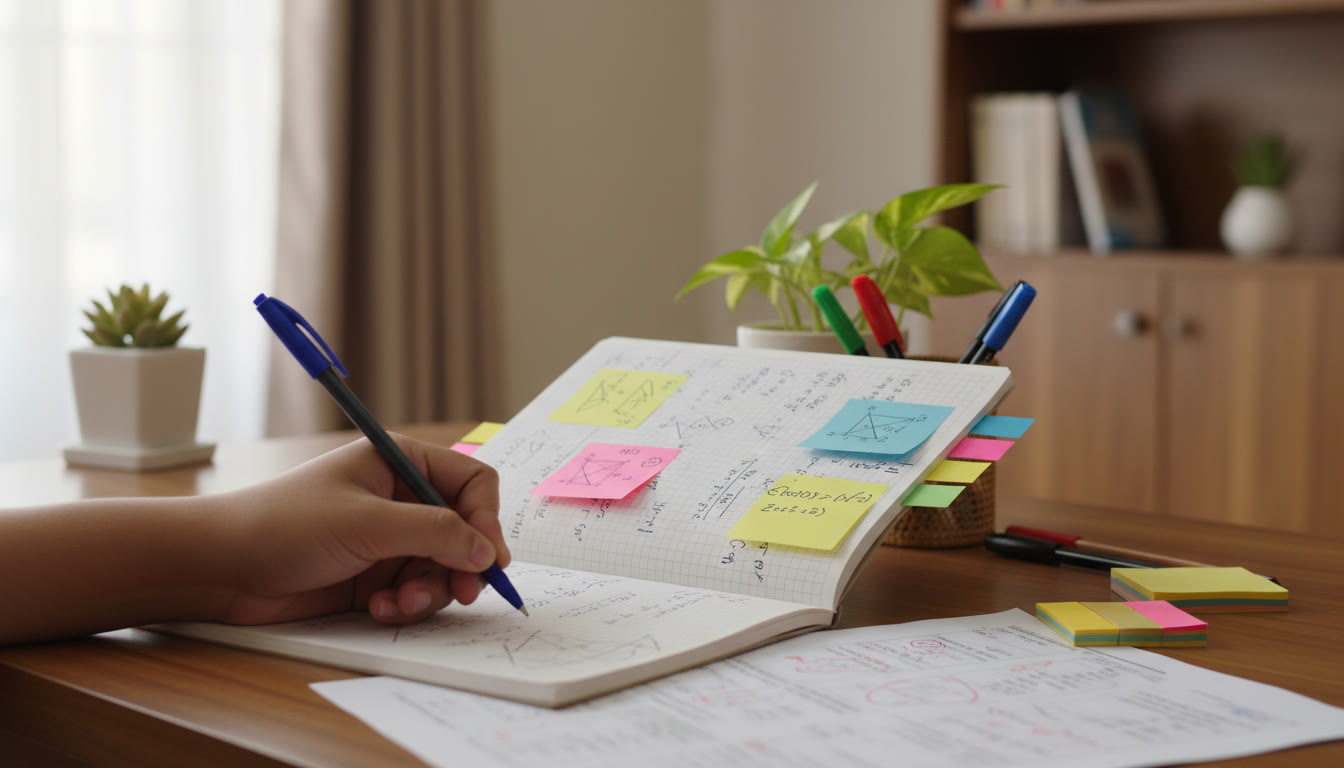
Weekly rhythm: a model schedule
Adapt this depending on your available time. The important point is predictability: consistent short cycles beat sporadic marathons.
- Day 1: Chapter A – First pass PYQs (timed), error log.
- Day 2: Targeted revision for errors from Chapter A + 2 quick mixed PYQs.
- Day 3: Chapter B – First pass PYQs (timed), error log.
- Day 4: Targeted revision for Chapter B errors + revisit one tougher question from Chapter A.
- Day 5: Mixed mini‑test (30–45 minutes) combining Chapters A & B.
- Day 6: Full deep revision session — reattempt logged errors and update review dates.
- Day 7: Rest or light conceptual review (mental consolidation day).
How to measure progress without getting lost in scores
Scores are signals, not the destination. Track the following metrics instead of raw percentage:
- Error type reduction: Are repeat mistakes in the same concept decreasing?
- Time per question: Has your average time for medium‑level PYQs dropped while accuracy holds?
- Retention: Are you recalling fixes from your error log during later practice sessions?
When personalized support helps — a short note on tutoring fit
If you find structural gaps — unclear templates for a chapter, recurring conceptual errors despite repeated practice, or confusion in turning theory into exam technique — targeted 1‑on‑1 guidance can accelerate the loop. Sparkl‘s personalized approach often combines tailored study plans, expert tutors, and AI‑driven insights to diagnose where repeated mistakes originate and to frame an efficient, chapterwise remediation strategy. When you’re repeating the same error despite hard work, a focused tutor can help you rewrite the learning pathway so practice becomes productive instead of repetitive.
Common pitfalls and quick fixes
- Pitfall: Doing many PYQs without analysing mistakes. Fix: Spend at least as much time on the error log as you do on solving.
- Pitfall: Practising only the recent easy questions. Fix: Mix in one or two older or challenging PYQs each session to build adaptability.
- Pitfall: Ignoring small arithmetic or sign mistakes. Fix: Build a 3‑point quick‑check routine (units, sign, limiting value) after each numerical answer.
- Pitfall: Letting confidence cause complacency. Fix: Retest weak chapters after a week and after three weeks to ensure retention.
How to scale chapter practice as exam day approaches
Shift from ‘learning’ to ‘execution’ as you near the exam window:
- Increase mock frequency to weekly full‑length timed tests, with one recovery day for analysis.
- Convert chapter drills into short timed checkpoints — 20 minute bursts to evaluate quick recall.
- Stop adding new chapters at least a few weeks before the exam; focus on consolidation, mastery and error reduction.
Final checklist before a timed mock
- Set up your test space: distraction‑free, timer visible, scratch paper ready.
- Warm up with 15 minutes of quick conceptual flashcards for the chapter mix you plan to test.
- During the mock, flag uncertainties and move on — come back only if time allows.
- After the mock, update your error log immediately; energy fades if you wait.
Concluding thought
Chapter‑wise PYQ practice converts scattered knowledge into repeatable exam skills: gather representative questions, attempt them honestly and timed, log and categorise mistakes, and iterate with targeted fixes until the same problem no longer trips you up. That cycle — attempt, analyse, correct, repeat — is the engine that makes PYQs a reliable roadmap from understanding to performance.




















No Comments
Leave a comment Cancel