
How to Convert Mock Test Scores into Real Exam Scores: A Practical Playbook
Mock tests are not a verdict — they are a mirror. If you know how to read that mirror, you can change what you see. This guide walks you through practical, evidence-based steps to convert the marks you get in full-length, 3-hour MCQ mocks into a reliable score on the actual JEE exam. We’ll focus on what mocks measure, how to diagnose the exact reasons for a gap, and concrete daily and weekly actions that close it. Expect specific tactics for dealing with negative marking, OMR discipline, time allocation, and subject-wise priority in Physics, Chemistry and Mathematics.

Why a Mock Score Is a Starting Point — Not the Finish Line
A mock score bundles several signals: your conceptual understanding, your endurance, your exam temperament, and the mock’s difficulty level. Two students with identical mock marks may perform very differently in the real exam because one made silly mistakes while the other struggled with time. The key skill is to unpack the score into actionable insights — not to chase the number alone.
Read Your Mock Like a Scientist
- Separate raw marks from reliability: how consistent are your scores across mocks? One isolated high or low is noise; a trend of five tests is signal.
- Track types of errors: conceptual, procedural (forgot a step), silly arithmetic, time-based, or OMR/marking mistakes.
- Measure pace: how many minutes does a set of 5 questions take in each subject under exam conditions?
- Consider mock variation: difficulty, sectional balance, and how strictly OMR rules were enforced during the test.
Four Buckets for Every Mistake (and How to Treat Them)
When you mark your test, categorize every incorrect or skipped question into one of four buckets. This taxonomy turns guessing into planning.
- Conceptual Gaps: You don’t know the underlying idea or theorem. Fix: focused concept revision + 5 curated problems per concept.
- Technique/Procedure Errors: You have the idea but missed a step or method (e.g., sign error in integration, wrong substitution). Fix: redo solved problems with step-by-step commentary and timed replays.
- Silly/Accuracy Errors: Arithmetic slips, misreading units, arithmetic sign mistakes, or wrong option bubble. Fix: slow down during checking, use answer-elimination sanity checks, and create a ‘last-minute 90-second checklist’.
- Strategy/Time Errors: Poor question selection, bad sectional time balance, or poor OMR discipline. Fix: restructuring the attempt plan and practicing mock segmentation (first pass/second pass).
Turning Diagnosis into a Targeted Plan
Every mock should yield a micro-plan: a short list of 6–12 things to do before the next mock — not a vague “study more” note. Treat the mock review like a clinical prescription: one or two conceptual fixes, two technique drills, three timed practice fragments, and a mock-retake habit.
| Mock Score (Percentile of Your Own Maximum) | Likely Real-Exam Adjustment | Primary Focus | Actions (next 7–14 days) |
|---|---|---|---|
| Below 60% | Variable; often rises with structured study | Foundations, time management | Concept checklists, 2 topic ladders, short timed drills, reduce syllabus gaps |
| 60%–75% | Improvement likely with accuracy work | Accuracy & selective revision | Error logs, 10 accuracy drills, OMR practice, simulated 3-hour run |
| 75%–90% | Smaller gains but higher consistency | Polish, timed strategy, high-value topics | High-yield problem sets, mixed timed tests, review of previous mistakes |
| 90%+ | Focus on reliability under stress | Eliminate rare slips, stamina | Full exam simulations with strict OMR protocol, mindfulness & recovery |
Example: Converting a 68% Mock into a Stronger Real Score
Suppose you scored consistently in the high 60s. Common patterns: a small set of recurring concept errors in one subject, coupled with 6–8 silly mistakes per test and slightly rushed last 30 minutes. Your plan should be surgical: two weeks of targeted concept repair in the weak topic, daily 20-minute accuracy drills, and one strict 3-hour simulation each weekend focusing on disciplined OMR filling and question selection. That combination often converts margin errors into solid gains.
Weekly Practice Blueprint: Make Every Day Count
A weekly rhythm creates momentum. The simplest effective structure balances focused learning, active practice, and recovery.
- Monday: Focus session (one weak chapter, concept + 10 problems)
- Tuesday: Timed sectional drill (45–60 minutes on one subject)
- Wednesday: Mixed accuracy practice (30 minutes of error correction drills)
- Thursday: Technique workshop (derivations, shortcuts, formula checks)
- Friday: Rapid revision (flashcards, quick concept tests)
- Saturday: Full-length mock under exam conditions (3-hour run) + OMR discipline
- Sunday: Deep review — categorize errors, write the micro-plan for next week
| Day | Time | Activity | Goal |
|---|---|---|---|
| Saturday | 3 hours | Simulated full mock (strict OMR) | Build stamina and exam rhythm |
| Sunday | 60–90 mins | Analysis & micro-plan | Convert errors to actions |
OMR Discipline and Negative Marking: The Small Rules That Save Marks
In MCQ exams with negative marking, a careless bubble or a rushed answer can cost you more than a full hour of study. OMR discipline is not glamorous, but it’s test-critical.
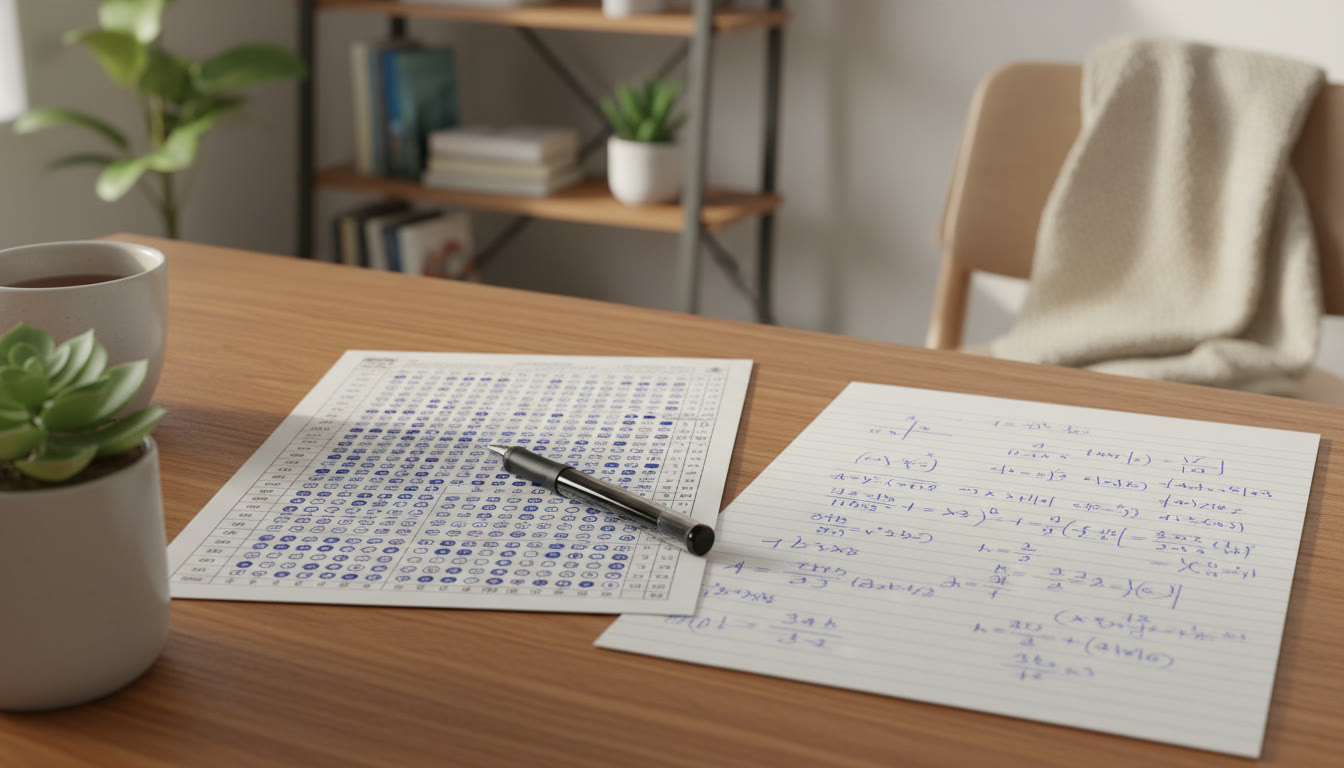
- Always fill the OMR with a black ballpoint (practice with the same pen). Make sure the bubble is fully shaded and stay within the bubble boundary.
- When changing an answer, erase neatly if allowed and re-fill carefully; do this in practice so it becomes automatic.
- Use a two-pass strategy on the paper: first pass — solve clear-cut high-confidence problems; second pass — attempt medium-difficulty; third pass — risk-evaluation for remaining questions.
- When in doubt, use elimination to increase confidence before risking a negative mark; develop a quick ‘three-elimination’ habit for tough MCQs.
Accuracy First: How to Stop Losing Marks to Simple Mistakes
Silly mistakes are the enemy of score conversion because they are fixable without new learning. Build micro-habits that make accuracy automatic:
- After every solved question, do a 15-second sanity check: unit check, dimensional analysis, sign sanity, and a quick plug-in where possible.
- For multi-step problems, mark intermediate results clearly on your rough sheet to avoid copying the wrong value into the final computation.
- Maintain an error log with exact cause (e.g., arithmetic, misread, conceptual). Review only logged mistakes on alternate days.
Time Allocation in a 3-Hour Mock: A Practical Split
Rigidly dividing time by 60 minutes per subject is tempting, but a flexible plan based on strengths yields better results. Consider an initial allocation and adapt based on practice trends.
- Initial pass (first 75–90 minutes): pick high-confidence 40–50% of total questions across all subjects.
- Second pass (next 60 minutes): tackle medium-difficulty problems where you have a method but need more time.
- Final pass (last 30–45 minutes): risk-managed attempts and careful OMR filling.
Decision Rules for Question Selection
Turn hesitation into rules. Example quick-decision heuristics you can practice until they become instinctive:
- If the method is unclear after 60 seconds, mark for review and move on.
- If a question involves long algebraic manipulation and a short trick exists, only attempt after confirming the trick on paper (30–60 seconds).
- Reserve 20–30 minutes at the end strictly for verification and OMR corrections.
Use Analytics, Not Just Repetition
Repeated mocks without reflection produce stagnant improvement. What drives conversion is targeted intervention guided by data: pattern of mistakes, chapter-wise accuracy, time per question, and whether accuracy improves under fatigue.
Technology and personalized coaching can accelerate this loop. For example, Sparkl‘s personalized tutoring ties diagnostic data to focused practice plans — one-on-one guidance to isolate micro-patterns, tailored study plans, expert tutors for conceptual fixes, and AI-driven insights that flag fragile topics before the next mock. Use analytics to decide which three topics you will repair this week and exactly which problems you will solve to verify repair.
Active Revision Techniques That Stick
Converting mock performance depends heavily on how you revise. Passive reading is a time trap; active recall and spaced repetition are your allies.
- Use flashcards for quick-check formulas and short reaction problems; review them in 10–15 minute bursts multiple times per week.
- Teach-back: explain a solved problem out loud as if teaching someone else. That exposes shaky steps quickly.
- Do closed-book problem solving at least twice per weak topic: once immediately after study, once after 48–72 hours.
Stamina, Rest, and Exam Temperament
Mocks are a test of knowledge and endurance. If scores drop in the last 30–45 minutes, the issue is often fatigue or poor time pacing, not raw ability. Strategies:
- Simulate exam day conditions on at least two weekends per month: actual timing, same nutrition, and uninterrupted 3-hour focus window.
- Build a short pre-exam ritual: warm-up problems, breathing exercises, and a 60-second mental checklist to avoid panic decisions.
- Sleep and micro-recovery matter: a consistent sleep schedule across mock weeks beats cramming for marginal gains.
Sample Short-Term Repair Plan (14 Days)
Here’s an example plan for a student who wants measurable gains between two mocks 14 days apart. It balances concept work, accuracy drills, strategy practice, and recovery.
- Days 1–2: Deep concept repair (pick 2 weak topics) with 8–12 targeted problems each.
- Days 3–5: Accuracy block (daily 30-minute error-focused sets) and 45-minute timed sectional practice.
- Day 6: Light mixed practice + active recall revision of corrected mistakes.
- Day 7: Simulated full mock (3-hour) under strict rules.
- Days 8–11: Rework recurring mistakes, practice alternate solution methods, and take shorter timed tests (60–90 minutes).
- Day 12: Full mock with a focus on OMR discipline and time-split execution.
- Days 13–14: Recovery, light review of flashcards, and focused one-topic drills only.
Checklist: Before You Sit Any Mock
- Set the environment: quiet, timed, and identical to exam conditions as far as possible.
- Use the same stationery you will use on exam day (pen type for OMR practice).
- Decide your two-pass or three-pass solving protocol and stick to it during the test.
- Have a simple, written emergency plan: if you run out of time, what sections will you prioritize?
When and How to Use Personal Coaching or Tutoring
Not every weak spot needs tutoring. But when you notice persistent, recurrent mistakes that you cannot fix by solo drills — especially conceptual traps or recurring exam-strategy flaws — focused one-on-one help can accelerate conversion. Sparkl‘s small-group and one-on-one models (with tailored study plans and AI-backed progress reports) can help convert patterns into plans quickly by giving you an action-oriented roadmap and accountability for correction.
Putting It All Together: Convert Scores Through a Feedback Loop
The conversion from mock marks to reliable real-exam performance is iterative: test → diagnose → act → test again. Each cycle should reduce the number of mistakes that are ‘fixable without learning new content’ (like silly slips, time errors, and OMR mistakes). Over 6–10 disciplined cycles you will notice the variance of your mock scores shrink and the mean score rise. That tightening of variance is often the clearest sign that practice is turning into performance.
Final Academic Conclusion
Mock tests become reliable predictors of real JEE performance when you treat them as controlled experiments: diagnose precisely, correct surgically, and rehearse exam conditions until decision-making and accuracy are automatic.



















No Comments
Leave a comment Cancel