
How to Improve Score Using JEE Main Mock Tests
Mock tests are not just practice papers — they are the closest simulation you get to the real JEE Main battlefield. When used well, a mock test shows exactly where your preparation is solid, where it’s fragile, and how your exam temperament behaves under pressure. This post walks you through a practical, student-friendly roadmap to turn every full-length mock (the standard 3-hour simulation) into measurable score improvement.

Why mock tests matter more than extra hours of study
It’s tempting to believe that more hours with books automatically means a higher score. The reality is sharper: the quality of hours and the feedback loop you build matter far more. Mock tests compress study, revision, strategy and stress into a reproducible event — and that is powerful because it lets you learn fast.
What a mock test reveals
- Speed vs accuracy trade-offs under time pressure.
- Recurring conceptual gaps across Physics, Chemistry, and Mathematics.
- Question-selection instincts: which questions you prioritize and why.
- Your error taxonomy — careless slips, calculation mistakes, conceptual gaps, or time-induced panic.
When you treat a mock as an experiment and not merely a score, every attempt becomes a data-rich lesson.
Designing a mock-test routine that actually improves scores
Frequency and spacing
Pick a rhythm that fits your stage of preparation. Early on, weekly full-length mocks help you build stamina and discover major topic weaknesses. As the exam cycle approaches, increase the realism: simulate test-day routines, reduce interruptions, and maintain at most two full-length mocks per week to avoid burnout. Quality beats quantity — a poorly reviewed mock is wasted effort.
Make every mock a 3-hour full-length rehearsal
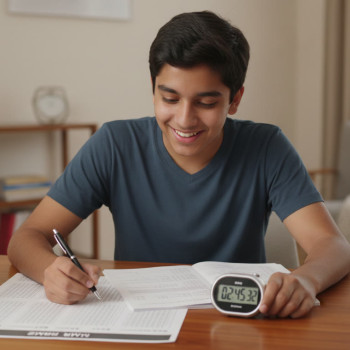
JEE Main-style practice demands a full 3-hour run to build concentration. Even if your mock has fewer or more questions, keep the timing and pace consistent. Practicing in shorter bursts trains short-term focus but fails to develop the long concentration muscles needed for the complete paper.
Realistic environment and OMR discipline
Although many official tests are computer-based, practicing strict OMR-style discipline — careful marking, one answer per question, consistent notation — helps you in two ways: it builds procedural calm for any mode (paper-based or computer-based) and reduces careless mistakes caused by hurried answer entry. If you use simulated paper-and-bubble sheets for some mocks, practice filling bubbles and tracking time on a watch.
Before the test: a short checklist that pays dividends
- Set the exact 3-hour timer and eliminate notifications (phone face down, do not disturb).
- Keep a dedicated scrap notebook and a ruler or calculator substitute (for rough sketches and calculations where allowed).
- Decide on your first-pass strategy (subject order, easy-first, or strength-first) and stick to it.
- Prepare a small set of pre-test rituals: 5 deep breaths, a short positive cue, and a mental checklist of must-do steps (read question fully, underline data, pick next question).
During the test: concrete tactics that save marks
Adopt a two-pass or three-pass approach
A structured pass strategy prevents you from getting trapped on difficult questions early on. A suggested split for a 180-minute mock is below — use the table to guide how you distribute energy rather than rigidly timing each minute.
| Phase | Minutes | What to focus on |
|---|---|---|
| First sweep (quick attempts) | 60 | Attempt all easy and certain questions across sections; secure quick marks. |
| Second sweep (tackle medium/hard) | 80 | Work on problems that need concentration and written work; allocate selectively by strength. |
| Third sweep (target and review) | 30 | Attempt remaining feasible questions and revisit marked ones. |
| Final check (answer entry & calm) | 10 | Verify bubbles/entries, fix any obvious slips, and breathe. |
Negative marking: disciplined elimination, not blind guessing
Negative marking punishes random guessing. Your best friend is elimination: if you can remove one or more options confidently, the expected value of an attempt rises. If you cannot eliminate any options and you are unsure, it’s often better to skip. Turn guessing into a calculated risk by practicing elimination techniques in practice sessions.
Answer entry and OMR-type discipline
- Decide where and how you’ll mark an attempt: mark and move, or mark and come back — consistency matters.
- If using a simulated OMR sheet, use a pencil with the right hardness (if allowed) and darken bubbles fully on practice sheets; practice correction methods.
- Keep a small margin in your scrap notebook to note question numbers you plan to revisit; don’t rely solely on memory.
After the test: the analysis routine that converts attempts into points
Immediate audit within 24 hours
Your first review should be quick and surgical — ideally within the first 24 hours. Re-look at every wrong answer and every question you marked. For each item, write one line that captures the real reason for the error: conceptual gap, careless sign error, misreading, time pressure, or calculation slip. That single-line discipline will make trends visible fast.
Build a mistake log and tag errors
Consolidate mistakes into a categorized log. Each entry should have four fields: question number, error type (conceptual / careless / calculation / interpretation), remedy (short), and action (practice question set / concept revision / formula sheet update).
- Conceptual — note the specific concept and a short plan to re-study it.
- Careless — identify trigger and create a ritual to avoid it (e.g., always re-read numerical values twice).
- Calculation — perform targeted numeric drill and time-bound arithmetic practice.
Trend tracking: the long game
One mock is noise; ten mocks reveal trends. Track your accuracy by topic (e.g., integration, electrostatics, organic reactions) and watch for consistent dips. Use the trends to redesign your weekly study plan: move one hour per week from a strong topic to a weak one, or convert a vague weakness into a micro-project (solve 30 targeted problems, then test again).

Data you should record after every mock
Collect simple metrics after each test. You don’t need fancy dashboards — a spreadsheet with the following columns will do wonders:
- Raw score and percentile (if available)
- Accuracy percentage (attempts vs correct)
- Time spent per section
- Top 3 recurring error types
- Topic-wise correctness
With this data, you can set realistic micro-goals for the next mock (for example: increase accuracy in medium-difficulty math problems by 10% over three mocks).
How to turn mistakes into focused practice
Micro-projects: targeted work that beats broad re-reading
Create micro-projects that address themes uncovered by mocks. If you keep getting trig identities wrong, a three-day micro-project might be: (1) rewrite and memorize the minimal identity list, (2) solve 20 short problems targeting identity simplification, (3) do a timed 30-minute mock focusing only on trig-based questions. Short, focused cycles produce faster gains than vague revision.
Use comparative practice: easier → medium → hard
After identifying a weak topic, sequence practice from simpler questions to complex blends. This scaffolding builds confidence and reduces panic during the test when a blended question appears.
Time management and pacing — an exam-day mindset
Good time management is predictable: it follows rules you practiced many times. A few practical rules:
- Never spend more than the planned time on a single question in your first sweep.
- Resist reworking a calculation more than twice during a single attempt; mark and move, then return in the review phase with fresh eyes.
- Keep pockets of time: aim to have at least 15–20 minutes at the end for a calm final sweep.
Practical per-question pacing
Instead of a fixed seconds-per-question rule, think in buckets: quick (solvable in under 2 minutes), medium (5–12 minutes), and hard (12+ minutes). Your first sweep should be quick-bucket heavy, the second should unfold medium-bucket work, and the third is for calculated risks on the hard bucket.
Psychology: building calm so you don’t lose marks to nerves
Exam temperament is trainable. Practice breathing techniques that take less than 60 seconds, and rehearse a recovery routine for moments of panic: stop, breathe, do a quick body-scan, and return to the easiest remaining question. Small rituals anchor you to composure under time stress.
When to bring in personalized help
Some plateaus respond best to personal attention. Personalized tutoring accelerates the loop between mock, analysis, and improvement by offering tailored drills, one-on-one guidance for stubborn topics, and actionable study plans. If you choose to pair mocks with tutoring, look for experts who do three things well: diagnose precisely, assign targeted practice, and help you internalize better exam habits.
If you combine mock-test cycles with Sparkl‘s one-on-one guidance, you can get tailored study plans and AI-driven insights that convert repeated mistakes into focused improvement steps. Many students find that the focused accountability and expert feedback shorten the distance between raw practice and consistent scores.
Practical weekly plan: a sample schedule
This sample balance keeps mocks meaningful while preserving study time. Adjust the intensity depending on where you are in your preparation journey.
- Monday–Wednesday: Conceptual study + problem sets (topic-specific).
- Thursday: Targeted revision and speed drills for weak topics identified in previous mocks.
- Friday: Light revision and relaxation techniques to prime focus.
- Saturday: Full-length 3-hour mock under realistic conditions.
- Sunday: Immediate audit (first 24-hour review) and targeted micro-practice based on the mistake log.
Common traps and how to avoid them
- Trap: Running too many mocks without review. Fix: Cap mocks and force a structured review for each one.
- Trap: Chasing raw scores rather than accuracy and trend. Fix: Track error types and topic gains over time.
- Trap: Ignoring exam-mode discipline (bubbling, answer entry) in practice. Fix: Rehearse final 10 minutes of each mock as if you’re on test day.
Final checklist before your next mock
- Set the 3-hour timer and clear interruptions.
- Decide your pass strategy and write it down on the top of your scratchpage.
- Bring a one-line goal for the mock (e.g., reduce careless errors by 50%).
- After the test, log metrics, tag errors, and create one micro-project for the week.
Conclusion
Mock tests are a practice ecosystem: the test itself, the immediate audit, the mistake log, and the micro-practice cycles form a feedback loop that consistently raises scores when executed deliberately. Treat every mock as an experiment, track simple metrics, and focus your energy on converting the most damaging mistakes into targeted practice. Over time, this disciplined cycle builds speed, accuracy, and the calm temperament that the JEE Main-style exam rewards.















No Comments
Leave a comment Cancel