
Why PYQs matter — and how to read them like a map
Previous-year questions (PYQs) are not trophies to collect; they are the clearest signal of what exam setters expect. When you sit down to scan a stack of PYQs, don’t just count correct answers — read the choices, spot recurring concepts, and chart the question formats that appear most often. The JEE Main environment is competitive and precision-driven: it’s an MCQ-heavy, time-bound examination that rewards accuracy, speed, and strategy. Familiarity with PYQs tunes your intuition about what’s high-yield and what’s a time sink.

Keep three facts in mind as you use PYQs to shape preparation: the official test is a fixed-duration session (practice with full 3‑hour mocks), incorrect choices attract penalties (so guessing must be tactical), and the scoring awards marks per question rather than for partial steps — treat derivations and diagrams as learning tools, not a path to partial credit in the exam.
How to mine PYQs efficiently
Tagging and frequency analysis
Open a spreadsheet or a notebook and tag each PYQ by subject, chapter, concept, and difficulty. After 30–50 questions you’ll see patterns: some concepts repeat; others vanish. Prioritize topics that show up repeatedly and carry concept depth — these are your high‑yield targets.
Quality over quantity
Don’t aim to solve every PYQ in the world. Instead, solve representative questions thoroughly: annotate why distractors are wrong, note the typical trap, and mark alternative solution paths. That marginal 10–15 minutes of analysis per question converts practice into durable understanding.
High-weightage topics at a glance
The following compact table summarizes recurring PYQ themes and what to focus on when you study. Use it as a triage tool: allocate more time to topics marked as ‘Core’ in early cycles of revision.
| Subject | High‑weight Topics (PYQ trends) | Why they recur | Study focus |
|---|---|---|---|
| Physics | Mechanics (kinematics, dynamics, energy), Electricity & Magnetism, Optics, Thermodynamics, Modern Physics | Core principles + calculational structure lend themselves to concise MCQs | Master concepts, dimensional checks, common approximations, and standard problem methods |
| Mathematics | Calculus (limits, derivatives, integrals, application), Coordinate Geometry, Algebra (quadratics, sequences & series), Vectors & 3D | Many questions test procedural skill plus pattern recognition | Memorize standard results, practice manipulations, and sharpen speed |
| Chemistry | Physical Chemistry (stoichiometry, equilibrium, thermodynamics, electrochemistry), Organic reaction patterns, Inorganic periodic trends and bonding | Conceptual clarity plus numerical practice make these dependable topics | Combine concept notes with problem drills and quick recall sheets |
Physics: build conceptual scaffolding, then speed
Core chapters to prioritise
- Mechanics: vectors, Newton’s laws, energy and momentum — these are the backbone for many PYQs.
- Electricity & Magnetism: circuit analysis, electrostatics, fields, and simple magnetic systems.
- Optics and Waves: ray optics, interference, diffraction — neat conceptual questions and quick calculations.
- Thermodynamics and Modern Physics: basics of thermal concepts, photoelectric effect, atomic models and nuclear basics.
How PYQs change the way you practice
Physics PYQs are often compact — a one‑line premise, one calculation, and distractors created from common mistakes. So: practice the clean mechanics of solving (write down what’s conserved, sketch the situation, identify approximations). When you see vector geometry or clever energy arguments in PYQs, zoom out: the setters often prefer elegant short solutions over brute force. For example, a problem about a block on an incline might collapse into an energy argument rather than multiple force equations — spot those shortcuts during practice.
Mathematics: pattern recognition beats panic
Top topics and tactical goals
- Calculus: focus on limit tricks, derivative shortcuts, and standard integrals. Practice area and optimization problems carefully — they appear in many PYQs.
- Coordinate Geometry: mastering conics, straight lines, and circles is high-return; practice analytic methods and geometric intuition.
- Algebra: quadratic equations, sequences and series, and basic complex numbers keep returning in varied formats.
- Vectors & 3D: be confident with dot/cross products and equations of lines and planes — these are quick score‑winners when you know the formulas.
Speed and accuracy techniques
Mathematics demands both procedural fluency and exam-sense. Build a toolbox of ready maneuvers: factorization patterns you see often, quick derivative tests for maxima/minima, and a small set of integral substitutions that handle many integrals. Reserve time during a mock to apply checks: dimensional analysis (where applicable), plugging simple special values, and back-substitution to verify roots.
Chemistry: memory plus application
Physical chemistry — the steady scorer
Physical chemistry questions often require setting up equations (stoichiometry, equilibrium constants, thermodynamic relations). The trick is to reduce algebraic clutter: standardize your notation, keep a small notebook of common formula forms, and practice converting word problems into equations rapidly.
Organic and Inorganic — pattern and recall
In organic chemistry, reaction mechanisms and functional-group transformations are king. PYQs test recognition: given reactants and conditions, what’s the major product? In inorganic chemistry, the periodic table, oxidation states, hybridization and simple coordination chemistry questions recur. Flashcards for inorganic facts and mechanism trees for organic reactions make revision efficient.
Mock-test strategy: simulate, score, iterate
Before you start the 3‑hour mock
- Set up exam-like conditions: quiet room, fixed 3‑hour timer, no reference materials, and if you practise OMR-style paper mocks do them with strict pointer discipline (no random marking, fill answers cleanly).
- If you’re practicing on a computer, mimic CBT behavior: use the platform’s review flagging, navigate sections, and learn to jump between questions efficiently.
During the mock
- First pass: attempt all sure-shot or easy questions quickly. That builds a safety score.
- Second pass: tackle medium-difficulty questions you flagged, using timeboxing. Third pass: attempt high-difficulty only if time permits.
- Apply elimination: since wrong answers carry penalties, eliminate impossible options before guessing; blind guessing is rarely worth it.
After the mock — the analysis ritual
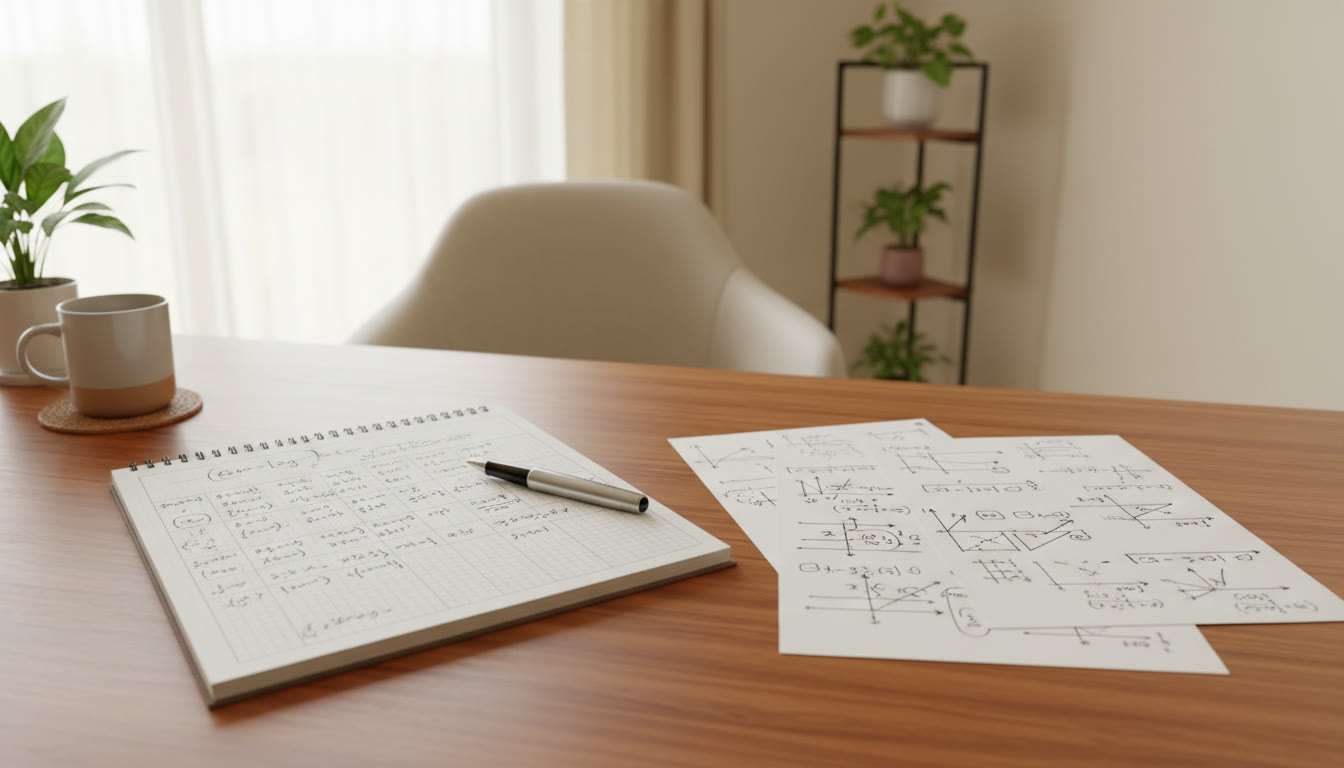
Your work after the test matters more than the raw score. Create an error log with these columns: question id, mistake type (conceptual, calculation, careless), time taken, correct solution summary, and practice required. Revisit the same topic in a focused 24–72 hour cycle — the memory consolidation window is real.
Smart time allocation for a 3‑hour session
Time management isn’t about dividing the clock evenly among sections; it’s about prioritizing high-yield opportunities. A pragmatic rule: secure easy points first, protect time for medium questions that convert faster, and only then invest time in the hardest items. For students who prefer a subject-wise strategy, rotate: tackle one subject in the easy-first pass, then move on to the next — keeping mental freshness in mind.
How to dissect problems after a practice session
Classify errors — the four buckets
- Conceptual gaps: you misunderstood the underlying principle.
- Technique gaps: you knew the idea but lacked the method.
- Calculation or algebra mistakes: arithmetic, signs, or unit slips.
- Exam-craft mistakes: misreading the question or poor time choices.
For each mistake, write a one-line corrective action: e.g., “Rework conservation problems — focus on choosing the system and clearly stating conserved quantities” or “Memorize common integral substitutions.” Then add 2–3 targeted practice problems for the topic. Repetition with immediate feedback is the key.
Sample focused 3‑week plan using PYQs (compact)
| Week | Primary Goal | Daily Routine |
|---|---|---|
| Week 1 | Identify high‑yield PYQ topics & close small gaps | 1 full mock, 2 focused topic sessions, 1 PYQ review block, nightly error-log work |
| Week 2 | Consolidate core concepts and speed drills | 2 full mocks, timed problem sets on core topics, flashcard review for chemistry/inorganic |
| Week 3 | Polish technique, avoid new topics, sharpen exam habits | 2 full mocks, light revision of error logs, simulation of exam day routine |
Practice quality checks: what a good session looks like
- You attempted >70% of questions with deliberate choices rather than random guessing.
- Your error log contains action items and three follow-up problems for each recurring error.
- You can explain the logic of every incorrect question in two sentences — that forces clarity.
- Your pace allows you a 10–15 minute end window for review and catching careless slips.
When to get targeted help — how personalization accelerates recovery
Everyone hits a plateau. When your mock scores stagnate despite steady effort, targeted interventions reduce wasted study hours. Personalized 1‑on‑1 guidance helps in two ways: (1) it isolates the weakest cognitive patterns — i.e., specific recurring mistakes in physics problem setup or algebra slips in math — and (2) it prescribes very small, high‑impact drills to fix them. If structured coaching fits your style, consider options that offer short feedback loops: a tutor who gives specific correction drills, or an AI‑enabled dashboard that points to micro-skills you need to practice next.
For those who want a blend of human mentorship and data-driven focus, Sparkl can provide tailored 1‑on‑1 guidance, customized study plans, and AI-driven insights that highlight weak subtopics from your mock history. Such a targeted approach is especially useful when PYQ trends show you which micro‑skills are repeatedly tested but still shaky in your performance profile.
Practical examples: turning a PYQ into a 10‑minute drill
Take a PYQ that combines coordinate geometry and calculus. Break it down into steps: (1) restate the geometric condition in algebraic form, (2) reduce to a standard equation, (3) differentiate or integrate as required, and (4) quickly check edge cases. Create two additional variations of the problem that change a parameter slightly — solving those three in one sitting builds pattern recognition.
Common myths and the reality check
- Myth: Doing more questions always helps. Reality: Doing more low-quality questions without analysis cements mistakes.
- Myth: Memorizing solutions is enough. Reality: Understanding the why and being able to tweak the approach for variations is what counts.
- Myth: You’ll get partial marks for steps. Reality: Official scoring gives marks per question; show steps to learn, not to expect partial credit.
Final checklist before any full-length mock
- Clear environment, timer set to 180 minutes, all distractions off.
- Materials ready: rough sheets for calculations, pen/pencil for paper mocks, and a clean answer strategy for CBT navigation.
- Plan for analysis: you will spend at least 45–60 minutes after the mock reviewing errors and writing action items.
Concluding academic point
Use PYQs as diagnostic instruments: map frequency to focus, convert errors into micro‑drills, and make every mock test a deliberately designed experiment in improvement. Train accuracy first, then speed; treat diagrams and derivations as tools for clarity rather than tickets to partial credit; and structure practice so that each hour produces measurable gains in conceptual robustness or time efficiency. With disciplined analysis and targeted practice, high‑weight topics become reliable sources of marks rather than mystery traps.













No Comments
Leave a comment Cancel