

How to Allocate Time in the JEE Main Paper: A Practical Roadmap
If you’ve ever sat down to a full-length JEE mock and felt the clock breathing down your neck, you’re not alone. Time in the JEE Main paper is both a resource and a constraint: used well it sharpens your score, used poorly it creates panic and missed opportunities. This guide is written for the student who wants a simple, repeatable system — not a miracle trick. It combines exam realities (MCQ-based testing, a 3-hour full-length exam window, negative marking and the need for disciplined answer marking) with practical routines you can train until they become second nature.

The exam realities you should plan around
Before we jump into minute-by-minute plans, set a few facts in stone so your practice reflects reality: the JEE Main environment demands precise option selection and time discipline (think of an OMR-like seriousness even in a computer-based interface), accuracy matters because of negative marking, and the test is organized around Physics, Chemistry and Mathematics (PCM). Answers are objective — partial credit for incomplete derivations is not something to rely on — so your time allocation must prioritize clear, complete responses.
Mindset first: speed, accuracy and question selection
Time allocation isn’t just a schedule — it’s a decision model. At its core are three rules you should repeat until they feel automatic:
- Value accuracy over reckless speed. A correct answer with modest time is better than two hasty incorrect ones.
- Classify questions fast: easy, medium, hard. Your pace, not perfection, wins the first pass.
- Choose when to invest time and when to drop a question. Some questions deserve quick attempts; a few deserve strategic skips.
Before the exam: build a realistic time budget for preparation
Good exam-day timing starts weeks (or months) earlier. Your study week should contain three repeating pillars: focused learning sessions, targeted practice problems, and full-length mock tests under realistic timing. Start by choosing a daily total you can sustain — it’s better to do 4–5 solid hours every day than burn out on a single 12-hour marathon.
Sample weekly split (pick what fits your daily hours)
| Profile | Daily Study Time | Subject Split (P / C / M) | Focus |
|---|---|---|---|
| Balanced Student | 6 hours | 2 / 2 / 2 | Concept + problem sets |
| Physics-Strong | 6 hours | 1.5 / 2 / 2.5 | Speed in Math, problem accuracy in Chemistry |
| Math-Weak | 6 hours | 2 / 1.5 / 2.5 | Concept drills in Math, quick-recall practice in Chemistry |
This table is a starting point. The key is to monitor your accuracy and time-per-question in mock tests and shift minutes from one subject to another week-by-week until your weakest area becomes stable.
Daily micro-routine that trains exam speed
- Morning: 60–90 minutes — concept-building or a new topic study (use focused blocks).
- Midday: 60 minutes — mixed problem set from two subjects (timed, no resources).
- Afternoon/Evening: 60–90 minutes — revision and error-log work; convert mistakes into micro-notes.
- Weekly: 3-hour full-length mock under exam-like rules (simulate negative marking and answer discipline).
How to use full-length 3-hour mocks to tune your time allocation
Mock tests are your laboratory. Treat every mock like an experiment: change one variable, record results, analyze. The variable here is time allocation. Record: time taken per question, accuracy by subject, and types of errors (calculation, concept, careless). Over a sequence of mocks, patterns emerge fast.

Exam-time template: an adaptable 180-minute plan
| Phase | Minutes | What to do |
|---|---|---|
| Initial sweep | 8–12 | Flip through the paper, mark easy questions, flag potential time-sinks |
| First pass (easy wins) | 70–85 | Solve all questions you can confidently finish under 2–3 minutes each |
| Second pass (medium difficulty) | 60–70 | Attempt medium-level questions; avoid sinking deep into one problem |
| Third pass (tough questions / numeric) | 18–30 | Pick 2–3 high-value attempts and do careful work; leave a few for educated guessing if elimination helps |
| Final review | 5–10 | Check flagged items, ensure answers were marked correctly, fix obvious slips |
Totals vary by student, but this three-pass approach prevents you from getting trapped in time-sinks early on. The initial sweep and first pass secure easy marks; the subsequent passes are for refinement.
Practical rules for negative-marking environments
- Never guess blindly. Use elimination to improve odds before you commit to an answer.
- If you can eliminate one or more options and the odds become favorable, a calculated guess is acceptable.
- Keep a mental cap on attempts — for many students that’s the number of questions they can answer at 90%+ confidence in practice mocks.
Subject-specific time tactics
Each subject presents a different speed/accuracy profile. Your allocation should reflect that.
Mathematics
Math questions usually take longer but give clearer differentiation. For most students, Math deserves larger uninterrupted blocks because you’ll need continuous concentration to navigate multi-step problems. Practice reducing average time per presentable question by working technique drills and timed problem rounds.
Physics
Physics mixes conceptual questions and numerical problems. Do concept checks quickly — if a question maps to a familiar principle, it’s often an easier win than a complicated derivation. Use quick sketches and standard formulas to shave minutes.
Chemistry
Chemistry is typically the fastest scoring subject if you’ve memorized key facts and practiced reaction logic. Organic synthesis and quick calculations can be faster than math, so plan to bank quicker points here, especially on the first pass.
Short-run practice templates: turning study time into speed
Block practice (2-hour slot)
- 0–10 min: Warm-up — 10 quick recall questions (formulas, definitions).
- 10–70 min: Topic drill — solve 10–12 problems in one subject, timed.
- 70–110 min: Mixed set — 20 mixed questions to simulate switching costs.
- 110–120 min: Error log and micro-revision.
These short sessions teach two things: speed on focused topics and the cognitive cost of switching between subjects.
How to read and adapt your mock-test data
After each mock, create a three-row summary: Accuracy, Time-per-question, Error-type for each subject. Example: if Math shows high time-per-question but high accuracy, you need speed drills; if Chemistry shows fast but low accuracy, focus on careless mistakes. This is where tailored help pays off: if you use a service for personalized feedback, it should give you not only scores but minute-by-minute time maps and targeted practice. For example, Sparkl‘s personalized tutoring can help convert mock-test analytics into a weekly plan with targeted drills and 1-on-1 guidance.
Quick rule for adjusting weekly time
- If accuracy < target and average time > acceptable: split the subject into micro-topics and add daily 30–45 minute speed drills.
- If time is okay but accuracy low: slow down slightly and focus on error classification and careless-check routines.
- If accuracy high but score plateaus: increase timed practice and simulate fatigue in longer sessions.
Day of the exam: micro-managing the 3 hours
The exam day is a distilled version of your practice. Here are specific, easy-to-execute actions:
- Arrive calm and rested. Quick breathing for 60 seconds before starting reduces early mistakes.
- Do a fast 5–8 minute survey of the paper and flag easy wins. This is your priority list.
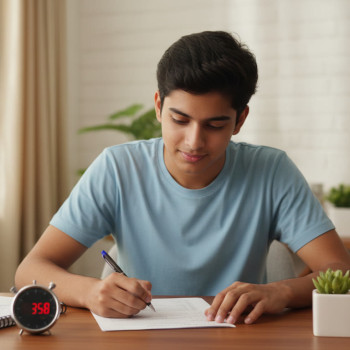
- Keep a visible clock and checkpoint times: after 60 minutes, you should have X expected attempts; after 120 minutes, Y; at 150 minutes, Z. These are personal numbers you derive from mock tests.
- Don’t chase a single problem for more than your pre-set cap (e.g., 12 minutes). Mark it and return if you have time.
- In the final review, check only what you flagged or anything you can confidently correct in under a minute.
Common mistakes that waste time — and how to fix them
- Starting with a hard question: fix by doing a rapid sweep first and collecting easy points.
- Over-checking simple answers: fix by limiting review time and focusing reviews on flagged items.
- Ignoring the mock-test error log: fix by converting each mistake into a 2-line micro-note for quick revision.
- Not simulating negative marking: fix by practicing with the same penalty rules you will face in the exam.
Sample 4-week sharpening plan leading to the exam
In the last month, shift from learning to performance. Reduce new topics and increase quality of practice.
- Week 1: One full mock + 4 focused speed sessions. Analyze error types and create a 20-topic error sheet.
- Week 2: Two full mocks + targeted drills on the 20-topic error sheet. Time each problem and aim to reduce average time by 10–15%.
- Week 3: Three full mocks under strict conditions. Start finalizing the exam-day checklist and exact time checkpoints.
- Week 4: Light practice, 1–2 mocks, focused revision on formulas and error notes. Practice the final review routine you will use on exam day.
If you feel you need one-on-one corrections to calibrate this plan, consider specialized tutoring that maps your mock data to drills; for example, Sparkl‘s tutors can provide tailored study plans and AI-driven insights that make that mapping faster and more precise.
Practical example: converting a weak area into banked marks
Suppose your mock results show Physics accuracy at 60% and average time per attempted question at 6 minutes. Convert that into action: break Physics into 10 subtopics, choose the 3 most error-prone topics, allocate 45-minute daily drills for them for a week, then test in a timed 30-question set. Track time improvement and accuracy. This micro-cycle of diagnose → target → drill → test is the engine behind time-efficiency gains.
Final checklist: what to automate so time management is effortless
- Auto-decide first-pass questions by speed: if a question looks solvable in ≤3 minutes, do it now.
- Use a strict cap per question on second and third passes and stick to it.
- Keep an error log that you consult for 15 minutes daily — it saves hours later.
- Practice full-length mocks with the same answer discipline you will use during the exam.
Concluding academic point
Time allocation for the JEE Main paper is a system you build and iterate: base it on realistic mock-test data, use a three-pass in-exam workflow, tailor subject blocks to the cognitive profile of Physics, Chemistry and Mathematics, and convert errors into targeted drills. Over time, deliberate practice under timed conditions produces two things: faster, more accurate problem solving and a reliable exam routine you can execute calmly under pressure.























No Comments
Leave a comment Cancel