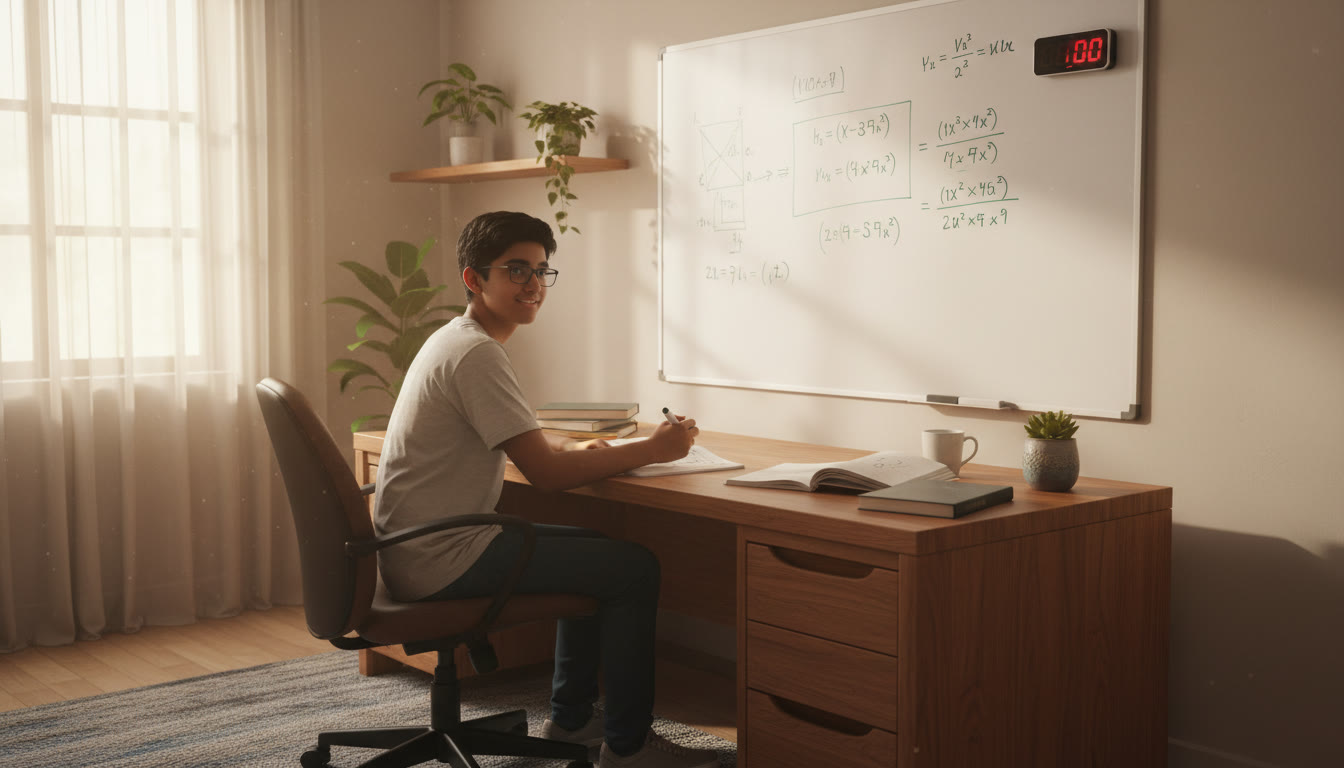

From JEE Main to Advanced Thinking: Why this shift matters
Clearing or performing well in JEE Main is a milestone — but it’s not the destination if your aim is to master genuinely advanced-level thinking. Main rewards breadth, speed, and accuracy on a well-defined syllabus. Advanced-level questions demand something different: synthesis across topics, confident navigation of ambiguity, flexible model-building, and intellectual stamina for three-hour intensive problem solving.
If you want to turn your solid Main-level foundation into creative, exam-ready reasoning, this article is a practical roadmap. I’ll walk you through diagnosis, study architecture, practice habits (including disciplined 3-hour full-length mock practice), exam mechanics like MCQ strategies, negative-marking and OMR discipline, and a reproducible weekly plan you can adapt. Expect concrete examples, small experiments you can try immediately, and a realistic table-style weekly layout to put the approach into practice.
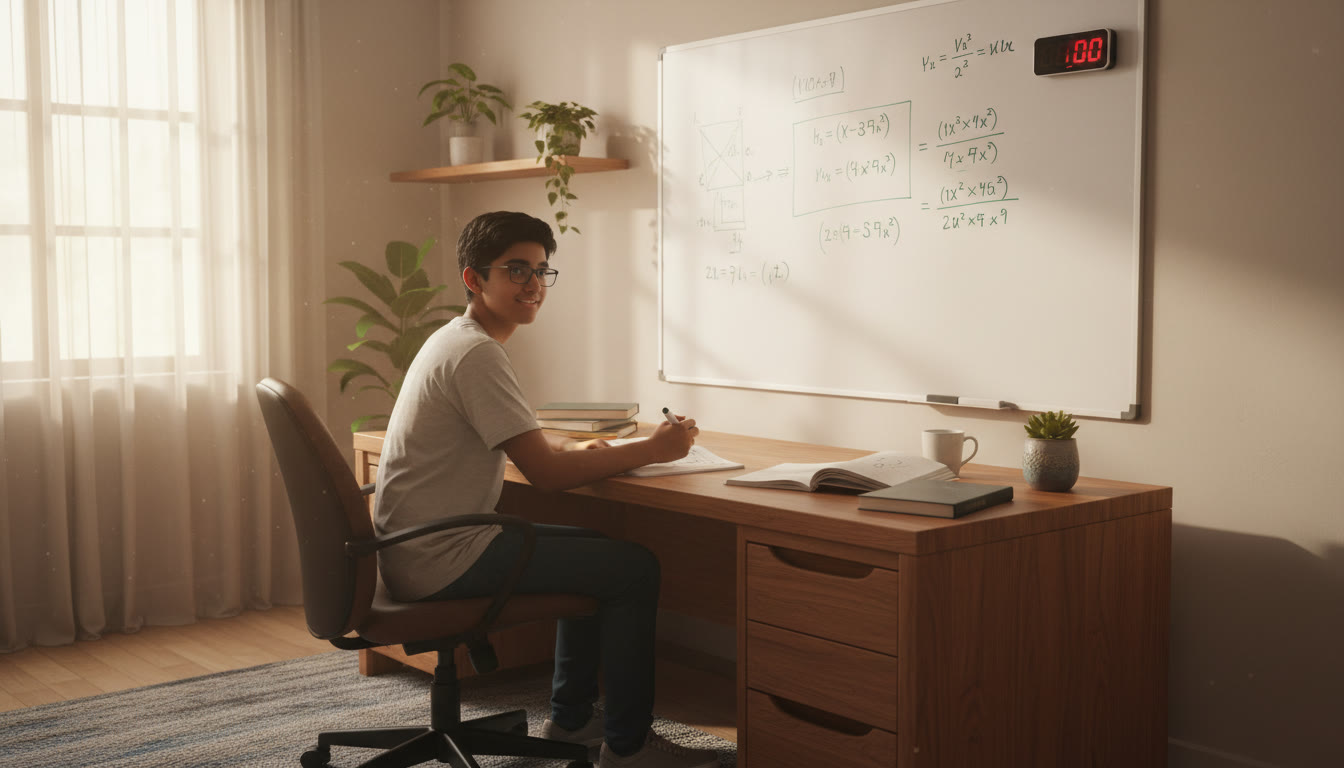
Start with a clear diagnosis: where you really stand
Before changing your study method, know precisely what to change. A candid diagnosis separates two common traps: (1) repeating the same practice without improved depth, and (2) confusing speed for understanding. Use these quick diagnostics to benchmark your starting point.
Simple diagnostic drills (do these once a week)
- Timed concept quiz: pick five major topics (one from physics, one from chemistry, one from mathematics, and two cross-cutting). Set 30 minutes and answer one or two conceptual questions each — no calculators, no formula sheets. Check which answers you derived vs. recognized.
- Problem translation test: take a typical Main-level problem and try to create a harder variant that adds a layer (a constraint change, extra variable, or tie-in with another chapter). If you can consistently make and solve a valid harder variant, your depth is growing.
- Error pattern log: after each test or practice session, categorize mistakes into ‘conceptual’, ‘calculation’, ‘careless/OMR’, and ‘strategy/time’. Aim to reduce one category at a time over four weeks.
Build conceptual scaffolding — don’t just memorize tricks
Advanced-level thinking is compressed knowledge: strong conceptual scaffolding lets you see multiple solution paths and pick the most efficient. That requires transforming passive notes into active mental models.
How to develop models that survive tough variants
- Chunk fundamentals: for every topic write a one-line essence (for example, “energy methods convert kinematic chains into scalar economy” or “symmetry reduces independent variables”).
- Create canonical examples: pick 3–5 problems per topic that demonstrate the complete idea (one easy, one medium, one creative). Work them until you can change parameters and predict the qualitative impact before computing numbers.
- Use diagrams and derivations as tools: diagrams are not fancy decorations — they are problem-translators. Whenever you solve, redraw the scenario and annotate forces, constraints, or limiting behaviors.
Remember: diagrams and derivations are learning tools, not exam-answer requirements. They speed thinking; they don’t have to be written verbatim during every exam answer, but practicing with them trains you to see structure in new problems.
Practice architecture: quality over naive quantity
Quantity gives exposure; quality gives transfer. Advanced-level thinking emerges when practice is deliberately varied and feedback-rich. That means fewer blind problem sets and more targeted sessions that force you to think along new dimensions.
Three complementary practice modes
- Focused concept drills (short sessions): isolate a single idea and solve 6–8 problems that tweak that idea. Time: 45–90 minutes.
- Integrated challenge problems (deep sessions): pick 2–3 longer problems that require multi-step reasoning and cross-topic links. Time: 90–180 minutes.
- Exam simulation (discipline sessions): full 3-hour mock tests under strict OMR-like conditions to practice stamina, time-slicing, and negative-marking management.
Rotate these modes so a typical week has at least one full mock (3-hour), two deep sessions, and several short drills. The mock is not just about score — it’s about the discipline of sustained reasoning and the habit of making safe OMR choices under pressure.
Master exam mechanics: MCQ strategy, negative marking, and OMR discipline
The mechanics of the exam shape smart behavior. MCQ-based tests with negative marking reward disciplined risk management. Learn how to make that work in your favor.
Practical rules for exam-day mechanics
- Adopt a two-pass approach: pass one for quick, high-confidence answers; pass two for medium-difficulty work; leave the last pass for risk-managed attempts at hard questions.
- Control time per question: set micro-deadlines. For example, if you have 90 questions in 180 minutes, average time is 2 minutes — but allocate 1–3 minutes dynamically and use the later pass to redistribute time from easy to hard questions.
- OMR discipline: practice marking answers on an OMR replica while timing. Simple habits — filling bubbles cleanly, double-checking question numbers, and avoiding stray marks — cut down preventable loss.
- No partial-marking assumptions: many advanced cycles award marks only for fully correct MCQ answers. Do not expect partial credit from incomplete derivations; train to either select the right option with justified confidence or leave it for a later pass.
Design practice around problem taxonomy
Not all hard problems are hard for the same reason. Building advanced-level thinking means learning to recognize the taxonomy that created the difficulty.
Common hardness categories and sample tactics
- Extension by parameter: a familiar concept with an extra parameter — tactic: vary parameters and create quick sanity checks (limits, dimensional analysis).
- Hidden rephrasing: the problem is actually a disguised application of another topic — tactic: ask “which physical principle or theorem simplifies this?”
- Multi-step composition: two or more independent ideas chained — tactic: break into sub-problems and label intermediate goals.
- Calculation-heavy traps: long arithmetic where conceptual shortcut exists — tactic: learn estimation, symmetry, and invariants to avoid needless computation.
Practice by making and solving your own variants. This backwards-engineering trains you to see why an author made the problem hard, and then how to unmake the hardness.
Feedback loops: how to learn from every mistake
Errors are data. The power comes from structured reflection, not punishment. Convert each mistake into a reusable correction.
Error correction routine (15–30 minutes per mistake set)
- Reconstruct: write down, in 2–3 lines, what you thought at the time of the mistake.
- Pinpoint the root cause: was it a gap in concept, a misread, a careless sign error, or a flawed strategy?
- Create a micro-drill: two or three problems that directly attack the root cause so the next encounter is predictable.
- Schedule a revisit: mark the micro-drill for review in 5–7 days and again in 3 weeks to ensure retention.
Sample weekly plan: balance depth, drills, and mocks
Below is a compact, adaptable weekly template you can scale up or down. The numbers are a framework — the discipline and pattern matter more than precise hours.
| Day | Morning | Afternoon | Evening/Review |
|---|---|---|---|
| Mon | Focused concept drills (90 min) — core topic | Problem set (90 min) — canonical + variations | Error log review (30–45 min) |
| Tue | Integrated challenge problems (120 min) | Light revision / notes consolidation (60 min) | Short timed quiz (45 min) |
| Wed | Mock test (3 hours) under strict conditions | Mock analysis: score breakdown & error mapping (90–120 min) | Restorative review (30 min) |
| Thu | Conceptual gap sessions (1–2 topics, 90–120 min) | Practice variants (90 min) | Micro-drills (30 min) |
| Fri | Interdisciplinary problems (Math + Physics/Chemistry, 120 min) | Short timed set (60 min) | Peer discussion or teaching (45–60 min) |
| Sat | Deep study block: tough topic (150 min) | Applied examples / real-world context (60–90 min) | Plan next week & rest (30–60 min) |
| Sun | Light review or selective mock (90–120 min) | Admin: notes, formula sheet updates (60 min) | Reflective journaling: strategy adjustments (30 min) |
Consistency beats intensity when building higher-level skills. The three-hour mock on a weekday (or weekend) builds mental endurance and OMR discipline; the post-mock analysis is where the learning compounds.
Mental skills: cognitive habits that scale
Advanced thinking isn’t only content — it’s a set of cognitive habits. Train these deliberately.
Essential mental habits
- Question translation: practice rephrasing a problem in one sentence — what is being asked, and which principle likely applies?
- Sanity checks: after every solution, run quick dimensional or limit checks to see if the answer is plausible.
- Multiple-path thinking: when you solve a problem, always note at least one alternative route — this builds flexibility.
- Controlled frustration training: let a tough problem sit for an hour, then switch tasks and return. This builds tolerance for long bursts of concentrated thought.

Tools, resources, and when personalised help accelerates progress
Good tools and the right mentor can compress years of trial-and-error into months. Use resources that force active thinking: spaced-repetition for key ideas, problem-sorting apps to find targeted variants, and mock-test platforms that replicate time and OMR conditions.
For students who want one-on-one clarity and a plan tailored to their diagnostic profile, Sparkl‘s personalised tutoring pairs focused mentoring with tailored study plans and AI-driven insight into your error patterns. That combination is most useful when you’ve already built a foundation and want to accelerate the hardest transitions — from solving to thinking.
Examples: turning a Main-level problem into an Advanced challenge
Seeing concrete transformations makes the approach less abstract. Here are two short examples of how to escalate a Main-style question into an Advanced-level exercise.
Example 1 — Projectile motion (physics)
- Main-level: calculate range given angle and speed on flat ground.
- Advanced variant: same launch but ground slopes, add air resistance as a small linear term, or consider collision with a moving object — now you must choose between energy arguments, reference-frame shifts, or perturbation approximations. The advanced solver identifies limiting cases and chooses approximations that simplify calculations without losing the core physics.
Example 2 — Algebra/Functions (mathematics)
- Main-level: find roots of a polynomial or solve an inequality.
- Advanced variant: ask for the parameter region where a derived inequality holds for all real x, or couple two functions and ask for number of intersections as a parameter varies. The solver uses monotonicity, bounding techniques, and sometimes a clever substitution rather than brute force.
How to measure real growth (beyond raw scores)
Scores move, but they are noisy. Track the underlying signals that indicate real cognitive growth.
Progress metrics to track weekly
- Problem-composition success: can you reliably create and solve harder variants of familiar problems?
- Error-type reduction: is the dominant error category shifting from conceptual to careless?
- Time-to-insight: measure how long it takes to get the first correct approach on a challenging problem; decreasing time is progress.
- Stamina indexes: quality of solutions in the final hour of a mock vs the first hour.
Common pitfalls and how to avoid them
- Over-reliance on shortcuts: shortcuts help but mask conceptual gaps. When you use one, briefly note the underlying theorem and practice a variant without the shortcut.
- Mock test without review: a mock without analysis is entertainment. Spend at least twice as long analyzing a mock as you did taking it, and turn that analysis into micro-drills.
- Copying solutions passively: rework a solved solution without looking — reconstruct the argument from memory, then compare.
- Neglecting OMR practice: a single OMR mistake can erase weeks of progress. Simulate exact exam conditions periodically.
Putting it together: a three-month experiment
Try this condensed experiment to see if the approach works for you. Week 1: baseline diagnostics and one full mock. Weeks 2–10: follow the weekly template with at least one 3-hour mock every 7–10 days and targeted micro-drills. Weeks 11–12: increase mock frequency and tighten feedback cycles. Measure the progress metrics above and iterate.
Small, consistent adjustments beat massive overhauls. If a tactic does not produce improvement in two cycles, replace it — not with more of the same, but with a different mode of practice (for example, swap a problem set for a peer-explaining session).
Final academic takeaway
Advanced-level thinking after JEE Main is built, not discovered. It grows when you pair disciplined mock practice with targeted conceptual work, structured error analysis, and deliberate problem-creation. Train the cognitive habits — translation, sanity checks, multiple-path thinking, and tolerance for concentrated effort — and make your practice intentionally varied: focused drills, integrated challenges, and realistic 3-hour mocks under strict OMR discipline. By tracking the right progress signals and refining your routines, you shift from solving to thinking, turning examination performance into genuine problem-solving skill.

























No Comments
Leave a comment Cancel