
IB DP Activities Strategy: How to Design a CAS Project Admissions Actually Respect
There’s a difference between doing a lot and doing something that matters. For IB Diploma students, CAS is your chance to show admissions officers a version of you that grades and transcripts don’t capture: curiosity in action, resilience under pressure, a real pattern of learning and contribution. The trick is to design a CAS experience that’s focused, documented, reflective, and—crucially—tells a story admissions can quickly understand and respect.
This guide walks you through that design process: picking a theme, setting measurable goals, planning a realistic timeline, collecting evidence, and turning the work into crisp activity entries, essays, and interview answers. The advice here is practical and student-tested, with examples you can adapt to your interests—creative, active, or service-oriented.

Why admissions care about CAS — and what they actually look for
Admissions officers read thousands of activity lists and personal statements. What makes a CAS project stand out is not how many hours you logged, but whether the project demonstrates:
- intentionality — you set goals and chose actions because of a reason;
- growth — you can describe what you learned and how you changed;
- impact — there’s evidence your work affected people, systems, or your own abilities;
- continuity — the project wasn’t a one-off, but a sustained commitment or a clearly documented learning arc;
- ethical thinking — you considered the needs and dignity of others and reflected on trade-offs.
If your project can be summarized in a short, compelling sentence that includes role, action, and outcome, you’ve already made a big leap toward something admissions will respect.
Begin with intention: choose a theme and commit to depth
Start by asking three simple questions: What problem do I care about? What can I realistically influence? What will I learn by doing this? The most memorable CAS projects are built around a tight theme—education access, local environmental restoration, mental health outreach, sports coaching for under-resourced kids, or a creative arts mentoring program—and pursue it with focus rather than scattering effort across unrelated activities.
Depth over breadth
Admissions prefer a clear thread. A deep project shows progression: planning, implementation, setback, adaptation, and reflection. That narrative gives you material for essays and interviews. For example, running weekly literacy workshops for the same group of learners over a semester is far stronger than one-off tutoring sessions with different kids each week.
Align with academic interests
If you’re aiming for a specific field—engineering, public health, environmental science—choose a CAS project that gives you relevant experiences you can speak about with genuine confidence. That said, genuine curiosity in a new area can also be compelling; what matters is that you can explain how the project shaped your thinking and readiness for university study.
Sample focused themes
- Community STEM workshops that move from demonstrations to students designing their own experiments.
- Neighborhood food-resilience project that tracks food distribution and trains volunteers.
- Peer mental-health ambassador program that writes, pilots, and evaluates wellbeing sessions.
- Local river clean-up with a monitoring program and a public-facing data dashboard.
Plan like a project manager: timelines, milestones, and risk awareness
Good CAS design borrows from project management: define milestones, assign roles, estimate resources, and build in check-ins. A clear timeline shows admissions you can plan and sustain commitments.
| Phase | Typical Duration | Core Tasks | Admission-friendly Evidence |
|---|---|---|---|
| Research & Design | 2–4 weeks | Identify community need, contact partners, set objectives | Research notes, partner emails, project brief |
| Pilot | 2–6 weeks | Run small pilot, collect initial feedback, adjust plan | Pilot report, photos, participant feedback |
| Implementation | 4–12 weeks (or ongoing) | Deliver sessions/events, gather data, lead team | Attendance logs, photos, testimonials |
| Consolidation | 2–4 weeks | Analyze data, write reflection, handover to partner | Final reflection, summary report, resources for next cohort |
These are flexible durations—what matters is visible progression and a final reflection that ties evidence to learning.
Measure impact: what counts as evidence
Admissions look for concrete signals that your work made a difference. Collect multiple types of evidence so your application can point to both numbers and narratives.
| Metric | Example Measure | How to Use It in Applications |
|---|---|---|
| Participation | Number of repeat participants, retention rates | Shows commitment and community buy-in |
| Outcomes | Pre/post skill test improvement, test scores, behavior change | Quantifies learning or impact |
| Scale | Hours of activity, resources distributed, classes taught | Demonstrates logistics and capacity |
| Sustainability | Partnerships formed, materials left behind, volunteer training | Indicates long-term thinking |
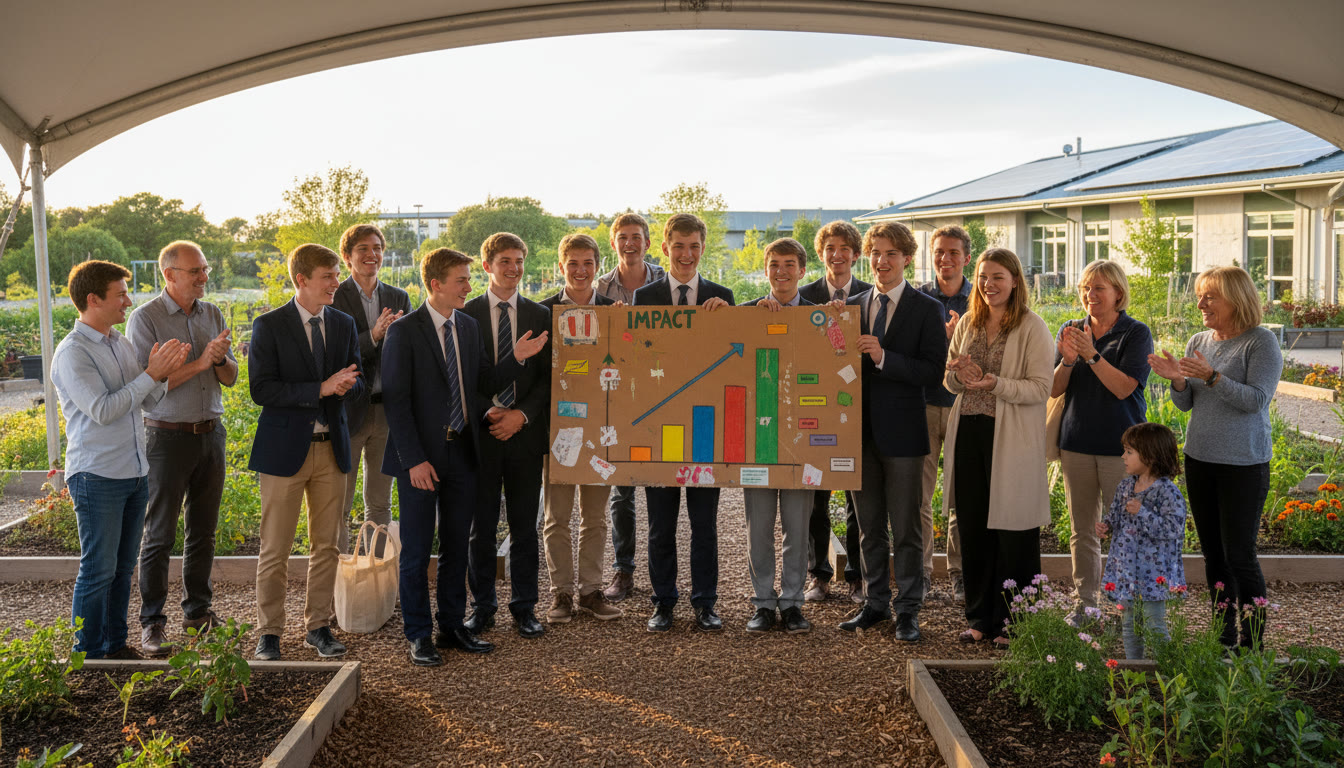
Evidence is stronger when triangulated—photographs plus a short testimonial from a participant or partner, plus a simple before/after metric. Keep raw logs (attendance sheets, sign-up emails) and capture reflections that show how data shaped your decisions.
Document and reflect deliberately
CAS isn’t a scrapbook—reflection is the analytical heart of the program. Admissions want to see not just what you did, but what you learned, how you handled setbacks, and how the experience changed your plans or mindset.
Reflection structure that actually helps
- Context: What was the situation or need?
- Action: What role did you take? What did you do?
- Outcome: What happened? Include measurable or observable results.
- Learning: What skills, insights, or ethical dilemmas emerged?
- Next steps: How would you improve or scale the work?
Use short evidence-linked reflections (100–250 words) throughout the project, and one longer final reflection that synthesizes the arc. Admissions officers often skim; a few sharp reflections that directly tie to outcomes will be read and remembered.
Turn project work into persuasive application material
Now translate your CAS story for three common application spaces: the activities list, the personal statement, and interview answers. Each has different length and tone constraints; tailor rather than repeat.
Activities list phrasing (concise + evidence)
- Role first: “Lead Coordinator” or “Founder and Coach”
- Action: one short verb describing what you did
- Impact: a compact metric or clear outcome
Example entry (one-line): Lead Coordinator — Community STEM Club: Designed weekly labs, trained 8 peer mentors, and increased participating students’ test scores in basic science concepts by 25% (pre/post pilot). Attach photo and mentor feedback.
Personal statement material (narrative + reflection)
Pick one or two moments that reveal character and learning. Admissions read for growth and self-awareness. Avoid a laundry list of tasks—use a tight anecdote where your choices mattered, then link to broader learning and future plans.
Interview preparation (short stories and STAR+R)
Interviews reward clarity. Use a STAR+R format: Situation, Task, Action, Result, Reflection. Keep the anecdote under two minutes, highlight your decision-making, and finish with one reflective sentence that connects to your academic motivations.
If you want extra practice turning project material into crisp essays or interview scripts, Sparkl‘s personalized tutoring — 1-on-1 guidance, tailored study plans, expert tutors, and AI-driven insights — can be a practical place to refine language, rehearse interview answers, and structure reflections so they read powerfully on paper and aloud.
Sample language you can adapt
Admissions like specific verbs and concrete outcomes. Here are phrases that tighten otherwise fluffy descriptions:
- Instead of “helped students,” say “designed and led a 12-week curriculum that improved participant reading fluency by X%.”
- Instead of “organized events,” say “coordinated logistics for a volunteer network of 30 people, reducing setup time by 40% through a shared toolkit.”
- When discussing setbacks: “Initial participation was low; I revised outreach by partnering with local schools and increased retention.”
Integrating CAS with EE and TOK for intellectual depth
Admissions notice when CAS feeds academic curiosity. If your Extended Essay or TOK exploration connects to your CAS topic—using data collected in the project, grounding a reflection in theory, or interrogating an ethical question that emerged—you demonstrate intellectual synthesis. Keep a separate folder of research notes and references that show you treated the project like a study as well as an activity.
Common pitfalls (and how to avoid them)
- Pitfall: Vague outcomes. Fix: Set one or two measurable indicators at the start.
- Pitfall: Poor documentation. Fix: Assign one team member to keep weekly logs and take photos.
- Pitfall: Overpromising scale. Fix: Pilot first, then scale—and document the pilot’s lessons.
- Pitfall: Reflection as an afterthought. Fix: Schedule short reflections after each milestone.
- Pitfall: Ignoring partner voices. Fix: Collect partner testimonials and evidence of sustained handover.
Quick, practical checklist before you submit applications
- Can you describe your role in one short sentence?
- Do you have at least two types of evidence (photo, testimonial, metric)?
- Is there a clear before/after or progression in your log?
- Does your reflection answer “What did I learn?” not just “What did I do?”
- Have you practiced telling your CAS story in 30 seconds and two minutes?
Examples of strong CAS project summaries for applications
Concrete examples help you see how language changes perception. Below are short, adaptable summaries you can model in an activities list or a short essay paragraph.
- “Founder & Project Lead — Neighborhood Food Resilience: Built a weekly distribution system and volunteer-training program; trained 20 volunteers and established a resource handbook for sustained handover.”
- “Coaching Lead — Youth Track & Field Initiative: Created progressive training plans and peer-coaching modules; improved average 400m times among participants by measurable amounts and formalized a mentorship pipeline.”
- “Workshop Designer — Community STEM Labs: Piloted inquiry-driven modules with primary school students and produced a curriculum adopted by two partner schools.”
Final practical tip: think like an admissions reader
Admissions officers spend seconds on each activity entry and a few minutes on essays. Make decisions for fast readers: put your role first, include one concrete metric, and end short descriptions with a learning point. When you rehearse interviews, practice telling the story out loud until the arc—need, action, change, learning—feels natural and true.
Your CAS project is not merely a box to check. When you design it with clarity, measurable impact, rigorous reflection, and honest storytelling, it becomes one of the clearest proofs on your application that you can identify real problems, work with others, persist through setbacks, and learn. Close the loop between action and reflection, document the evidence neatly, and you’ll have material that admissions genuinely respect.




















No Comments
Leave a comment Cancel