

IB DP Time Management: The DP1 System That Prevents Deadline Pile-Ups
Let’s be honest: DP1 feels like the soft opening of a theatrical production where the real show—DP2—suddenly slots into place. There are a thousand small tasks, a handful of big assessments (IAs, the Extended Essay, TOK milestones), and the pressure to build habits that will carry you across two intense years. The trick isn’t trying to do everything at once; it’s building a DP1 System that makes deadlines predictable, manageable, and impossible to pile up without notice.

Why DP1 is the perfect time to build a system
DP1 is the experimental year. You’re learning subject rhythms, discovering teacher expectations, and starting long-term work like the Extended Essay. That makes it the ideal moment to craft routines that will buffer DP2’s heavier load. A good DP1 System does three things: it maps the two-year landscape, breaks big tasks into small, time-boxed steps, and creates safety nets so one late draft doesn’t cascade into a week of missed deadlines.
The six pillars of the DP1 System
Think of the system as six pillars you assemble and test in DP1. Each pillar is simple, repeatable, and resilient to change—so when a teacher updates a date or a new IA pops up, your system absorbs the shock.
Pillar 1 — The Master Calendar
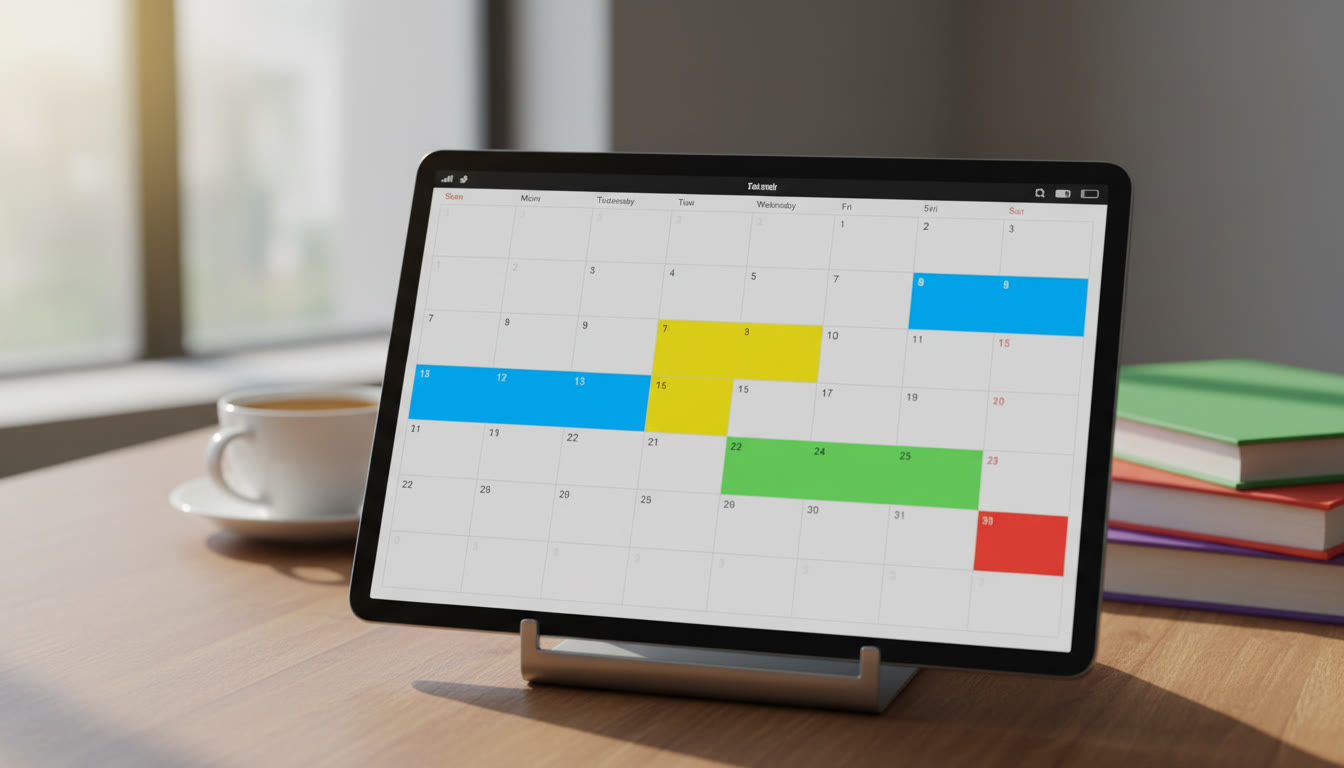
Create one single Master Calendar that holds every deadline, checkpoint, and mock exam window for your two-year DP journey. This is not a collection of classroom handouts; it’s the single truth you consult before booking study time. Use color-coding (subject or assessment type), and update it weekly. A Master Calendar turns surprise deadlines into planned tasks.
- Include teacher-provided deadlines, projected dates for drafts, and administrative milestones.
- Mark mandatory school events and unofficial project work (e.g., research trips) so nothing hides in the margins.
- Reserve buffer days for each major deliverable—more on buffers below.
Pillar 2 — Weekly Triage
Every Sunday evening (or a time that suits you), run a 20–30 minute Weekly Triage. This is a quick triage where you scan the Master Calendar, decide what needs immediate effort, assign microtasks, and set your three non-negotiable goals for the week. The Weekly Triage is the compass that keeps you moving in the right direction without overcommitting.
- Pick three wins: one academic, one project (IA/EE/TOK), one wellbeing or CAS check-in.
- Break each win into 20–60 minute microtasks you can schedule into your week.
- Leave at least one evening unscheduled to absorb spillover; this is where buffer days live.
Pillar 3 — The Task Ladder
For every major submission—an IA, an EE chapter, or a TOK presentation—create a Task Ladder: a visible list of incremental steps from idea to submission. Each rung is a microtask with a time estimate (15 minutes to 3 hours). The Task Ladder keeps big projects digestible and enables you to make real progress in short sessions, preventing the “I’ll start tomorrow” trap.
- Example rungs for an IA: read rubrics → draft research question → collect data → first analysis → teacher feedback → revise → final formatting.
- Estimate time and assign the rung to a date on your Master Calendar during Weekly Triage.
Pillar 4 — Focus Sprints and the Rhythm of Work
Block your day into Focus Sprints: concentrated stretches (25–50 minutes) dedicated to a single microtask, followed by a short break. Two or three sprints on a priority Task Ladder rung will feel exponentially more productive than five unfocused hours. Maintain a rhythm: study, short rest, review, and a longer break after a larger block.
- Use the 25/5 or 50/10 method—experiment and pick what fits your energy cycle.
- When a sprint finishes, update the Task Ladder and the Master Calendar if things shift.
Pillar 5 — Buffer Days and the Deadline Ladder
Preventing pile-ups is all about buffers. For each assignment, build a Deadline Ladder with three key dates: draft, teacher feedback, and final submission. Place buffer days between those dates (at least two for major work). If a teacher’s schedule slides, the buffers protect your final deadline.
- Assign at least one buffer day per IA and two for EE milestones.
- Use one buffer day per fortnight as an open catch-up slot—no new work allowed until you clear anything behind schedule.
Pillar 6 — Reflection & Adjustment
Every month, spend 30–45 minutes reflecting. Which sprints landed? Which deadlines compressed unexpectedly? Adjust your Master Calendar and Task Ladders. Reflection is the repair shop of your system: small fixes now prevent big problems later.
- Keep a habit log: what time did you study, how long, what felt effective?
- Record two things to keep and one to change for the next month.
Sample DP1 → DP2 roadmap (one view)
Here’s a compact timeline table that many students find clarifying during DP1. Use it to place your IAs, EE milestones, TOK checkpoints, and CAS planning across the two-year arc.
| Phase | Focus | Key Tasks | Checkpoint |
|---|---|---|---|
| Early DP1 | Orientation & habit building | Master Calendar, subject rhythms, choose EE topic | Weekly Triage established |
| Mid DP1 | IA drafts & EE research | Task Ladders for 2–3 IAs, EE literature review, CAS planning | First major draft submitted for feedback |
| End DP1 | Consolidation | Complete first EE chapter, most IA drafts, TOK ideas | Buffer days tested |
| Summer between years | Deep work & revision planning | EE write-up plan, subject revision map, mock exam prep | Mock exam blueprint |
| DP2 (first half) | Final drafts & intensive revision | Final EE edits, IA submissions, TOK presentations | Final deadlines confirmed |
How to use this table
Fill the table with your own school’s dates. Your Master Calendar should be a living version of this: concrete, dated, and checked every Weekly Triage.
Weekly templates that actually work
A practical weekly layout gives structure without rigidity. Below is a simple, adaptable pattern many DP1 students use to prevent small tasks from stacking into crises.
| Day | Priority 1 (classes/urgent) | Priority 2 (project work) | Priority 3 (review/wellbeing) |
|---|---|---|---|
| Monday | Class notes & immediate homework | 30–50 min IA Task Ladder rung | Light review (30 min), sleep hygiene |
| Tuesday | Classwork & short assignments | EE research or draft | Physical activity & short leisure |
| Wednesday | Lab or extended class tasks | Group or TOK prep | Buffer evening |
| Thursday | Homework catchups | IA revision after teacher feedback | Peer review session |
| Friday | Week wrap & urgent submissions | Deep focus sprint on major rung | Social time & recovery |
| Saturday | Mock revision or practice | Long EE/IA block (2–4 hours) | Outdoor time |
| Sunday | Weekly Triage & plan | Finish microtasks | Rest and reset |
Adapt this template by moving the long block to the day when you’re freshest. The goal is predictability: when you habitually carve out time for EE and IAs, last-minute meltdowns become rare.
Subject-specific rhythm tips
Every subject has its own cadence. Recognizing those patterns in DP1 helps you plan smarter.
Sciences (lab-based IAs)
- Book lab slots early and map the entire data collection process on your Task Ladder.
- Allocate time for repeats and data cleanup—experimental work almost always needs iteration.
Humanities & Group IAs
- Divide research tasks early and schedule check-ins; group momentum is fragile unless someone keeps the calendar live.
- Use small shared deadlines within your group to avoid last-minute merges.
Languages and Orals
- Start practicing speaking tasks early; 10-minute daily rehearsals compound quickly into confidence.
- Record mock orals for self-review and teacher feedback cycles.
Feedback loops: make teacher comments useful
Teacher feedback is most helpful when you show progress between drafts. Schedule explicit review sessions: send the first draft, note three questions for your teacher, and book a short check-in. This makes teacher time efficient and keeps your Task Ladder moving.
Simple tools (no brand-name baggage)
You don’t need a fancy stack of apps—pick one calendar, one task list, and one place for notes, and keep them synced in your Weekly Triage. Many students prefer a digital Master Calendar plus a paper Task Ladder they can physically check off. Combine focus timers with a modest distraction blocker during sprints and you’ll make more progress than by studying longer with interruptions.
How targeted tutoring and guidance fit into the DP1 System
Some students build systems with friends; others benefit from tailored help. If you choose to add guided support, look for one-on-one guidance that ties directly to your Task Ladders and Master Calendar. For example, Sparkl‘s personalized tutoring pairs structured check-ins with expert tutors who help shape study plans, refine EE direction, and translate teacher feedback into concrete next steps. That kind of targeted support helps students keep sprints focused and reduces friction in feedback loops.
Practical routines that protect your time
Beyond calendars and ladders, guardrails matter. Here are routines that prevent small leaks from turning into floods:
- Daily: Two short retrieval sessions (10–20 minutes each) for different subjects.
- Weekly: One deep work block (2+ hours) dedicated to EE/IA writing without checking email or messages.
- Monthly: An extended reflection to re-balance your calendar and test buffer days.
Stress, rest, and sustainable performance
Preventing deadline pile-ups isn’t just a scheduling problem—it’s an energy problem. Sprints are only useful if you’re rested. Make sleep a non-negotiable, schedule exercise as a planned activity, and treat social time like maintenance rather than a reward. Over the long run, the DP1 System isn’t about squeezing more study in; it’s about arranging your life so study time is high-quality and predictable.
Quick troubleshooting: what to do when a pile-up begins
If you feel a pile-up starting, act fast with a short emergency protocol:
- Pause and list every pending submission for the next ten days.
- Assign each a priority: must-submit, can-delay with permission, or negotiable.
- Break must-submits into microtasks and schedule two consecutive Focus Sprints for the highest priority item.
- Contact teachers with a concise update and ask for one targeted clarification instead of open-ended feedback requests.
- Use your next Weekly Triage to rebuild buffers; treat the pile-up as data, not failure.
Closing advice: build a system that learns
The DP1 System is less about perfection and more about iteration. Test one change a fortnight—more realistic scheduling, a stricter buffer, earlier teacher check-ins—and observe how your workload responds. Over time, those small experiments supply the evidence you need to tune your Master Calendar and Task Ladders. The goal is steady momentum: regular sprints that add up to confident, on-time submissions across two years.
Start small, protect your rest, and treat deadlines as predictable checkpoints instead of emergencies. Your DP1 System will not only prevent deadline pile-ups; it will make the entire Diploma experience more manageable and more meaningful.























No Comments
Leave a comment Cancel