
What to Do When Motivation Disappears: A Calm Roadmap for IB DP Students
There comes a moment in almost every IB Diploma journey when the engine sputters. You used to wake up planning revisions, jotting down ideas for your Extended Essay, or ticking off CAS activities — and suddenly the to-do list looks like a mountain you didn’t sign up for. The slump can feel louder than any deadline, and it’s normal, human, and fixable.
This piece is a friendly, practical guide built for the moments when motivation evaporates. It mixes short rescue tactics you can use today, habit changes that build lasting momentum, and a clear two-year roadmap so you know what to do at each phase of the Diploma Programme. Think of this as a toolkit you can dip into when the spark is gone — not a pep talk, but sensible, real advice that respects how tired and overwhelmed you might feel.

Why motivation fades — and why that’s okay
You’re not broken; you’re responding to pressure
The IB DP is demanding: multiple subjects, internal assessments, the Extended Essay, TOK, CAS, plus expectations from teachers, peers, and yourself. Over time the load compounds and motivation — which is fragile by nature — takes the hit. Recognizing that this is a predictable reaction, not a personal failure, is the first step toward recovering momentum.
Common causes (and what they tell you)
- Burnout: sustained effort with little recovery; results are sluggish despite high input.
- Perfectionism: waiting for the “right” time or the “perfect” conditions can freeze action.
- Decision fatigue: too many small choices (what to study, which IA to start) erode your willpower.
- Lack of visible progress: long-term projects like the Extended Essay don’t give instant feedback, so it’s easy to lose belief in progress.
Each of these reveals a different part of the map: energy, standards, cognitive load, and feedback loops. If you can name which one is bothering you, you can choose a targeted fix.
Immediate triage: three steps to get moving today
Step 1 — Pause and lower the stakes
When motivation is gone, the first instinct is to push harder. Instead, pause. Give yourself permission to reduce the daily target from “finish three chapters” to “do 20 focused minutes.” Lowering the stakes removes the pressure that kills motivation.
Step 2 — Micro-wins build momentum
Pick a tiny, clarifying task and finish it. Examples: write one paragraph of an EE introduction, outline one experiment for an IA, solve three practice questions on a tricky topic. Micro-wins release dopamine and rebuild confidence faster than marathon sessions that never start.
Step 3 — Reconnect to purpose
Spend five minutes reminding yourself why you picked your subjects. Curiosity, future goals, enjoyment of problem-solving — reconnecting to purpose can shift effort from “should” to “want to,” which is more sustainable.
Designing a two-year roadmap that protects motivation
A roadmap isn’t a rigid schedule; it is a skeleton that keeps the long haul manageable. Below is a compact two-year structure you can tailor to your subjects and school calendar. Think of it as milestones, not shackles: checkpoints that make large tasks feel achievable.
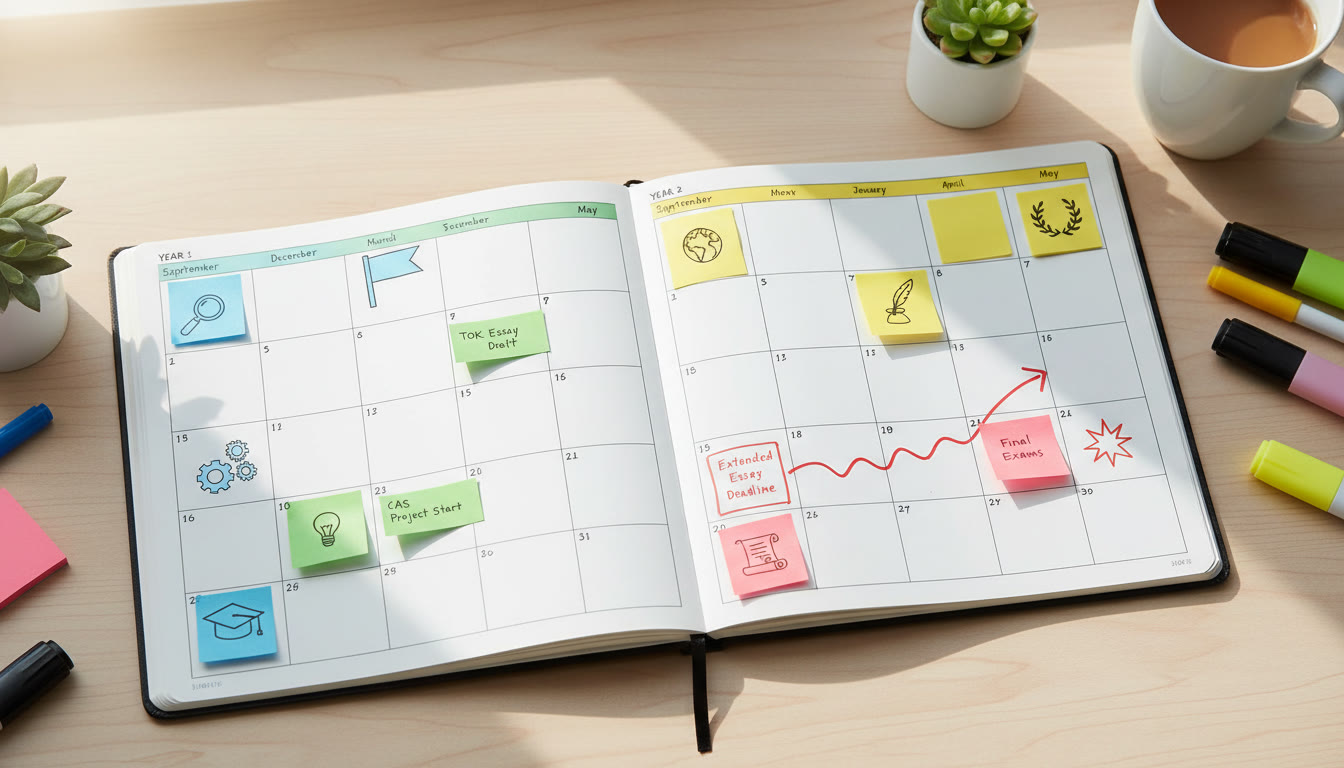
| Phase | Primary Focus | Concrete Goals | Weekly Time Allocation (example) | Key Checkpoints |
|---|---|---|---|---|
| Year 1 — Semester 1 | Orientation and foundation | Set subject routines; begin EE topic exploration; sketch CAS ideas. | 20–25 hours studying; 2–4 hours EE/CAS research | Subject learning gaps identified; EE 1-page proposal |
| Year 1 — Semester 2 | Consolidation and practice | Strengthen fundamentals; start internal assessments; draft EE outline. | 25–30 hours studying; 3–5 hours EE drafting | IA drafts submitted; EE first full draft |
| Year 2 — Semester 1 | Intensive application | Finalize IAs; rigorous EE editing; focused mocks and TOK link-up. | 30–35 hours studying; 4–6 hours EE polishing | Full EE submitted to supervisor; mock exams completed |
| Year 2 — Semester 2 | Revision and performance | Targeted exam practice; rest and energy management before assessments. | 25–40 hours (depending on exam proximity) | Exam window; final CAS reflections complete |
How to use the table
Customize the weekly time allocation to your subjects, but keep the idea of shifting intensity: build steady foundations in Year 1 and shift to deeper, targeted revision in Year 2. Regular mini-checkpoints (weekly) are more useful than a single large deadline.
Practical routines that keep motivation in short supply
Energy-first planning
Motivation follows energy. If you treat your day as a resource puzzle — when are you sharpest, when are you drained — you can schedule your hardest cognitive work during peak energy and lighter tasks for low-energy times.
- Do difficult study in your best 90-minute block.
- Use short recovery rituals (walk, music, power nap) to reset between sessions.
- Respect sleep: fragmented nights erode willpower fast.
Small habits, not dramatic overhauls
Big resolutions fail; tiny, consistent tweaks succeed. Try one small habit for a month — e.g., a 25-minute focused study session every day — then build another habit on top of it. Chains of small wins are more motivating than sporadic, heroic efforts.
Study techniques that make time pay off
- Active recall: test yourself rather than re-reading notes.
- Spaced repetition: revisit material in expanding intervals.
- Interleaving: mix related topics to strengthen long-term transfer.
- Exam-style practice: do timed past-paper sections and mark them against criteria.
Rebuilding confidence after a low grade or missed target
Focus on data, not drama
A disappointing result becomes useful if you treat it as information: which topics need work, which exam techniques failed, whether time management was the problem. Break the result into three actionable items and tackle them in the next two weeks.
A simple recovery checklist
- Identify the weakest 2–3 topics.
- Create a focused one-week plan to re-learn and practice those topics.
- Schedule a short review with the teacher or supervisor to confirm you’re on the right track.
How to protect long-term motivation: the scaffolding
Accountability without pressure
Accountability works when it’s kind and predictable. Arrange a weekly check-in with a friend, mentor, or teacher. If you prefer structure, a study group with clear goals for each meeting reduces ambiguity and keeps momentum steady.
When to bring in targeted help
Sometimes the fastest way back to motivation is to get targeted support for the exact problem you’re struggling with. Whether it’s a confusing topic, a stalled EE, or exam technique, short, focused guidance can transform weeks of struggle into a few productive sessions.
For students who choose personalized tutoring, Sparkl‘s 1-on-1 guidance can help create tailored study plans, clarify tricky subject content with expert tutors, and offer AI-driven insights to make revision more efficient. Used sparingly and strategically, that kind of support can reduce wasted time and restore confidence.
Sample weekly template: a gentle, effective routine
Here is a flexible weekly template you can adapt. The goal is consistency with recovery time built in.
- Monday–Friday: 2–3 focused sessions (45–90 minutes each) on high-priority subjects; short review of notes for 20 minutes in the evening.
- Wednesday: midweek check of EE progress or IA drafting (1 session).
- Saturday: longer practice session (past paper practice or extended project work).
- Sunday: rest or low-energy planning; reflection on wins and a loose plan for the week.
Integrating EE, TOK, and CAS without draining motivation
Extended Essay
Break it into micro-deadlines (topic, question, annotated bibliography, first draft, revision). A weekly 60–90 minute block dedicated to research or writing keeps the project visible without letting it consume your life.
Theory of Knowledge
Link TOK ideas to your subject study. Short TOK reflections after completing a topic help you build material gradually rather than cramming philosophical connections at the end.
CAS
Keep a simple evidence log and rotate activities. Quality over quantity: choose CAS activities that recharge you rather than ones that feel like chores.
When motivation is masking something deeper
Sometimes decreasing motivation is a red flag for stress, anxiety, or depression. If fatigue is persistent, if concentration is severely impaired, or if you’re withdrawing from friends and responsibilities, seek support — from your school counselor, family, or a health professional. Academic performance matters, but your wellbeing matters more.
Keeping the momentum: tools and rituals that really help
- Use a single planner for deadlines and daily tasks (digital or paper, your choice).
- Track small wins to make progress visible — a habit tracker or a simple checklist works wonders.
- Practice weekend reflection: what went well, what to tweak next week.
- When needed, use targeted tutoring for skill deficits — short bursts of focused support are often more effective than long, unfocused study marathons.
For tailored study plans and help aligning your roadmap with personal learning gaps, Sparkl‘s tutors can design sessions that fit the rhythm of your week and the specific challenges of your subjects.
Final academic reflection
Motivation will ebb and flow during the Diploma Programme; the skill you develop is managing those ebbs so that brief slumps don’t become derailments. Use low-pressure micro-goals to restart activity, structure your two-year roadmap into clear, adaptable milestones, and protect your energy through sensible routines. When progress feels slow, treat results as data rather than judgment, and pivot with a small, focused plan. With steady, compassionate effort, the long-term rewards of the IB DP — deeper understanding, transferable skills, and a portfolio of work you can be proud of — remain within reach.





















No Comments
Leave a comment Cancel