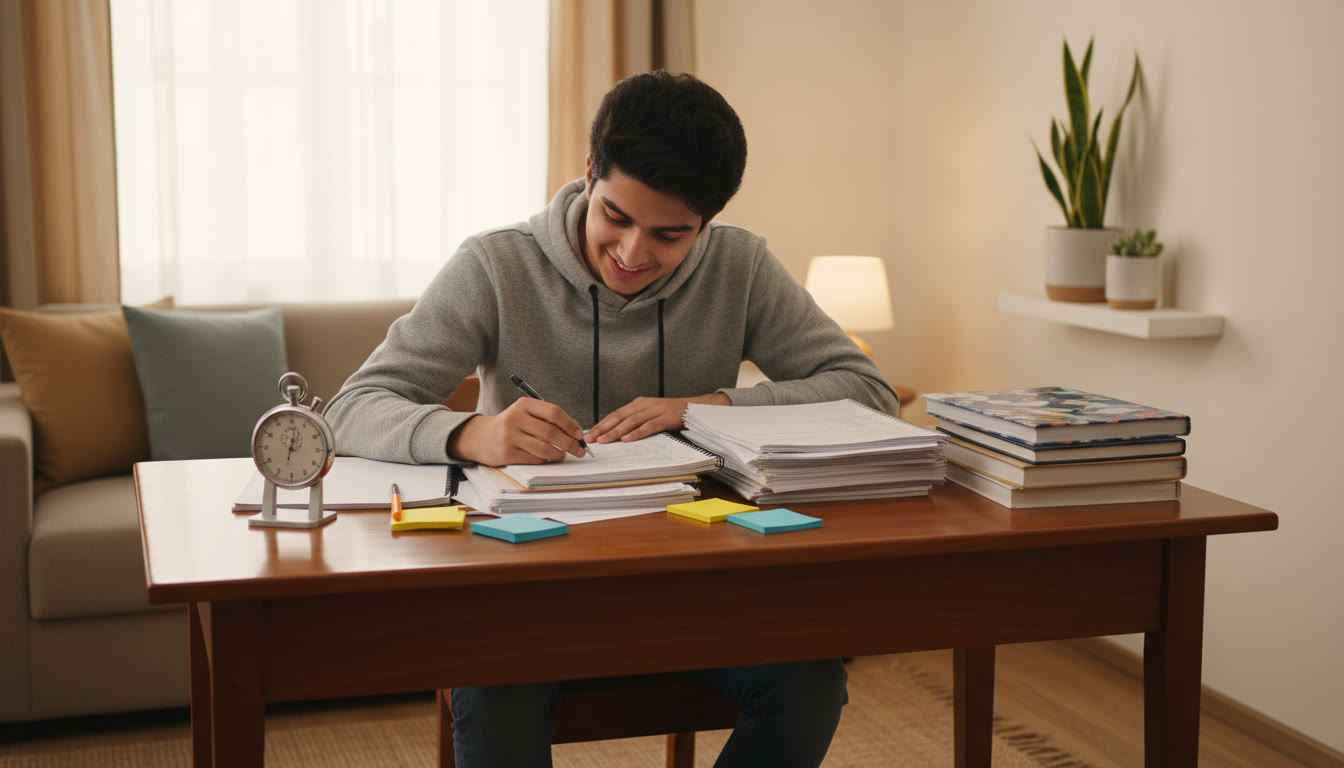

Why PYQs are the smartest place to focus your revision
If you could spend the next few weeks doing only one evidence-backed activity to raise your JEE Main score, making PYQs (previous-year questions) the spine of your revision would be the best choice. PYQs are not just a pile of papers; they are a concentrated lens into what examiners ask, how concepts are combined, and where marks are most reliably available under timed, negative-marking conditions.
This article gives a clear, human plan to turn PYQs into an engine for steady improvement: how to collect and categorize them, how to practice and time them, how to analyze errors so they stop repeating, and how to slot PYQs into full-length, three-hour mock practice runs. Everything here assumes the exam style you’re preparing for is MCQ-based, scored under negative marking, taken as full-length three-hour sessions in timed conditions, and requires strict answer-entry discipline (whether you’re using OMR-style sheets in mocks or a computer-based interface). Remember: PYQs are a tool for learning and pattern-recognition—not a shortcut for lazy memorization.
What PYQs actually tell you (and why that matters)
Solving PYQs does three powerful things:
- It shows repeated patterns: certain topics or question-types reappear in different disguises.
- It calibrates time and difficulty: you learn how long real questions take under pressure and which ones why cost you marks.
- It builds exam intuition: you begin to see the examiner’s logic—what shortcuts they expect, which steps are implicitly tested, and where careless arithmetic kills an otherwise correct approach.
Think of PYQs as both a mirror and a map: they reflect your weaknesses and mark the shortest, exam-proven path to scoring. Crucially, treat diagrams and derivations as learning tools that help you solve the problem—not as a request for long, descriptive answers. For MCQ exams with no partial marking, clarity and speed win.
Quick orientation on the exam-style features to plan around
- MCQ-based testing: practice option-based reasoning and elimination strategies rather than long descriptive answers.
- Three-hour full-length mock practice: simulate this format often to build stamina and time allocation instincts.
- Negative marking: learn safe-attempt strategies—attempt selectively and avoid wild guessing.
- Answer-entry discipline: practice whatever the mock interface is—OMR sheet handling for some paper mocks and clean, accurate clicking/entry for computer mocks.
- Syllabus alignment: focus PYQs by chapter within Physics, Chemistry, and Mathematics (and apply the same method if you’re also studying Biology for other exams).
Step-by-step framework: turning PYQs into high-value practice
Step 1 — Collect and curate your PYQs
Quality beats quantity. Gather PYQs year-wise and chapter-wise, but don’t let the pile overwhelm you. Create a simple tag system: Topic | Year | Difficulty (Easy/Medium/Hard) | Mistake type (Concept/Calculation/Carelessness). Save a single source of truth (a spreadsheet or study app) so you can sort and track progress. If you already have solved answers, keep them separate so your first pass forces you to think, not copy.
Step 2 — First pass: learn the pattern, not just the answer
Do an open-book first pass where your aim is to understand full solutions and spot the trick. Annotate each PYQ with three short notes: (1) core concept tested, (2) common trap or distractor, (3) one-line shortcut or approach. This makes later closed-book practice faster—because you’ve already mapped the terrain.
Step 3 — Closed-book timed practice and difficulty tagging
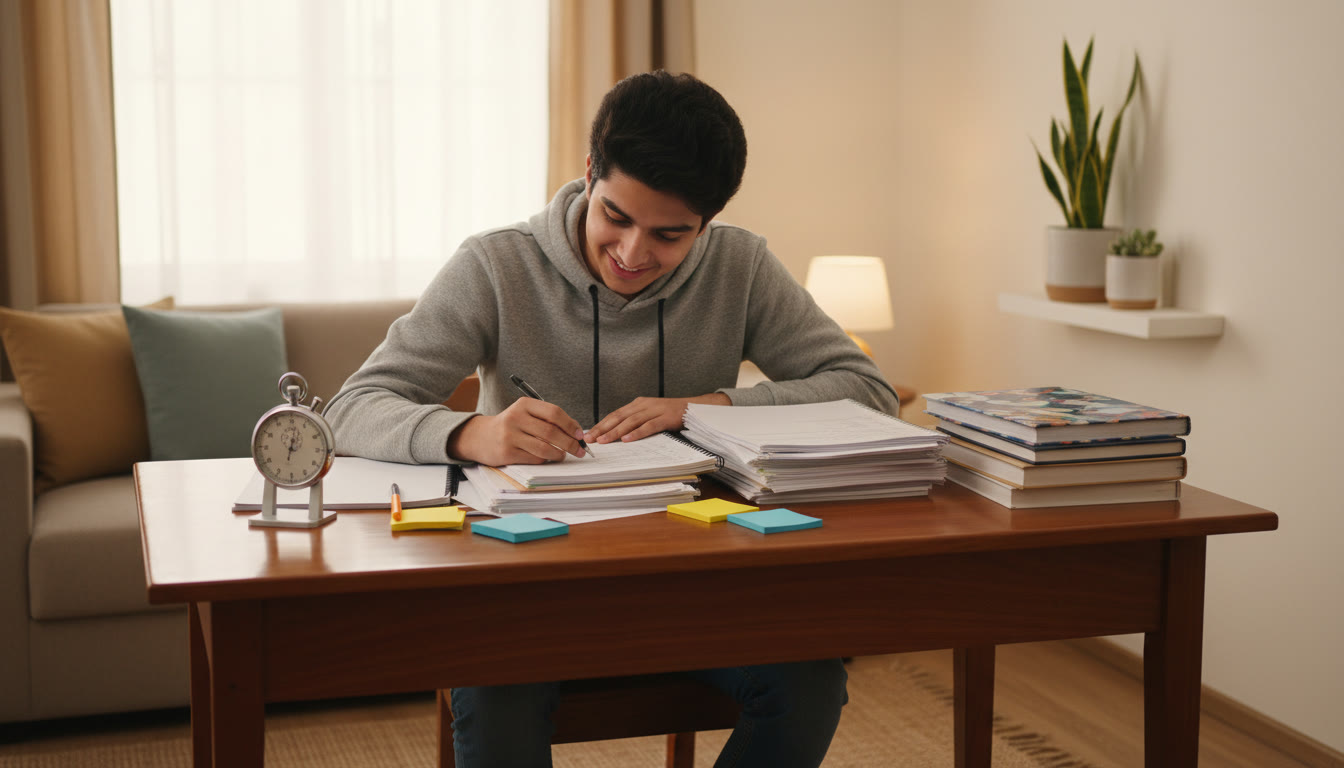
Now solve the same PYQs under timed conditions. Keep a stopwatch and simulate the three-hour full-length rhythm or break them into sectional 1-hour runs. After solving, mark each question as:
- Solved cleanly
- Solved after correction
- Not solved
Convert these into actionable items: prioritize ‘Not solved’ and ‘Solved after correction’ for immediate review.
Step 4 — Error log: the single most important habit
Maintain an error log that is concise and consistent. Each entry should contain:
- Question reference (topic, year, question no.)
- Type of mistake (conceptual, formula, arithmetic, interpretation, careless)
- Correct approach in 2–3 lines
- Target review date (spaced repetition slot)
Routinely review the error log in short bursts—five to ten minutes before bed or during short breaks. The habit of converting mistakes into tiny flashable notes makes sure errors don’t fossilize.
Step 5 — Spaced repetition and interleaving: how often to revisit each PYQ
Use a spaced schedule: immediate correction, review in 3–5 days, review in two weeks, then monthly. For topics you’re weak in, increase frequency. Don’t just re-solve the same question the same way: interleave problems from different topics and difficulty levels. This trains flexible retrieval under the kind of cognitive load you’ll face in a three-hour mock.
Practical weekly plan (compact table you can adapt)
Below is a sample six-week PYQ-focused plan you can adapt to your available time before the upcoming entry cycle. Tweak days and hours depending on how many hours you can study daily.
| Week | Main Focus | Daily Time (hrs) | Goal by Week-End |
|---|---|---|---|
| 1 | Collect PYQs, do open-pass review for two core chapters per subject | 3–5 | Organized PYQ bank + annotated notes |
| 2 | Timed closed-book solving of collected PYQs (sectional practice) | 3–5 | Initial error log with recurring mistakes identified |
| 3 | Full-length 3-hour mock + detailed analysis | 3–6 | One full mock score + correction plan |
| 4 | Target weak topics from error log; interleaved PYQs | 3–6 | Improvement in weak-topic accuracy |
| 5 | Two full mocks + rapid revision of common PYQ patterns | 4–6 | Steadier time management + fewer careless errors |
| 6 | Polish, light PYQs, formula/shortcut flash sessions | 2–4 | Consistent mock performance and calm test rhythm |
Subject-specific micro-strategies
Physics
Physics PYQs are often about selecting the right model and executing a few reliable steps. Build a set of mini-solution templates: energy-conservation shortcut, typical kinematics skeleton, circuit simplification checklist. When a PYQ uses a standard physical model in a subtle way, write down the ‘trigger’—the phrase or diagram detail that signals which template applies. Practice redrawing diagrams and labeling each force or vector—this reduces careless mis-reads.
Chemistry
Chemistry splits neatly into three kinds of PYQs:
- Physical chemistry numericals: practice units and approximations so arithmetic doesn’t slow you down.
- Organic chemistry reactions: memorize mechanism templates and common reagents; map them visually.
- Inorganic factual questions: make condensed flashcards for quick recall.
Use PYQs to highlight commonly tested reaction sequences and repeatedly tested facts rather than trying to memorize entire textbooks at the last minute.
Mathematics
Math PYQs reward pattern recognition. When you solve a PYQ, write down the method as a 3–6 step algorithm. Over time these tiny algorithms form a toolkit that helps you see the shortest path during a timed run. Don’t skip practice on ‘standard’ problems even if they feel routine—JEE-style PYQs often twist textbooks slightly to test flexibility.
Biology (if applicable to other exams you’re taking)
While JEE Main focuses on Physics, Chemistry and Mathematics, the PYQ approach translates straight to Biology for other entrance tests: map topic frequency, use diagrams liberally, and practice MCQs under timed conditions. Treat Biology PYQs as another dataset for pattern analysis and spaced revision.

Mock tests, negative marking and answer-entry discipline
Three-hour full-length mocks are the rehearsal room where all your PYQ practice must sound convincing. Run at least one full mock per week in the later stages of preparation and after each mock, spend at least twice the duration of the test analyzing mistakes—don’t just look at score; dig into time lost per question and question-type patterns.
Negative marking forces a conservative but smart attempt strategy. A quick rule-of-thumb: if you can eliminate one or two options and can logically justify the remaining choice in under a minute, attempt it; if you’re guessing blindly with no elimination, skip it. Practice marking answers in the same format as the actual test: if your mock is OMR-based, simulate filling OMR bubbles with steady pressure and neatness (many marks are lost to wrong entries, misalignment, or rushed shading). If your mocks are computer-based, practice accurate clicking and careful on-screen review—tabbing and mis-clicks are common error sources.
Sample sectional time approach for a 3-hour mock
- First 75 minutes: solve the 1st subject (fast but careful) and mark questions for review.
- Next 75 minutes: move to the 2nd subject with similar pacing.
- Final 30 minutes: attempt the remaining subject and return to flagged questions, avoiding fresh guesses unless you have logical eliminations.
How to use technology and personalized help effectively
Technology should amplify your revision—use a simple spreadsheet to track error logs, a timer app for sectional practice, and spaced-revision flashcards for formulae and reaction maps. Personalized guidance accelerates progress when it’s targeted: a tutor who reads your error log and corrects recurring conceptual gaps will save you weeks of ineffective practice.
Consider integrating tailored support where it fits naturally into your plan. Sparkl‘s personalized tutoring can help by offering 1-on-1 guidance, bespoke study plans that prioritize your weak PYQ patterns, expert tutors who convert mistakes into learning checks, and AI-driven insights that suggest which topics to revisit next. Pair that kind of focused mentoring with disciplined PYQ cycles for the highest leverage.
Common traps and how to avoid them
Students fall into a few repeatable traps with PYQs:
- Solving mentally and never writing: always write compact solutions so you practice the motor skill of working under time pressure.
- Repeating the same mistake: use the error log’s target review dates and force yourself to re-solve the same item after correction.
- Over-reliance on memorized tricks: if a trick works only because you recognized the exact previous wording, you’re vulnerable to small twists—practice conceptual backup plans.
- Neglecting timing: great accuracy with slow speed loses out in a three-hour exam. Always pair accuracy drills with timed rounds.
Final weeks checklist and calm exam rhythm
In the weeks before your test: reduce heavy new inputs and lean into PYQs that force retrieval of key concepts. Use short, daily PYQ rounds (30–60 minutes) for confidence maintenance; alternate that with full three-hour mock tests spaced to allow deep analysis time.
On the day of a mock or the exam, focus on answer-entry discipline: mark answers cleanly, re-check flagged questions only if you have time, and avoid last-minute frantic rework that invites careless mistakes. Your mock-test habit of precise OMR or computer-based entry will protect you from many avoidable mark losses.
Parting academic note
PYQs are a reliable, practical guide: treat them as data, not superstition. Structure your revision around collecting, categorizing, timed practice, error logging, and spaced re-testing. Pair that cycle with full-length three-hour mocks, disciplined answer-entry habits, and targeted subject micro-strategies. With steady, reflective practice—where mistakes become the syllabus of what to study next—you turn past questions into tomorrow’s score.



















No Comments
Leave a comment Cancel