
Common Mistakes While Solving PYQs
Previous year questions (PYQs) are one of the most valuable tools in a JEE aspirant’s toolbox — when you use them the right way. Too many students treat PYQs like a checklist to be ticked off, or a treasure map for which exact questions will reappear. The truth is kinder and tougher: PYQs reveal the exam’s logic, the way concepts are tested, and the habits that win marks under exam pressure. This post walks you through the common traps students fall into when practising PYQs and gives practical, exam-aware fixes you can use immediately.

Why PYQs are so useful — and where students commonly miss the point
PYQs are not just a question bank; they are a diagnostic instrument. A well-used PYQ tells you exactly which concepts are consistently important, how questions are framed, and what kinds of shortcuts or traps the paper-setters favour. Yet students often mis-use PYQs in a few predictable ways: memorising solution steps, ignoring weaker topics that rarely appear, or failing to simulate exam conditions. Because national-level testing is MCQ-based (with full-length mock tests typically run under 3-hour timing), involves negative marking for incorrect attempts, and demands strict answer-entry discipline, practice must reflect those constraints. Treat diagrams, derivations, and rough notes as learning tools — they help you understand the concept, not decorate your answer sheet.
Top mistakes students make when solving PYQs — and the fixes that work
Mistake 1: Memorising solutions instead of the underlying concept
What happens: You can reproduce a solved answer because you memorised steps, but when the problem is reworded or slightly altered you get stuck.
- Why it’s damaging: Exams rarely repeat questions verbatim. You need transferable understanding, not rote recall.
- Fix: After you solve a PYQ, write the one-line conceptual takeaway (e.g., “conservation of energy with non-conservative work applies when…”) and then create a one-sentence variation of the problem and solve that variation without looking.
Mistake 2: Not simulating exam conditions (timing, negative marking, isolation)
What happens: You solve freely with a calculator, extended time, or with solution videos; in the real test, stress and time pressure change everything.
- Why it’s damaging: Time pressure magnifies silly errors and poor strategy choices.
- Fix: Do full-length mocks under timed conditions, enforce the negative-marking rule you’ll face in the actual paper, and practise with the same type of answer entry you’ll use — whether computer-based or OMR-style simulations used by many test-prep sessions.
Mistake 3: Aimless guessing; ignoring elimination strategies
What happens: In an attempt to increase attempts, students guess wildly and suffer because negative marking punishes random errors.
- Why it’s damaging: One correct guess doesn’t compensate for multiple wrong ones.
- Fix: Use elimination rules. If you can eliminate one or two options confidently, the expected value of an educated guess can be positive; if not, skip. Practise the math of expected value on past MCQs until you’re comfortable with when guessing helps and when it harms.
Mistake 4: Not analysing errors properly — repeating the same mistake
What happens: After a mock, you look at right/wrong counts but don’t track the reason for error: conceptual gap, calculation slip, or misreading the question.
- Why it’s damaging: Without categorising errors, you can’t fix root causes.
- Fix: Maintain an error log with these columns: question ID, topic tag, reason for error (conceptual/calculation/careless/interpretation), correction action, re-test date. Revisit each logged error after a fixed interval.
Mistake 5: Overfitting to patterns — expecting the same tricks to reappear
What happens: Students assume because a certain trick appeared often in previous cycles it will keep appearing in the same way.
- Why it’s damaging: Examiners change emphasis; relying on pattern-hunting is fragile preparation.
- Fix: Use PYQs to identify important concepts and testing styles, not to memorize specific shortcuts. For every observed pattern, ask “why is this concept important?” and practice related problems that vary contexts.
Mistake 6: Sloppy OMR/answer-entry practice
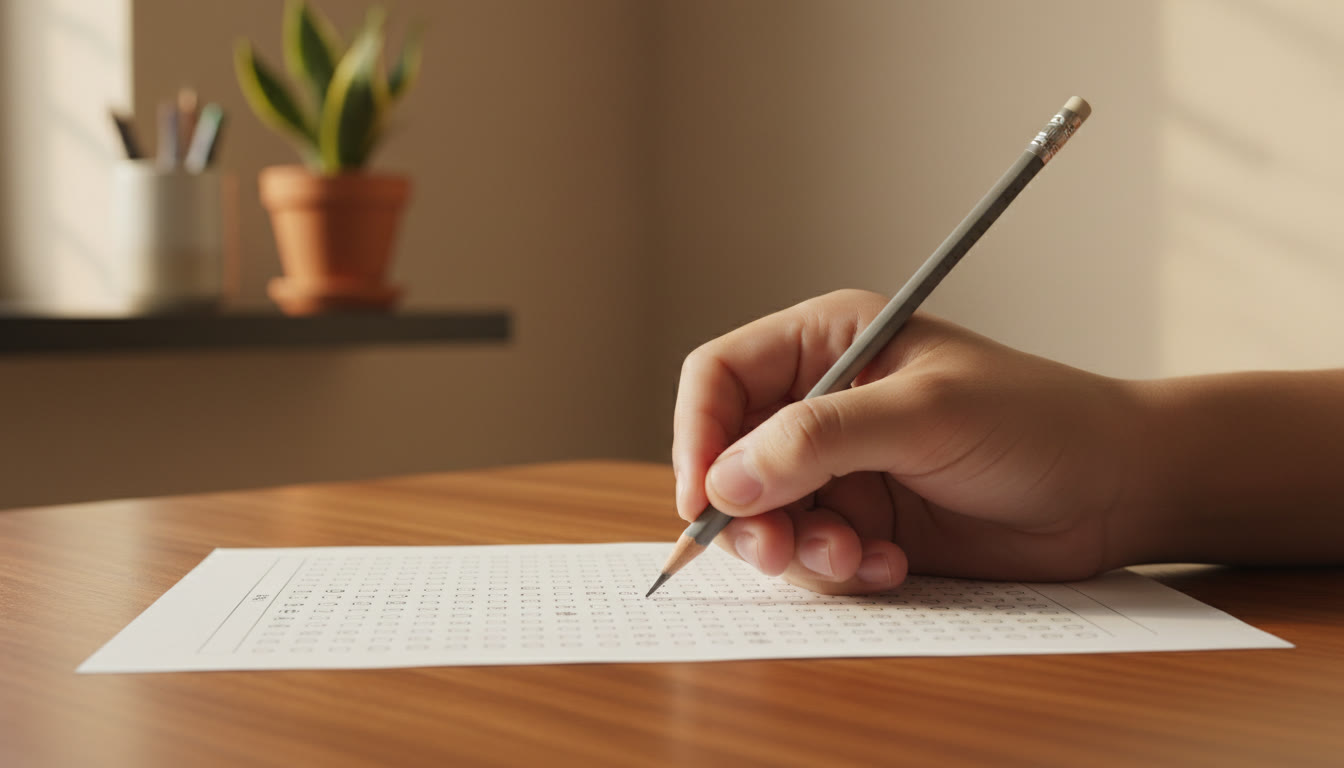
What happens: In simulations or pen-and-paper practice you mark the wrong bubble, smear answers, or transfer answers inaccurately — all of which cost marks in a real test.
- Why it’s damaging: Careless answer entry can convert correct knowledge into zero marks.
- Fix: Practise disciplined marking: darken bubbles fully, avoid crossing answers, follow any time-saving conventions the test permits, and practise the exact answer-entry medium you’ll use. If you need targeted coaching to fix habit issues, consider personalised one-on-one guidance like Sparkl‘s tutoring that focuses on exam habits.
Mistake 7: Ignoring topic mapping — solving PYQs without linking to the syllabus
What happens: You solve dozens of PYQs but don’t tag them by topic. When revision time comes, you don’t know which subtopics need attention.
- Why it’s damaging: You can waste weeks re-solving problems that test the same tiny idea while neglecting untested or weak areas.
- Fix: Tag each PYQ with syllabus codes (e.g., Mechanics → Kinematics → Relative motion). Use that map to prioritise a week-by-week revision plan.
Mistake 8: Relying on long written solutions without re-solving yourself
What happens: You read solutions and assume you’d reproduce them under time pressure. Passive exposure doesn’t equal mastery.
- Why it’s damaging: Passive reading increases familiarity but not fluency.
- Fix: Read a solution only after you’ve attempted the problem and recorded your approach. If you couldn’t solve it, re-solve after studying the concept, then compare methods.
Mistake 9: Arithmetic and unit errors (small slips with big consequences)
What happens: You lose marks because of unit mismatches, sign errors, or careless arithmetic even though your conceptual route was correct.
- Why it’s damaging: One arithmetic slip can flip a correct solution to wrong in MCQ format.
- Fix: Build quick checks into every solution: estimate the order of magnitude, verify units, and do a reverse-check (plug your answer back into the original equation where possible).
Mistake 10: Treating diagrams and derivations as unnecessary fluff
What happens: Students skip carefully drawing diagrams or writing the first principles and try to use memorised shortcuts instead.
- Why it’s damaging: Diagrams and stepwise derivations often reveal constraints and signs that shortcuts miss.
- Fix: For every geometry, optics, or mechanics problem, sketch a neat diagram. For derivations, write the principle (e.g., Newton’s second law, conservation of charge) as your first line; it clarifies assumptions and reduces sign errors.
Mistake 11: Not re-attempting a PYQ after correcting the mistake
What happens: You understand the correction theoretically but never re-test yourself on that variant, allowing the error to re-emerge in the next mock.
- Why it’s damaging: Learning without spaced re-testing is forgetful learning.
- Fix: Re-attempt the same question (or a close variant) after a delay — use spaced repetition to cement the fix.
Mistake 12: Failing to prioritise — spending excessive time on low-yield questions
What happens: You perfect one niche topic but miss covering several medium-weight topics that collectively carry more marks.
- Why it’s damaging: JEE-style exams reward broad competence and efficient selection.
- Fix: Use topic-weight data from PYQs to build a Pareto-style plan: focus first on high-frequency, medium-difficulty items that deliver consistent marks.
A quick-reference table: Mistake, impact and quick fixes
| Common Mistake | Impact in a Mock | Quick Fix |
|---|---|---|
| Memorising steps | Fails when question is varied | Extract the core concept and solve a variation |
| No timed simulation | Poor time/pressure performance | Do full-length timed mocks regularly |
| Aimless guessing | Net score loss via negative marking | Use elimination & expected value rules |
| Poor error analysis | Same mistakes repeat | Keep an error log with categories |
How to analyse PYQs correctly — a four-step routine
Adopt a short, repeatable routine every time you finish a PYQ set. Consistency matters far more than intensity.
- Step 1 — Immediate review (within 24 hours): For every question, record whether you were correct and why you were wrong if applicable.
- Step 2 — Categorise errors: Tag each mistake as conceptual, careless, calculation, or misinterpretation. This tells you whether to revise theory, slow down, or practise arithmetic.
- Step 3 — Fix & re-test: Do targeted micro-drills for the weak category, then re-attempt similar questions without looking at solutions.
- Step 4 — Spaced reinforcement: Revisit logged errors after a week and after three weeks. If you still get the same type wrong, escalate to one-on-one coaching or focused study blocks.
Practical in-test habits drawn from PYQ practice
What you practise becomes habit. Use these concrete in-test habits to convert PYQ practice into exam performance.
- First-pass strategy: Quickly attempt the easy, high-confidence questions to secure marks and build momentum.
- Second-pass strategy: Tackle medium-difficulty items and use elimination to avoid bad guesses.
- Third-pass strategy: Reserve remaining time for the toughest items; use intelligent guessing only if elimination yields a favourable expected value.
- Micro-checks: After key calculations, do a 10–20 second sanity check on units and magnitude.
- OMR/entry discipline: If your mock uses OMR, practise darkening the bubble cleanly and avoid stray marks; if your actual exam is computer-based, use the same navigation and marking flags you’ll have on test day.
When to seek personalised help — and what to look for
Many mistakes are behavioural: hasty reading, arithmetic sloppiness, or poor timing. If error logs repeatedly show the same category of mistakes, that’s the moment to get focused help. Personalised tutoring can accelerate fixes by providing one-on-one feedback, targeted micro-drills, and habit correction.
For example, when a student keeps making careless sign errors in mechanics despite knowing the formulas, a tutor can isolate the exact decision point where the error happens and use short, repetitive practice drills to correct the habit. If you want bespoke support for pattern analysis, time management, or correcting repeated error types, tailored guidance such as Sparkl‘s personalised tutoring can provide 1-on-1 coaching, tailored study plans, and AI-driven insights to speed up the correction process.
Sample weekly plan to integrate PYQs (compact and realistic)
| Day | Focus | Duration | Objective |
|---|---|---|---|
| Monday | Topic revision + 10 PYQs (timed) | 3 hours | Reinforce core concept; log errors |
| Wednesday | Full-length timed PYQ set (mixed) | 3 hours | Simulate exam conditions |
| Friday | Targeted micro-drills on logged errors | 2 hours | Fix repeated mistakes |
| Sunday | Review & re-attempt a corrected PYQ set | 2 hours | Spaced repetition |
Quick practical checklist before a full-length mock
- Know the marking rules and practice with the same negative-marking scheme.
- Decide your first-pass time limits per section and stick to them.
- Arrange a quiet, uninterrupted environment and use the same answer-entry medium (OMR practice or computer simulation).
- Keep a fresh error-log sheet and a timer visible; after the test, do the error categorisation immediately.
Small examples that illustrate common PYQ traps
1) A kinematics question gives an initial speed and asks for the time to reach a plane; a student drops the sign on acceleration and picks the negative root — a sign oversight, not a conceptual failure. Quick fix: always label directions and put signs in the first line of work.
2) A chemistry equilibrium problem expects recognition of a limiting step; a student plugs in values into an equilibrium expression without checking stoichiometry first. Quick fix: write the balanced reaction as step one and annotate mole changes before calculating.
3) In a maths integration question, a student recognises a substitution but forgets to change bounds in definite integration and carries out the calculation incorrectly. Quick fix: always write the substitution and new limits underneath the substitution line.
Final notes — turning PYQs into growth, not anxiety
PYQs are a mirror. If you treat them as a test of memory, you’ll get shaky results; if you treat them as a diagnostic that reveals how you think under pressure, they become the fastest route to consistent improvement. The difference is small in practice — take 10 minutes after every mock to categorise mistakes, plan two targeted drills, and re-test with spaced repetition. With disciplined analysis, clear tagging, timed re-attempts, and an honest error log, PYQs will stop being a checklist and become a performance engine.
Fix the pattern, not just the problem: correct the habit that produced the mistake and re-test until the habit changes. This is the academic path to turning PYQ practice into reliable exam performance.




















No Comments
Leave a comment Cancel