
How to Optimize Time in Exam: A Practical Playbook for JEE Aspirants
You’ve done the learning. You’ve scribbled formula sheets, sat through hundreds of practice problems and rewind/re-watched tricky derivations. Now the clock becomes a teammate and, sometimes, an adversary. Optimizing time in an exam isn’t about rushing — it’s about making every minute multiply your score. This guide speaks plainly: MCQ-based testing, the reality of negative marking, OMR/answer-entry discipline, and the three-hour full-length mock practice are not abstract lines on a syllabus. They define how you must plan, practice, and perform.

A quick reality check
Exams in the current entry cycle are MCQ-driven and designed to reward speed plus accuracy. You’ll sit for a long, concentrated stretch (typically a three-hour window), so energy management, question selection, and disciplined answer marking matter as much as raw preparation. Negative marking means a wrong guess can hurt your score; thoughtful elimination and confident attempts beat frantic answering. Whether your test uses a computer interface or an OMR-style sheet, the discipline of marking answers correctly — and keeping rough work organized — is non-negotiable.
Mindset first: treat time as a resource, not a hurdle
Begin by changing the question. Instead of asking “How much time can I save?” ask “How can I allocate time so my strengths convert to marks, and my weaknesses don’t steal minutes?” Time optimization is a set of decisions you make before and during the paper: which questions to attempt now, which to flag, how long to spend on a calculation, when to trust an elimination, and when to move on. Those decisions are trainable.
The two-speed approach
- Speedy-first-pass: skim and secure — pick the low-hanging, high-confidence questions you can solve quickly.
- Deliberate-second-pass: focus on the tougher problems with longer thought cycles, derivations, or multi-step calculations.
Train both speeds in practice. The first pass builds momentum and reduces anxiety; the second pass captures value where most marks hide.
Before the exam: plan practice to mirror the exam
Practice must be exam-faithful. That means 3-hour full-length mock practice under realistic conditions (same breaks, same interface or answer sheet rules, same calculator rules if any). Don’t treat a practice mock as a learning problem set — treat it as a simulation. Time it, resist looking up solutions mid-test, and replicate the pressure.
Weekly structure that scales
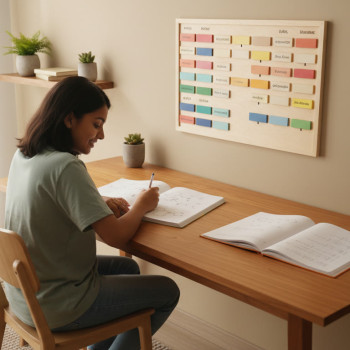
Consistency beats sporadic heroics. Use block scheduling: alternating days of focused concept-building, problem practice, and full or sectional timed tests. Reserve one day a week for consolidation: error log review and a short timed session to convert mistakes into mastered techniques.
| Day | Morning | Afternoon | Evening |
|---|---|---|---|
| Mon | Concept study (Physics) | Problem set (Physics) | Revision notes + 30-min recall |
| Tue | Concept study (Chemistry) | Timed practice (Chemistry) | Errors + flashcards |
| Wed | Mock-section (Math) | Derivation practice | Light problem-solving |
| Thu | Full-length test (3-hour mock) | Rest + light review | Test analysis |
| Fri | Targeted revision | Application problems | Group doubt session |
| Sat | Alternate subjects quick tests | Timed mixed problems | Summary sheets |
| Sun | Rest or light reading | Weekly consolidation | Plan next week |
This table is a flexible skeleton. Adjust according to strengths and upcoming test windows, but keep the 3-hour mock practice as a weekly or bi-weekly ritual — it’s the single best way to tune pacing.
Design focused practice sessions
- Short drills (30–60 minutes) for speed on standard MCQs.
- One hard-problem hour to build stamina for multi-step questions.
- Active recall sessions: close the book and write out key formulas, diagrams, or derivations without looking.
Subject-wise time allocation strategy
Different subjects demand different rhythms. Physics often needs careful reading and a plan before writing equations; Chemistry mixes quick theory and long organic mechanisms; Mathematics can swing between a 2-minute trick and a 20-minute heavy-lift question.
Rules of thumb
- Use your strengths early: open with the subject or section in which you are fastest and most accurate to build confidence and bank marks.
- Allocate time by question type: quick conceptual MCQs first, calculation-heavy later.
- Don’t let a single long problem monopolize more than one clearly defined time-box unless it promises a near-certain return.
During the exam: tactical time moves that win marks
Think of the exam as having three phases: first sweep, deep work, and review. A disciplined plan for each phase prevents panic and ensures you capture value across the paper.
Phase 1 — First sweep (30–40 minutes)
- Quickly read every question and mark: Attempt, Review, Skip (or Flag).
- Answer all clearly easy questions immediately — these are your base score.
- Avoid arithmetic-heavy ones unless they’re clearly fast; speed here is your friend.
Phase 2 — Deep work (next 100–110 minutes)
Work on flagged medium and hard questions. Use a mental stopwatch: give each problem a strict time-box depending on its expected complexity. If the problem exceeds that time, move on and come back later with fresh eyes.
Phase 3 — Review and polish (final 20–30 minutes)
- Return to skipped questions with a calm, elimination-based approach.
- Verify calculation steps on any question where you guessed or felt shaky.
- Check answer entry: wrong bubbles or mis-clicks on OMR/CBT are preventable losses.

Smart guessing and negative marking
Negative marking punishes random guessing. Use elimination: if two options remain and you can confidently eliminate the others, the odds favor an attempt. If uncertainty is total (no elimination possible), it’s often safer to skip. Practice making these judgment calls in mocks so your risk tolerance is calibrated under pressure.
Practical OMR / answer-entry discipline
Whether using a computer interface or filling bubbles, follow a routine: read, calculate, write final answer on your rough sheet, then transfer carefully. When using rough sheets, mark the question number clearly near the work. When using a computer, double-check the question number before finalizing the choice. Small transfer errors are cheap to prevent and expensive to correct later.
| Exam window (example) | Focus | Goal |
|---|---|---|
| First 30–40 min | First sweep | Secure all easy marks |
| Next 100–110 min | Solve medium/hard | Attempt high-return problems |
| Last 20–30 min | Review & answer entry | Error check and fill blanks |
After the mock: analysis that rewires performance
Mocks are data — not a praise or a punishment. Immediately after each timed test, do a calm post-mortem within 24 hours. Note three things: mistakes you repeated, problems that ate time, and neat wins you can repeat. Your error log should be short, specific, and action-driven: list the root cause (concept gap, silly mistake, calculation slip), the fix, and a mini-drill to test the fix.
How to analyze effectively
- Rank errors by frequency and by time lost. Fix the frequent, low-time errors first (silly mistakes); then address occasional, high-time losses (conceptual gaps).
- Re-solve missed problems without looking at solutions. If you still struggle, write a one-paragraph explanation in your own words and add it to a revision sheet.
- Track improvement over three mock cycles to know if a strategy is actually working or just comforting.
For many students, guided analysis accelerates improvement. If you explore tailored support, consider Sparkl‘s personalized tutoring for 1-on-1 guidance, tailored study plans, expert tutors, and AI-driven insights that help identify time sinks and high-yield strengths. Use external help to build an objective error plan, not just to explain solutions.
Study habits that actually save time
Efficient studying is not simply faster studying — it’s higher-return studying. Replace passive reading with active tools that compress recall time when it matters most.
High-impact habits
- Spaced repetition: review formulas and core ideas at increasing intervals so recall in an exam is automatic.
- Error log: a single-page one-liner for each recurring mistake; review it daily for the week after the mistake and weekly thereafter.
- Summary sheets: a double-sided formula sheet for each subject that you can revise in 10–15 minutes.
- Timed micro-tests: 20–30 minute drills focusing on a single concept or question-type to build speed and pattern recognition.
Use diagrams and derivations as speed tools
Diagrams and concise derivations are not there for aesthetics — they convert thinking time into recognition. When a physical scenario appears in Physics, a neat sketch removes ambiguity. For Maths, a short outline of the approach often saves 5–10 minutes versus starting algebraic grind. Treat these aids as exam-time shortcuts, not classroom decorations.
Common time traps and how to avoid them
- Trap: Spending too long on a single problem. Fix: enforce a time-box and move on when it expires.
- Trap: Transferring answers carelessly. Fix: develop a calm transfer routine and practice it in every mock.
- Trap: Re-doing solved questions in review. Fix: mark the level of certainty (High/Medium/Low) during initial attempt and only recheck Medium and Low during review unless time allows.
- Trap: Starting with your weakest subject. Fix: open with your strongest subject to secure marks and calm nerves.
Sample day plan on a test-prep week
| Time | Activity |
|---|---|
| 6:00–7:00 | Light revision + formula recall (no screens) |
| 8:00–10:00 | Full-length mock / sectional test |
| 11:00–12:00 | Short break + review of critical mistakes |
| 14:00–16:00 | Focused subject practice (weak topics) |
| 17:00–18:00 | Speed drills (30–40 MCQs) |
| 19:00–20:00 | Write summary sheets and plan next day |
Notice the rhythm: intense focus blocks separated by recovery windows. Your brain needs short rests to consolidate solutions and avoid sloppy mistakes.
Final practical checklist before you walk into the exam hall
- Sleep and nutrition: treat the night before like a tool — marginal gains in rest beat late-night cramming.
- Materials: admit only the allowed items and practice with them beforehand so nothing is unfamiliar.
- Mindset: start with 5 deep breaths. Your first minutes decide whether you run a calm race or react to stress.
- Time anchors: set small checkpoints (for example, first sweep done in X minutes) and stick to them; adjustments are fine but don’t abandon the anchors entirely.
Conclusion
Optimizing time in an exam is a repeatable skill: build it by simulating the three-hour reality, training both speed and depth, analyzing mock tests with ruthless clarity, and enforcing simple in-exam routines that prevent small mistakes from becoming big losses. When you treat every minute deliberately — assigning it a purpose, practicing that purpose, and reviewing outcomes — time stops being an obstacle and becomes one of your strongest allies in converting preparation into marks.


















No Comments
Leave a comment Cancel