
How to Plan 4 Years for JEE Success: A Student-Friendly Roadmap
If you’re thinking about JEE and you’ve got four years to prepare, you have a rare advantage: time. Four years lets you build a foundation, develop reliable study habits, and ramp up intensity without burning out. The exam you’re aiming for is MCQ-based, taken under strict OMR/exam-discipline conditions, usually simulated in full-length 3-hour mock tests with negative marking for wrong answers. That means early, steady practice — not last-minute magic — is what pays off.
This guide is written for steady learners: students who want a plan that grows with them, who want concrete weekly and yearly milestones, and who value both deep conceptual clarity and realistic mock-practice. I’ll sketch a year-by-year roadmap, subject-by-subject tactics, mock-test strategy, study techniques that actually work, and common pitfalls to avoid. Wherever it fits naturally, I’ll mention how tailored 1-on-1 guidance or AI-driven insight can amplify your progress.

Why a four-year plan works
Four years lets you transform preparation from frantic cramming into cumulative mastery. In year one you plant seeds — conceptual clarity, comfortable math mechanics, and chemistry intuition. In year two you strengthen the trunk — problem-solving stamina, topic depth, and pattern recognition. Year three is where you refine speed, accuracy, and exam temperament with frequent full-length practice. The final stretch is consolidation: mistake correction, strategic revision, and simulated exam discipline.
Benefits of a staged plan:
- Reduced panic: steady progress lowers anxiety and reduces disruptive late-stage cramming.
- Deeper retention: spaced learning makes concepts stick, which is vital because JEE testing rewards flexible application rather than rote recall.
- Room for reflection: time to analyze mistakes, adapt techniques, and calibrate pace.
Year-by-year roadmap at a glance
| Year | Primary focus | Typical weekly hours (range) | Key milestones |
|---|---|---|---|
| Year 1 — Foundation | Concept building, curiosity, clean notes | 8–12 | Finish core school syllabus topics once; start topic-wise problem sets; maintain concise notes |
| Year 2 — Strengthening | Applied practice, mid-level problem solving | 10–16 | Complete standard problem sets for major topics; begin weekly tests; first full-length mock |
| Year 3 — Acceleration | Speed, accuracy, frequent full-length mocks | 15–25 | Weekly or biweekly full-length mocks; rigorous error analysis; focused topic clearance |
| Year 4 — Consolidation | Revision cycles, high-frequency timed mocks | 20–30 | Strong performance on timed mocks; refined OMR discipline; steady accuracy under exam conditions |
Year 1 — Foundation: curiosity and clean habits
Start with the basics: learn definitions, build a mental map of each subject, and get comfortable with derivations and diagrams. Your aim is conceptual clarity: know why a formula works, don’t only memorize it. Build tidy, searchable notes (digital or paper) that capture the essence of a topic in a page: key formulas, typical tricks, and 2–3 solved example problems.
- Daily habit: 45–70 minutes of focused study per subject, with short breaks and active recall at the end of each session.
- Weekly habit: one topic test that mixes problems already studied; write a short reflection: “What confused me?”
- Do not rush mock tests yet — start with short timed topic tests and slow, careful analysis of mistakes.
Personalized feedback helps greatly at this stage: 1-on-1 guidance can set the right foundations, correct misconceptions early, and build a study rhythm that suits your strengths. If you choose to work with a tutor, look for someone who emphasizes conceptual explanations and gives clear, focused homework.
Year 2 — Strengthening: bridge to problem solving
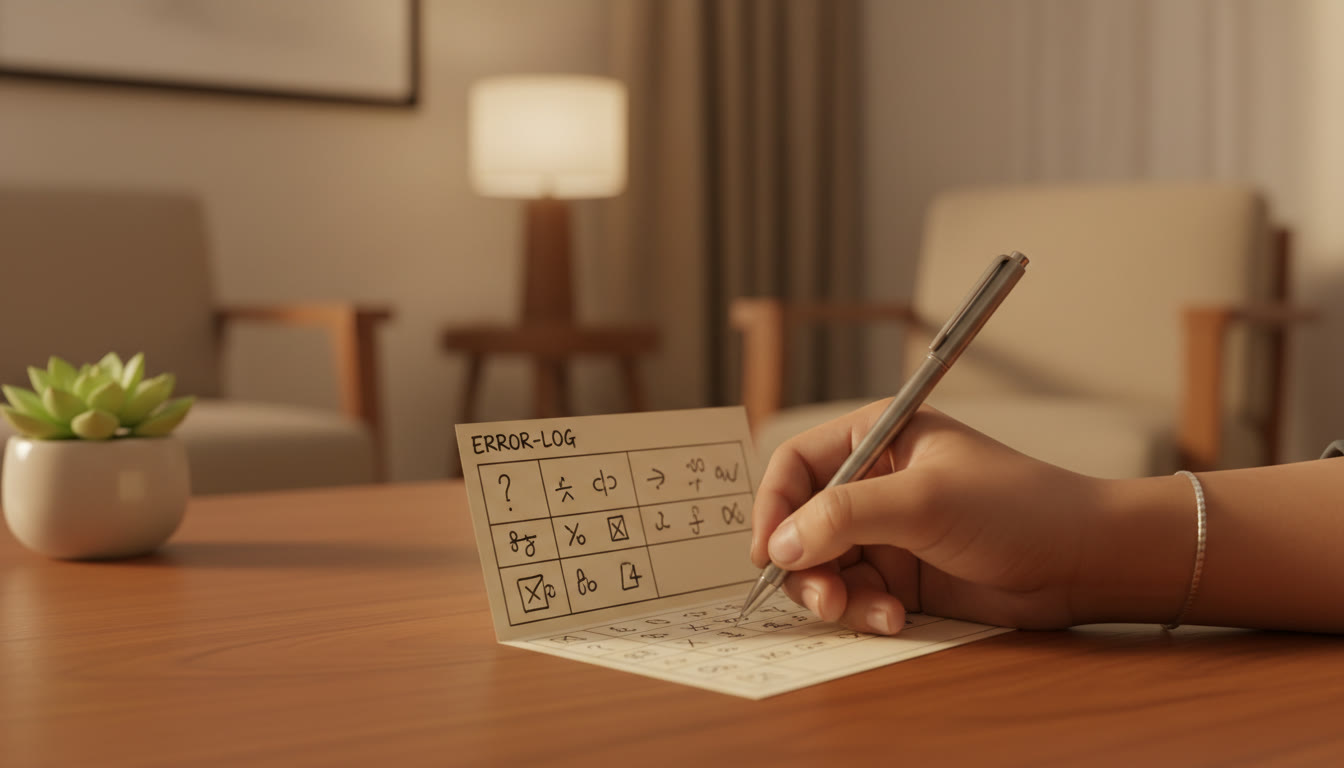
In year two you move from understanding to applying. Increase problem difficulty gradually. Start timing yourself on sets and learn to switch strategies if the first method stalls. Keep a persistent error log: every new mistake should go into it with a short note on how you fixed it. That log becomes gold when you revise.
- Introduce weekly cumulative tests that cover several topics together.
- Balance breadth and depth: finish moderate-to-hard problems for high-frequency topics; keep revisiting weak topics often.
- Begin a light mock-test routine: one full-length simulation every 1–2 months, focusing on exam discipline and time awareness.
Year 3 — Acceleration: mocks, timing, and real-exam habits
This is the year where practice becomes surgical. Increase full-length mock frequency: during the later part of this stage, you should be doing full 3-hour simulations at least every week or two, under strict exam conditions. Treat each mock as a diagnostic tool: do a thorough error analysis and convert each recurring mistake into a micro-action — e.g., “practice 10 projectile motion numeric problems” or “memorize the exceptions in a chemistry reactions list.”
A few exam-specific notes to keep in mind: the real exam is MCQ-based; wrong answers can attract negative marking; OMR discipline matters (no stray marks, clean erasures). That means timing, accuracy, and exam etiquette are as important as hard problem practice.
At this stage, targeted mentorship or AI-driven insights can help accelerate improvement: adaptive practice that spots repeated mistake patterns and suggests specific drills reduces wasted time and keeps you focused on the highest-impact adjustments.
Year 4 — Consolidation: revision, targeted mocks, and mental readiness
The final year is about consolidation. Switch your aim from learning new territory to strengthening recall and reliability. Use spaced repetition cycles for high-value formulas and methods; create a short “cheat-sheet” for each subject that you can review daily. Ramp up mock frequency and simulate exactly the exam environment: full 3-hour blocks, same break schedule, and strict OMR practice. Practice filling OMRs under time pressure to eliminate last-minute slip-ups.
- Prioritize error correction: don’t just re-solve a problem; identify why you erred and create a small drill to prevent its recurrence.
- Finalize your exam-day routine: breakfast, travel time buffer, stationary checklist, and a calm pre-exam warm-up problem set.
Subject-wise strategies
Physics
Physics rewards a blend of conceptual thinking and numerical fluency. For each topic, focus on the physical picture first (what’s moving and why), then derive the key relation yourself rather than just reading it. Practice derivations to the point where you can reproduce core steps without notes — this builds understanding that survives stress on test day.
- Techniques: dimensional checks, limiting-case reasoning, and sketching quick free-body diagrams or field lines.
- Practice: solve a mix of short and extended problems; for extended problems, break them into sub-questions and time each part.
Chemistry
Chemistry is threefold: physical, organic, and inorganic. Use different study languages for each: physical chemistry needs numerical practice; organic chemistry needs mechanism mapping and pattern recognition; inorganic chemistry benefits from categorization and memory techniques. Build reaction maps, group similar reactions, and keep short mnemonic cards for tricky inorganic facts.
- Practical tip: convert mechanisms into 3–5 step templates that you can adapt to new molecules.
- Practice: dedicate short, frequent review sessions for reaction lists so you retain them across months.
Mathematics
Mathematics is practice-heavy. The more problem types you see, the faster you’ll recognize patterns. Start by mastering standard techniques (algebraic manipulation, standard inequalities, coordinate geometry basics) and keep revisiting them in mixed-problem sets. For geometry and algebra, writing tidy, logical steps saves time when you’re under pressure.
- Strategy: maintain a “toolbox” of methods — substitution tricks, canonical factorizations, common limits, and transformation ideas.
- Practice: timed problem sets and error logs. For every problem you couldn’t solve, note the reason and create a 5-problem drill targeting that weakness.
Mock tests and exam simulation
Mocks are your true measuring instrument. They replicate the exam’s MCQ format, time pressure, and negative marking. Treat them as experiments: don’t just take the test — analyze every wrong and every guessed answer. Find the decision pattern that led to that guess and decide a rule: should you attempt similar questions later, or skip them?
| Mock Phase | Frequency | Focus |
|---|---|---|
| Early phase | Monthly | Simulate, analyze method, build stamina |
| Mid phase | Fortnightly | Timing, sectional balance, and refined error corrections |
| Final phase | Weekly (or more) | Exam temperament, OMR practice, and consistent scoring |
How to allocate 3 hours in a full-length mock
Every student’s tempo is different, but here’s a principled approach: allocate rough time blocks per section, reserve a review window at the end, and practice sticking to the plan. The exam environment and negative marking reward calm, selective answering over frantic guessing. Practice writing in the OMR format and leaving neat marks so scanning errors don’t cost you points.
Study techniques that actually work
- Active recall: Close the book and reproduce the idea. Ask yourself: “What are the exact steps?”
- Spaced repetition: Schedule timed returns to topics — first after a day, then after a week, then after a month.
- Interleaving: Mix topics in practice sets so your brain learns to choose the right technique rather than reacting by topic label.
- Feynman technique: Teach a concept in plain words. If you can’t, you haven’t learned it yet.
- Error logs: Maintain a concise list of mistakes and the corrective drills. Review this list before every mock.
Example: For projectile motion problems, instead of repeating the same solved example, create ten short variations that change one parameter at a time (angle, initial speed, height). That variation builds flexible skill much faster than passively reading solutions.
Weekly micro-plan (sample)
Here’s a sample weekly structure you can adapt. The idea is sustainable repetition with focused intensity on weak spots.
- Daily: 2–3 hours of dedicated self-study (post-school) with one focused subject block of 60–90 minutes.
- Three times a week: short timed problem set (45–90 minutes) on a single topic.
- One session per week: mixed-topic test (60–120 minutes) followed by detailed error analysis.
- One rest or light-revision day: review notes and flashcards, light exercise, mental reset.
Balancing school, health, and long-term momentum
Board tests and school life will coexist with your JEE path. Use the overlap: school classes are a source of structured exposure, and most school syllabus topics map to the exam syllabus. Do not neglect sleep — 7–8 hours supports memory consolidation. Schedule short breaks and simple exercise; the brain rewards small, consistent rhythms more than heroic all-night sessions.
Burnout prevention tips:
- Set weekly goals, not only daily ones. Progress is measurable and more motivating when you see it accumulate.
- Keep a short list of enjoyable micro-habits (15–30 minutes) so you can decompress without derailing study momentum.
- If you use personalized tutoring or analytic platforms, ensure they help you prioritize drills rather than overwhelm you with infinite practice.
Common pitfalls and how to fix them
- Over-reliance on tricks: fix by building conceptual understanding and using tricks only as shortcuts.
- Inconsistent revision: fix by scheduling spaced repetition explicitly on your calendar.
- Ignoring weak topics: treat each weakness as a small project with 3–5 drills.
- Poor mock analysis: fix by writing an error-correction plan after every mock and actually doing the drills.
How guided support can amplify a four-year plan
Personalized help can speed up the debug loop: a tutor who gives focused assignments, corrects recurring mistakes, and holds you accountable shortens the path from confusion to competence. Similarly, adaptive practice that uses data to suggest the next drill reduces wasted effort. For students who choose guided support, 1-on-1 sessions combined with tailored study plans and periodic analytic feedback often turn plateauing effort into steady score gains.
One example approach: pair a weekly full-length mock with a guided 30–45 minute analysis session. The coach or mentor helps you spot patterns you might miss alone (e.g., a tendency to rush algebra-heavy problems) and assigns a compact corrective drill for the week.
If you explore guided tutoring, look for personalized plans that focus on your error patterns, give clear homework, and track progress week-to-week.
Final checklist for each phase
- Foundation: tidy notes, one topic test per week, clear conceptual understanding.
- Strengthening: topic depth, error logs, monthly cumulative tests.
- Acceleration: frequent full-length mocks, exam simulation, OMR practice.
- Consolidation: spaced revision, daily checklist of high-yield formulas, final-phase stabilization of accuracy.
Concluding thought
Four years gives you the luxury to learn steadily: build concepts first, turn them into practiced skills, simulate the exam environment often, and relentlessly fix errors. Consistency, reflective analysis of mistakes, and purposeful mock practice under exam-like conditions form the three pillars that make a four-year plan reliably effective.















No Comments
Leave a comment Cancel