

Beginner’s Friendly Guide to JEE Main Mock Tests
Take a slow breath — mock tests are not final judgments; they are training sessions that tell you exactly where to sharpen your study. If you are just starting your mock-test journey, this guide will walk you step-by-step through realistic preparation, how to handle a three‑hour MCQ-style exam, and how to turn every paper into a precise improvement plan. You’ll learn how to respect negative marking, practice proper answer-marking discipline, and use mock feedback to build steady, measurable gains.

Why Mock Tests Matter More Than You Think
Mocks do three important jobs at once: they train knowledge retrieval, decision-making, and exam temperament. You can be brilliant on paper, but unless you practice retrieving concepts under time pressure, you’ll feel slower on the real day. Mocks recreate the rhythm of the exam so you learn pacing; they force you to make tactical decisions (which questions to attempt, which to leave for review); and they teach emotional control — how to stay calm after a rough patch and keep accuracy high.
- Knowledge recall: Answering many timed questions turns passive notes into fast retrieval tools.
- Decision instincts: You’ll improve at choosing which questions to attempt first and when to move on.
- Exam temperament: Repeated simulation reduces panic and improves accuracy under pressure.
Understand the Exam Shape: MCQs, Three Hours, and Marking Realities
Most JEE-style mocks are set up to match the real-day structure: objective multiple-choice questions (MCQs), a full-length timed session of three hours, and a marking scheme that penalizes incorrect answers. For JEE preparation, the syllabus alignment is with Physics, Chemistry and Mathematics (PCM). Keep a few critical rules in mind:
- MCQ nature: There are no partial-credit essays in the test — answers are option-based and either right or wrong for scoring purposes.
- Negative marking: Incorrect answers often carry a penalty. Wild guessing is typically a losing strategy unless your elimination skills push the probability of a correct guess above a calculated threshold.
- Answer-discipline: Whether you practice on paper (OMR) or a computer-based interface, train the exact action you’ll do on test day — shading neatly, or selecting and flagging answers carefully online.
A useful decision rule: if the scheme awards X points for a correct answer and penalizes Y points for a wrong one, make a guess only when your estimated chance p of being correct satisfies p * X – (1 – p) * Y > 0. That rearranges to p > Y / (X + Y). Practically, elimination of even one wrong option often makes guessing worthwhile; learn to identify when that threshold is crossed.
Before the Mock: Prepare the Conditions
Preparation is ritual. The better you simulate the real environment, the more honest the feedback you get. Don’t treat a mock like a casual practice run — set it up as if it is the real thing.
- Choose a quiet, fixed block of three hours and add 60–90 minutes for analysis right after. The review is where the learning happens.
- Match the medium: if your mock is computer-based, practice the interface and navigation; if it’s paper-based, practise OMR shading speed and accuracy.
- Switch off distractions and wear comfortable clothing — small comforts reduce avoidable mental friction.
- Use a visible countdown timer and have scratch paper, pens and a calculator-equivalent mindset (mental shortcuts, formula sheet) ready if your practice allows it.
Top-Of-Test Checklist
- Confirm the mock’s marking scheme and number of questions before you begin.
- Plan the first 10–15 minutes — quick scan strategies, rough time allocation per subject, and which question types you’ll hunt in the opening pass.
- Decide your initial risk tolerance: which question types will you attempt immediately and which will you save for a second pass.
During the Mock: Tactics That Work
When the clock starts, your goal is to maximize net marks, not raw attempts. That requires a consistent rhythm rather than sprinting through the paper.
Three-Pass Approach
- First pass (fast accuracy): Spend around 45–70 minutes identifying and solving low-hanging questions you can do quickly and confidently. These give steady points without big time investment.
- Second pass (tactical attempts): Use the next 60–70 minutes to work through medium-difficulty questions and apply elimination strategies for MCQs.
- Final pass (deep focus): Use the remaining time for calculation-heavy, multi-step problems. Keep calm and don’t let the clock force sloppy arithmetic.
Answer-Selection and OMR/Interface Discipline
If your practice uses paper OMR sheets, perfect the shading habit: neat, full shading and consistent marking speed. For computer-based tests, learn to use the interface’s flagging/review features and practice navigating without losing track of unanswered questions. Small slips in marking or navigation can cost multiple marks under time pressure.
Smart Guessing — When It Pays
Guess only when elimination makes the odds work for you. Instead of guessing randomly, ask: can I eliminate one or more options? If you can confidently eliminate one option in a four-option MCQ, your probability of success rises, and the expected value of guessing often becomes positive. Train the skill of rapid elimination — that’s where experience pays off.
After the Mock: Analysis That Actually Changes Scores
The post-test routine is where a mock shifts from being a snapshot to becoming a diagnostic instrument. A careful, disciplined analysis cycle transforms errors into concrete study tasks.
Step-by-Step Review
- Record raw metrics: attempted, correct, incorrect, skipped. Convert to score using the mock’s marking rule.
- Classify each mistake: categories like conceptual gap, careless arithmetic slip, misreading, strategy/time error, or interface/O MR slip.
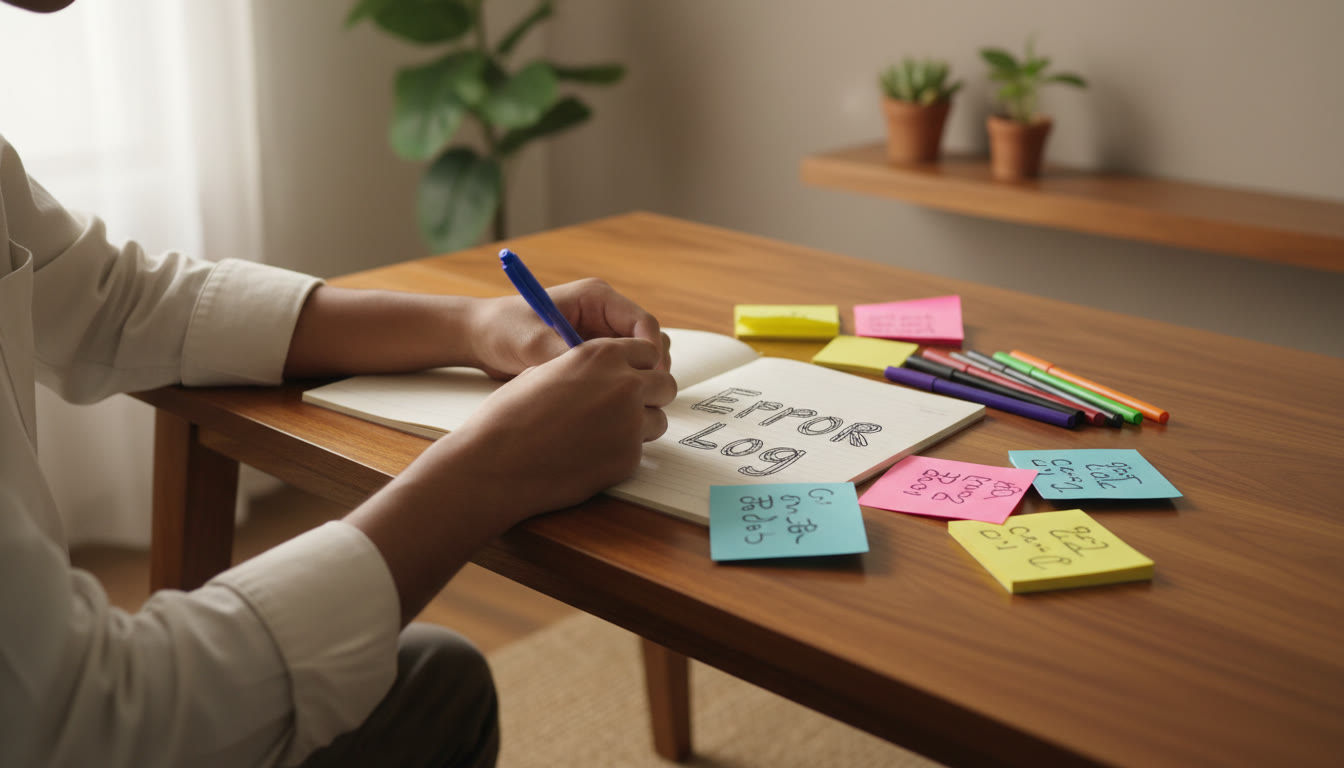
- Create an error log: note the topic, question number, mistake type, and a one-line corrective action you will do in the next 48 hours.
- Re-solve without looking: Close the solution and reattempt the question in isolation to strengthen retrieval.
- Plan targeted follow-up: schedule 3–5 short practice tasks that close the gap you identified; don’t just bookmark the topic for vague review.
| Field | Example | Action |
|---|---|---|
| Question No. | Physics Q12 | Do 8 projectile motion problems; review vector sign rules |
| Error Type | Careless arithmetic | Practice 15 two-step calculation questions slowly |
| Root Cause | Rushing on final checks | Introduce a 10-second final check routine for each solved question |
How Many Mocks Should a Beginner Do?
Start conservatively with one full-length mock per week and 2–3 short topic-focused timed sets during the week. The most useful mocks are those you analyze thoroughly. As your endurance and analysis speed improve, shift to two full mocks a week if your schedule permits. Always prioritize quality of analysis over the cadence of tests; doing many mocks without focused correction produces small gains.
Common Beginner Errors and Clean Fixes
- Rushing arithmetic: Adopt a two-step finish — solve, then peek at signs and units for 8–10 seconds before moving on.
- Poor marking discipline: In CBT practice, use flags and avoid last-minute answer swaps. In OMR practice, master neat, complete shading.
- Random guessing: Use elimination drills so guessing becomes informed rather than random.
- Surface-level revision: Replace passive re-reading with targeted problem sets tied to mistakes in your error log.
Micro-Drills That Build Competence
Micro-drills are short, intense practices that correct precise weaknesses. Examples:
- Elimination rounds: Five MCQs, focus solely on discarding wrong options within 90 seconds per question.
- Two-minute tight solves: Pick 10 typical short problems and solve each within two minutes to build quick recall.
- Reverse-engineer: Start from answer choices and practice reaching the correct option in the minimum number of logical steps.
Designing a Weekly Mock-and-Revision Plan
A simple, repeatable weekly framework helps beginners translate mock feedback into steady improvement. Make each task small and measurable.
| Day | Activity | Duration | Goal |
|---|---|---|---|
| Monday | Mini topic timed set | 60 minutes | Fix a specific weakness |
| Wednesday | Concept rebuild + practice | 90 minutes | Close conceptual gaps |
| Saturday | Full-length mock + analysis | 3 hours + 90 mins | Simulate exam day and apply review routine |
| Sunday | Light consolidation | 60 minutes | Rest and reinforce |
When Guided Help Accelerates Progress
Many beginners benefit from targeted, personalized guidance when recurring mistakes persist. If your error log shows the same conceptual gaps after several mock cycles, one-on-one help that produces short, test-focused practice cycles can be very efficient. For students who choose guided review, look for support that integrates immediate post-mock action plans and helps you practice the same mistake patterns with tight feedback loops.
Some students pair self-study with periodic tutor feedback so their mock analysis becomes a guided loop. If you choose a guided option, make sure the help you get includes a concrete plan after each mock: specific problem sets, short drills, and focused revision targets rather than high-level advice. Consider whether personal guidance will slot into your weekly mock routine so that each paper directly informs the next practice cycle. For students who explore structured help, Sparkl‘s 1-on-1 guidance and AI-driven insights can be used to design short corrective cycles and tailored practice after each mock.
Exam Simulation: The Little Things That Make the Test Familiar
True simulation includes ambient details: practice at the same time of day as your target exam window, wear the same type of clothes you will wear on test day, and use the same layout for your workspace. If the test interface is computer-based, practice identical navigation and timer checks. Small, repeated simulations build a muscle memory that reduces decision overhead during the real exam.
Test-Day Simulation Checklist
- Three-hour uninterrupted test block + post-test analysis window.
- Exactly the same medium and interface you expect on exam day.
- One realistic break plan (if allowed in the mock), folded into your time allocation.
- Hydration, light snack, and a short warm-up set of 5 problems before the mock to prime recall.
Final Academic Takeaway
Mock tests convert study into measurable progress when they are done with structure and reflective analysis. Focus on reproducible routines: simulate the real conditions, use a disciplined review cycle to log and fix errors, practice targeted micro-drills, and refine time-management instincts. Over time, steady mock practice builds not just knowledge but the decision-making and calmness needed to perform consistently on the actual three-hour MCQ exam.
















No Comments
Leave a comment Cancel