
JEE Main Mock Test Guide for Advanced Students
If you’re an advanced JEE aspirant, mock tests aren’t just practice — they are a laboratory where you refine timing, accuracy, and exam temperament. This guide walks you through full-length mock-test strategy (the typical three-hour simulation), how to treat MCQ and numerical questions under negative marking pressure, OMR/answer-entry discipline, and how to turn each mock into a targeted improvement plan aligned with Physics, Chemistry and Mathematics.

What a Full-Length Mock Should Simulate
Match the exam mechanics: MCQ format and timing
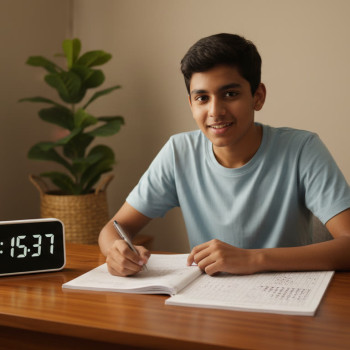
Top-level mocks replicate the real testing environment as closely as possible: fixed time window (three continuous hours for a single-paper session), MCQ-centric sections, and the psychological pressure of limited time. Most advanced students benefit from treating a mock like the actual exam — no interruptions, single-sitting concentration, and strict time tracking.
Negative marking and answer discipline
Mocks should include the same scoring philosophy you will face in the real test: correct answers earn positive marks while incorrect MCQ attempts attract negative marks. That tradeoff changes the game: an extra attempt without confidence can easily cost you more than the potential gain. Practicing with negative marking on every mock conditions your decision-making under risk.
OMR simulation—even if the exam is CBT
Even though official delivery may be computer-based in the current cycle, practicing OMR discipline is still useful. Many offline or classroom mocks use OMR sheets; moreover, the discipline of careful answer entry, double-checking question numbers, and avoiding stray marks strengthens your exam-room habits for any delivery mode.
Why Advanced Students Need Full-Length Mocks
At the advanced level, incremental knowledge gains are small — what differentiates a top scorer is consistency, speed, and error-free execution. Full-length mocks build three critical things:
- Stamina: maintaining concentration for a full three-hour window.
- Time-accuracy calibration: learning how much time a typical good-quality solution actually takes.
- Stress resilience: practicing recovery after a stretch of hard questions or a scoring setback.
How often should an advanced student take full-length mocks?
There’s no one-size-fits-all answer, but a useful rule of thumb is quality over quantity: start with one full-length mock per week during stable preparation phases, and increase frequency to two per week in the intense revision blocks leading into the current cycle. Between mocks, allocate one or two days for focused problem-fix and concept consolidation.
Designing a Mock-Test Week: Structure & Purpose
Sample week layout for sustained progress
Keep the mock as the anchor of the week. Use pre-mock days for targeted practice and post-mock days for analysis and correction. This rhythm turns each mock into a feedback loop instead of a passive result.
| Day | Focus | Goal |
|---|---|---|
| Day 1–2 | Targeted practice (weak topics) | Build accuracy and concept clarity |
| Day 3 | Timed sectional drills | Sharpen speed |
| Day 4 | Full-length mock (3 hours) | Simulate exam conditions |
| Day 5 | Immediate review and error logging | Identify gaps & misconceptions |
| Day 6–7 | Targeted remediation & mixed practice | Consolidate corrections |
During the Mock: Practical Tactics
Question triage — a simple three-tier rule
When you first read each question, classify it quickly:
- Tier A: Bankable in under 1–2 minutes — solve immediately.
- Tier B: Requires work but solvable with 3–6 minutes — attempt if you have time.
- Tier C: Time sink or high-risk — mark and return if time permits.
This triage keeps you from getting stuck on a single problem and lets high-value questions build your score early.
Time-blocking trick
Start with a loose plan — for a three-hour test, a simple split is 60 minutes per subject if you prefer even distribution. But advanced students often benefit from flexible time-slicing: begin with the subject you’re strongest in to secure early bankable marks, or begin with the subject requiring higher concentration depending on your daily energy curve.
Scoring Strategy: Example Table and Calculations
Use a consistent scoring template to project outcomes and set accuracy targets. Below is a straightforward example using a conventional +4 / -1 scheme for MCQs (adjust if your mock uses a different marking pattern).
| Metric | Value (Example) |
|---|---|
| Correct answer | +4 |
| Incorrect answer | -1 |
| Unattempted | 0 |
| Attempt target (total) | 60 |
| Target accuracy | 80% (48 correct, 12 wrong) |
| Projected score | (48 × 4) − (12 × 1) = 192 − 12 = 180 |
That example shows the leverage of accuracy: reducing wrong attempts while keeping attempts steady raises your score more than simply increasing raw attempts without accuracy. Work to push your accuracy beyond 80% on bankable questions.
Post-Mock Analysis: Turning Data into Better Performance
Immediate, honest reflection
Within an hour of the mock, write a candid 10–15 line note about how you felt: where you panicked, where time disappeared, and which questions took more time than expected. This emotional snapshot helps you recognize cognitive patterns that pure numbers miss.
Quantitative post-mortem
Use a simple error-log sheet for each mock with columns: Question number, Topic, Mistake type (conceptual / calculation / careless), Time spent, and Fix (what to do next). The most valuable column is ‘Fix’ — if you don’t convert the mistake into a micro-action, it will recur.
| Metric | Value |
|---|---|
| Total attempted | 60 |
| Correct | 48 |
| Incorrect | 12 |
| Accuracy | 80% |
| Average time per attempted question | ~3 minutes |
Action plan from analysis
- Identify the two topics with the highest mistake density and schedule targeted drills for them.
- Convert repeated careless errors into a checklist (units, signs, diagrams) you consult before submitting an answer.
- Adjust triage rules if you’re losing time on Tier B questions. Maybe reduce target time or mark earlier for review.
Advanced Tactics for Rank Optimization
Selective aggression
As you approach the top percentile, raw attempt counts matter less than quality-of-attempts. Selective aggression means you convert moderately tough, high-value questions reliably and avoid speculative attempts on ultra-hard ones that drag down accuracy.
Sectional balance versus personal strengths
Some students do better playing to strengths: secure near-perfect marks in two sections and aim for a defensible score in the third. Others need balanced scores across Physics, Chemistry and Mathematics. Use your mocks to discover which path yields higher net marks for you.
Risk budget
Before the test, set yourself a small risk budget: a fixed number of risky attempts you may take when time permits. Once that budget is used, revert to conservative, high-accuracy play. This prevents emotional overshooting during the exam.

Mini Case Studies: How Two Advanced Students Use Mocks
Riya — the precision seeker
Riya uses weekly full-length mocks primarily to polish accuracy. After each mock she spends two days on error correction and does only topic-wise timed drills. Her goal is to keep wrong attempts under 12 per paper and to raise conceptual clarity in mechanics and integral calculus. Over time, her attempt count stayed constant while accuracy climbed — that’s the most efficient path to higher scores for students like Riya.
Aman — the time optimizer
Aman starts with sectional timed sprints to improve speed. He treats the full-length mock as a diagnostic of time leaks: which questions cost extra minutes and why. His error log highlights calculation bottlenecks; he then drills numerical agility exercises and reduces average solution time by a minute per question in subsequent mocks. Faster, equally accurate execution improved his score significantly without adding study hours.
Common Pitfalls and How to Fix Them
- Pitfall: Skipping analysis. Fix: spend at least one focused hour per mock on an error log and two concrete corrective tasks.
- Pitfall: Over-practicing only Max-difficulty problems. Fix: mix bankable, medium-difficulty practice with selective hard problems to maintain accuracy.
- Pitfall: Ignoring time-of-day effects. Fix: schedule mocks at the same time you expect your real exam to align your alertness curve.
- Pitfall: Assuming partial credit for incomplete MCQs. Fix: treat MCQs as binary — an answer is either correct or incorrect; do not rely on partial marking in your scoring strategy.
How to Use a Tutoring Partner or Personalized Help
For many advanced students, external calibration helps. A skilled coach or a personalized tutor can shorten the feedback loop by pointing out recurring conceptual blind spots, fine-tuning time allocations and suggesting micro-drills. If you try personalized support, focus on three things: 1-on-1 guidance that targets your weak nodes, tailored study plans that fit your mock schedule, and data-driven insights that show where marks are gained or lost.
Consider combining your mock-test routine with personalized review sessions so the tutor sees not just your scores but your error patterns. For example, Sparkl‘s personalized tutoring can be used to translate mock analysis into tailored 1-on-1 plans that accelerate correction and reinforce exam habits.
Integrating Mock Tests into Revision Cycles
Mocks are not separate from revision — they are the compass that tells you where to revise. Use a three-cycle window for each topic: initial learning, practice, and mock-based reinforcement. After a mock, tag topics into three categories:
- Green — strong: occasional drills to maintain fluency.
- Amber — shaky: revisit concept notes and do mixed difficulty drills.
- Red — weak: intensive revision with guided problem sets and targeted coaching.
Incorporate those tags into your next two weeks of study, then validate progress with the next mock.
Practical Checklist — Mock Day Essentials
- Warm-up: 20–30 minutes of light, focused review — key formulas and small derivations.
- Environment: quiet room, uninterrupted three-hour window, charged laptop (for CBT) or OMR-ready materials.
- Time-keeping: visible timer; set milestones (e.g., 1 hour left, 30 minutes left) to trigger strategy checks.
- Answer discipline: fill bubbles/enter answers carefully, double-check question numbers for OMR-style sheets.
- Post-mock: within 60 minutes, write your emotional reflection and then start the error-log.
Final Tips: Small Changes, Big Gains
- Micro-rests: short mental breaks during long study days reduce cognitive fatigue and improve recall during mocks.
- Simulate pressure: practice a handful of mocks under simulated stakes (timed prizes or accountability partners) to build composure.
- Focus on concepts, not tricks: the mock is best used to expose shaky concepts—fix those at the source.
- Keep records: maintain a simple spreadsheet of mock dates, scores, accuracy, and top-3 recurring mistakes — trend analysis beats episodic effort.
Conclusion
Mock tests for JEE Main are not an endpoint but the engine of continuous improvement: a disciplined loop of simulation, analysis, and targeted correction. For advanced students this means prioritizing accuracy over reckless attempts, simulating the three-hour pressure faithfully, applying strict OMR/answer-entry habits, and converting every error into a concrete fix. When mocks are treated as precise diagnostics rather than mere trials, they become the most powerful tool in your preparation toolkit.
























No Comments
Leave a comment Cancel