
Last-Year JEE Main Daily Routine: A Calm, Practical Playbook
The last year before JEE Main is a runway — not a sprint. You have to convert the runway into strong, practiced takeoffs every single day. This guide walks you through a realistic, human-friendly daily routine that respects your energy, the exam format (MCQ-based with full-length 3-hour mock practice), and exam discipline like careful answer marking and negative marking consequences. It’s written so you can pick ideas and adapt them immediately, whether you’re deep into concepts, polishing problem speed, or aiming to finish the last mile with confidence.
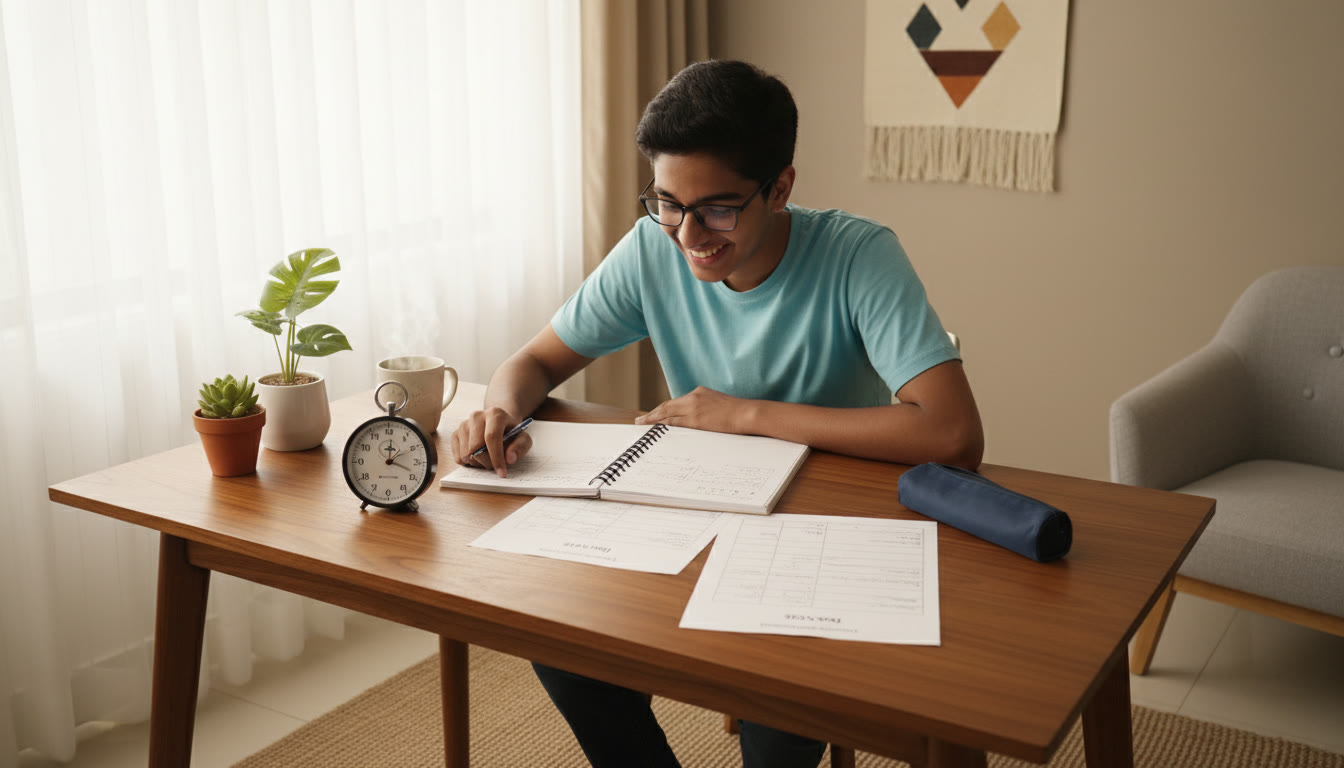
First Things First: Ground Rules That Shape Every Day
Before we talk time blocks and subject rotations, set four unarguable rules that will anchor your last-year routine:
- Practice full-length 3-hour mock tests under exam-like conditions regularly and treat them as measurement tools, not morale checks.
- Remember the exam is MCQ-based: speed, accuracy, and intelligent elimination matter more than long-form written explanations; partial credit for descriptive steps is not part of the scoring model.
- Respect format discipline—whether you practice on paper in offline mocks or on a computer in CBT mock environments, train the exact behavior you will use in the exam (accurate option selection, avoiding stray marks in paper mocks, and careful flagging for review in CBT).
- Negative marking exists: build habits that reduce guesswork and reward confident, methodical attempts.
How to Think About the 3-Hour Window
The official full-length practice session is three hours. That single number drives how you divide attention: planning, attempt order, time for review, and stress management. Treat every weekly mock as the true north for your pacing — and use daily studies to shore up weak topics you discovered in those mocks.
Exam-simulation essentials
- Mock duration: run weekly 3-hour tests simulating exam conditions (no phone, timed sections, official instructions followed).
- Timing discipline: practice selective skipping. If a question eats more than your planned time, mark it and move on — return during a second sweep.
- Answer marking: when you practice on paper, train the same careful marking technique that OMR-style answer sheets require; for CBT, get fluent with the interface so you don’t waste time locating features like the review flag.
- Post-mock review: dedicate at least as much time to analysis as you did to the test itself; identify conceptual gaps, careless mistakes, and time sinks.
Daily Energy Blocks: A Practical Template
Your day should be a cycle of focused study, targeted practice, active revision, and recovery. Below is a sample daily block plan designed for the last year — adaptable to your peak hours and school/college commitments.
| Time | Activity | Purpose | Notes |
|---|---|---|---|
| 6:00 – 6:30 | Wake & Light Revision | Memory priming (formula flash, short concept review) | Use this time for high-recall items you can review standing up. |
| 6:30 – 8:30 | Deep Focus Session 1 | Tackling hard concepts or new chapters | Uninterrupted, high-concentration work (no phone). |
| 8:30 – 9:00 | Breakfast & Short Walk | Recharge and move blood to the brain | Keep meals light and protein-rich. |
| 9:00 – 12:00 | Focused Practice Session | Problem solving: mixed questions from one subject | Time-bound drills: simulate timed batches (60–90 minutes). |
| 12:00 – 13:00 | Lunch & Rest | Reset cognitive load | Avoid heavy screens; comfortable rest 15–20 min. |
| 13:00 – 15:30 | Deep Focus Session 2 | Alternate subject; derivations and proofs | Use active note-making and practice derivations by hand. |
| 15:30 – 16:00 | Short Exercise/Break | Boost alertness | Ten minutes of light cardio or stretching. |
| 16:00 – 18:00 | Revision & Error Log Work | Go over mistakes from previous mocks/practice | Maintain an error log: note why a mistake happened. |
| 18:00 – 19:00 | Light Study / Doubts Clearing | Clarify easy doubts or watch short explanatory videos | Keep it light — avoid starting new heavy topics. |
| 19:00 – 20:00 | Dinner & Family Time | Relax | Social rest matters for sustained focus. |
| 20:00 – 21:30 | Mock Practice / Test Analysis (if scheduled) | Full-length or sectional timed practice | When not testing, use this slot for concept consolidation. |
| 21:30 – 22:00 | Light Revision | Rule-based and formula checks | Wind-down routine: no heavy problem solving. |
| 22:00 – 22:30 | Prepare for Sleep | Recovery | Aim for consistent 7–8 hours of sleep. |
How to personalize this template
- Identify your peak mental hours and place the most demanding subject there.
- If you have school/college hours, shift the blocks but keep the deep-focus sessions intact.
- Shorten or expand sessions based on concentration span; use a timer to track real focus time.
Weekly Map: Where Mocks, Revision, and New Learning Fit
A smart weekly layout mixes deliberate practice, focused revision, and simulation. Below is a compact weekly rhythm you can adapt.
| Day | Morning | Afternoon | Evening |
|---|---|---|---|
| Monday | New concept deep work (Subject A) | Problem set (Subject A) | Revision & error log |
| Tuesday | New concept deep work (Subject B) | Problem set (Subject B) | Quick mixed practice |
| Wednesday | Concept consolidation (Subject C) | Timed sectional practice | Review mistakes |
| Thursday | Bridge weak areas | Application-based problem solving | Formula-review session |
| Friday | Mixed-topic speed drills | Revision | Light practice |
| Saturday | Full-length 3-hour mock test | Mock analysis and error log | Targeted fixes (weak topics) |
| Sunday | Restorative revision (light) | Consolidate notes and formulas | Plan the week ahead |
Why the Saturday mock?
Weekly full-length mocks train your stamina and help you build realistic pacing habits for the 3-hour window. The analysis immediately after the mock is where the score improves — you must translate every mistake into a tiny correction in your daily routine.
Subject Strategy: Aligning Your Days with Syllabus Priorities
Most engineering aspirants focus on Physics, Chemistry, and Mathematics; structure revision so each subject gets deliberate monthly and weekly attention. If you also deal with exams involving Biology or other subjects in parallel, treat those as separate focused blocks and maintain the same practice/test discipline.
Subject-specific quick tips
- Physics: practice numerical fluency and check units. Build a formula sheet and practice quick estimations to eliminate improbably large/small options in MCQs.
- C hemistry: separate objective practice by sub-area — physical (problem solving), inorganic (rote + concept mapping), and organic (reaction flows). For MCQs, pattern recognition helps speed up attempts.
- Mathematics: timed problem sets and repeated techniques for common topics (calculus, algebra, coordinate geometry) are the key. Work on reducing setup time.
- Biology note (if applicable): if you’re handling biology in another exam alongside JEE, compartmentalize study time; biology needs consistent factual revision more than problem-solving speed.
Active Revision Tools That Save Hours
Passive rereading is the biggest time sink. Replace it with:
- Spaced recall (quick self-quizzes at increasing intervals).
- Error logs: for every mistake, write one-line cause and one concrete fix.
- Formula sheets and one-page concept maps for each chapter.
- Timed mini-tests: 20–30 minute bursts focused on a single skill.

Designing Your Mock-Test Strategy
Mocks are assessment + training. Treat them as the ultimate feedback loop:
- Simulate CBT/OMR behavior: train clicking answers reliably, using the review flag, and avoiding interface fumbling.
- Adopt a two-pass approach in the 3-hour window: first pass — secure easy & medium questions; second pass — attempt hard ones you marked.
- Guard against blind guessing: if negative marking applies, eliminate as many options as possible before guessing.
- After the test, focus on why time was lost: was it concept weakness, careless error, or misreading the question?
Mental Resilience, Sleep, and Nutrition — The Non-Negotiables
Consistency beats frantic bursts. Sleep consolidates memory; short aerobic activity sharpens attention; balanced meals feed focus. Micro-breaks every 50–60 minutes will prevent diminishing returns in long study blocks.
Quick daily health checklist
- Aim for regular sleep and at least 7 hours of quality rest.
- Include a 20–30 minute brisk walk or light exercise daily.
- Snack smart: nuts, fruits, and protein-rich foods over sugary items that spike and crash energy.
When to Bring in Personalized Help
If you find the same error repeating despite practice, or you’re not improving in mock scores, targeted 1-on-1 guidance can create big efficiency gains. Sparkl‘s personalized tutoring offerings — 1-on-1 guidance, tailored study plans, expert tutors, and AI-driven insights — are the kind of interventions that tighten weak links in your preparation when used sparingly and precisely.
How to use tutoring efficiently
- Bring 2–3 focused problems or recurring mistakes to each session.
- Ask the tutor to model problem-selection decisions under time pressure.
- Use sessions to refine the mock-test strategy and practice exam interface behavior.
Time Management Tools & Tracking
Simple trackers beat complex systems. Track these three numbers daily: focused-study minutes, number of problems solved with full solutions, and new mistakes added to your error log. Review weekly trends and nudge your schedule where you see consistent slippage.
Common Pitfalls and Simple Corrections
- Pitfall: Over-scheduling every hour. Correction: build in buffer hours and mandatory breaks.
- Pitfall: Ignoring mock analysis. Correction: spend at least equal time analyzing as taking the mock.
- Pitfall: Mistaking speed for mastery. Correction: measure both accuracy and speed; score improvement must be sustainable.
Last 30 Days: Sharpen, Don’t Relearn
The final month is about consolidation: formula checks, error log corrections, targeted mocks, and careful rest. The priority is not new chapters but removing the last few weaknesses and ensuring exam-simulation fluency.
| Phase | Focus | Daily Habit |
|---|---|---|
| Days 30–15 | High-value topics and error correction | 1 full mock + daily mini-revisions; no new chapters |
| Days 14–7 | Speed & accuracy; sleep hygiene | Alternate full mocks with light revision; reduce heavy learning |
| Last 6 days | Relaxed revision and exam logistics | Short, calm reviews; maintain sleep and avoid last-minute cramming |
Final Practical Checklist (Daily)
- One focused deep-work session at your peak hour.
- One timed practice block (mixed or subject-specific).
- Daily error-log update with one corrective action per mistake.
- One short mock or sectional simulation at least twice a week; one full 3-hour mock weekly.
- Quality sleep, light exercise, and steady meals.
Closing Thought
Time management in the last year is less about doing more and more about doing the right things consistently: focused practice, disciplined mocks, methodical revision, and small, surgical fixes to recurring errors. Make your schedule a reflection of priorities, not a test of willpower; refine it weekly based on mock analysis and energy patterns, and keep your approach steady and evidence-driven.

















No Comments
Leave a comment Cancel