

Mistakes to Avoid to Score 99 Percentile in JEE Main
Hitting the 99 percentile in JEE Main isn’t magic — it’s the product of careful choices, steady habits, and ruthless trimming of counterproductive study patterns. If you’re reading this, you’ve likely felt the tug between long hours and unfocused effort, or the frustration of practice-test scores that refuse to budge. This article walks you through the most common mistakes students make on that final stretch, why they hurt your percentile, and precise, practical fixes you can start using today.
Think of this as a checklist of traps to avoid and course-corrections that incrementally add up to big gains. I’ll use real examples, quick comparison drills, checklists you can implement this week, and a clear mock-test blueprint so your practice translates into percentile, not just confidence.

What does 99 percentile actually demand?
Percentiles are relative, not absolute. Scoring in the 99th percentile means you scored better than about 99% of the test-taking cohort in the current cycle. That doesn’t always mean the absolute highest raw score — it means your performance was consistently strong, accurate, and strategically optimized compared to most peers.
Two important implications:
- Accuracy is more valuable than attempting every question. Negative marking in the MCQ format penalizes careless guessing, so precision and selective attempts matter.
- Adaptability and exam-simulation discipline matter more than last-minute cramming. Regular full-length, timed practice (the same three-hour rhythm you’ll face on test day) is essential so you build both stamina and smart decision-making under time pressure.
Top mistakes students make — and how to fix them
Below are the high-impact traps that repeatedly show up when students are chasing that 99 percentile. For each mistake I’ll explain the harm and the practical correction you can implement immediately.
Mistake 1 — Chasing marks, not mastering concepts
Why it hurts: Hunting for short tricks or memorized solutions leads to brittle understanding. Under pressure, those shortcuts break down and you end up losing marks on seemingly easy questions because the underlying concept wasn’t solid.
Fix: Reframe study sessions as concept-upgrade sessions. After solving a problem, ask: could I derive this result if I’d never seen the question before? If not, revisit the core idea and re-solve two variations until the reasoning feels natural.
Mistake 2 — Practicing the same solved problems over and over
Why it hurts: Repeatedly reworking problems you already know inflates confidence without building transfer skills. True improvement comes from tackling fresh problems and recognizing patterns across variations.
Fix: Use a 70/30 rule. Spend 70% of practice time on new or slightly varied problems, 30% on review. Track the source of each problem (topic and difficulty) so you force breadth in practice.
Mistake 3 — Ignoring mock-test analysis
Why it hurts: Taking full-length mocks is essential, but treating them like standalone trials wastes them. Many students treat mocks as score-checks instead of diagnostic goldmines, and therefore repeat the same errors.
Fix: Post-mock routine: (1) Spend as much time analyzing the mock as you did taking it, (2) categorize mistakes into conceptual, careless, or timing issues, and (3) create a short action plan for the next two days targeting those exact errors.
Mistake 4 — Poor time allocation during the exam
Why it hurts: Randomly jumping between sections or spending too long on one tough question kills both time and confidence. Many students then rush easy questions and make careless errors.
Fix: Adopt a time-slicing plan that suits your strengths. Example approach: Do a first pass for guaranteed attempts in each section, flag harder ones, then return for a timed second pass. Practice this rhythm in every full-length mock so it becomes instinctive.
Mistake 5 — Neglecting negative-marking strategy
Why it hurts: Blind guessing in high volumes often erodes your score. Negative marking systems reward selective attempts and penalize indiscriminate guessing.
Fix: Teach yourself to make three-tier decisions: Attempt if confident, mark-for-review and skip if unsure but solvable under a hint, and leave blank if you can’t see a path in under a short time limit. In mocks, track how many marks come from guesses versus knowledge to fine-tune risk tolerance.
Mistake 6 — Incomplete syllabus coverage and over-specialization
Why it hurts: Scoring high on JEE Main demands competency across Physics, Chemistry, and Mathematics. Over-focusing on favorite topics creates weak spots that competitive cutoffs expose.
Fix: Use a rotating revision plan that ensures every topic is touched weekly. Prioritize topics by weight and your personal error rate, not by interest. Small consistent reviews beat episodic ‘intensive’ sessions that leave gaps.
Mistake 7 — Treating derivations and diagrams as optional
Why it hurts: Leaving derivations or conceptual sketches aside makes answers fragile. Many problems are solved faster and more reliably when you sketch a small diagram or write a quick derivation, especially in physics and math.
Fix: Make tiny sketches and one-line derivations routine during practice, not optional extras. Build the habit so the visual cue appears automatically during the exam.
Mistake 8 — Poor sleep, nutrition, and stamina planning
Why it hurts: Mental fatigue increases careless mistakes. Long study hours without proper rest reduce retention and test-time performance. Stamina isn’t built overnight; it’s trained.
Fix: Schedule regular sleep and recovery within your study plan. Use full three-hour mocks to train endurance and pair them with timed breaks and recovery sleep in the following 24 hours to reinforce memory consolidation.
Mistake 9 — Letting emotions dictate attempts on test day
Why it hurts: Panic encourages random attempts and hasty decisions. That behavior is what turns a good mock score into an average result on the real day.
Fix: Build simple calming rituals: controlled breathing for 60 seconds before you open the test portal, a mental checklist (“first pass — easy ones; second pass — flagged”), and a rule to never spend more than a pre-decided fixed time on one question before moving on.
Mistake 10 — Waiting too long to get targeted help
Why it hurts: If a weak area is persistent across several mock cycles, delaying personalized help costs more time than the help saves. Many students wait too long to change strategy.
Fix: Seek targeted help the moment your mock-analysis shows stagnation on a topic after 3-4 practice cycles. Personalized 1-on-1 guidance, tailored study plans, and AI-driven insights can accelerate correction. For instance, Sparkl‘s approach to individualized feedback and small-group tuning can fit into a focused recovery plan.
Common mistakes — quick reference table
| Mistake | Why it hurts | Quick fix (action in 48 hours) |
|---|---|---|
| Chasing tricks over concepts | Brittle answers under variation | Pick 3 problems, re-derive solutions from first principles |
| Repeating known problems | No transfer learning | Replace 50% practice with new problems |
| Skipping mock analysis | Repeats same mistakes | Do one-hour error audit after each mock |
| Excessive guessing | Score erosion via negative marking | Adopt ‘confident attempt’ threshold; track guess hit-rate |
| Sectional neglect | Weak spots hurt cutoffs | Implement rotating revision touch-points weekly |
How to structure your mock-test practice
Mocks are the bridge between preparation and percentile. Here is a simple, repeatable framework to make mocks do the heavy lifting.
- Simulate the environment: full three-hour mock, minimal interruptions, exam-room posture, and a timing device. Treat it like the real exam to train attention and stamina.
- Take the first pass in a conservative style: solve all questions you can confidently finish within 2–3 minutes. Flag medium-difficulty problems and leave hard, uncertain ones for the second pass.
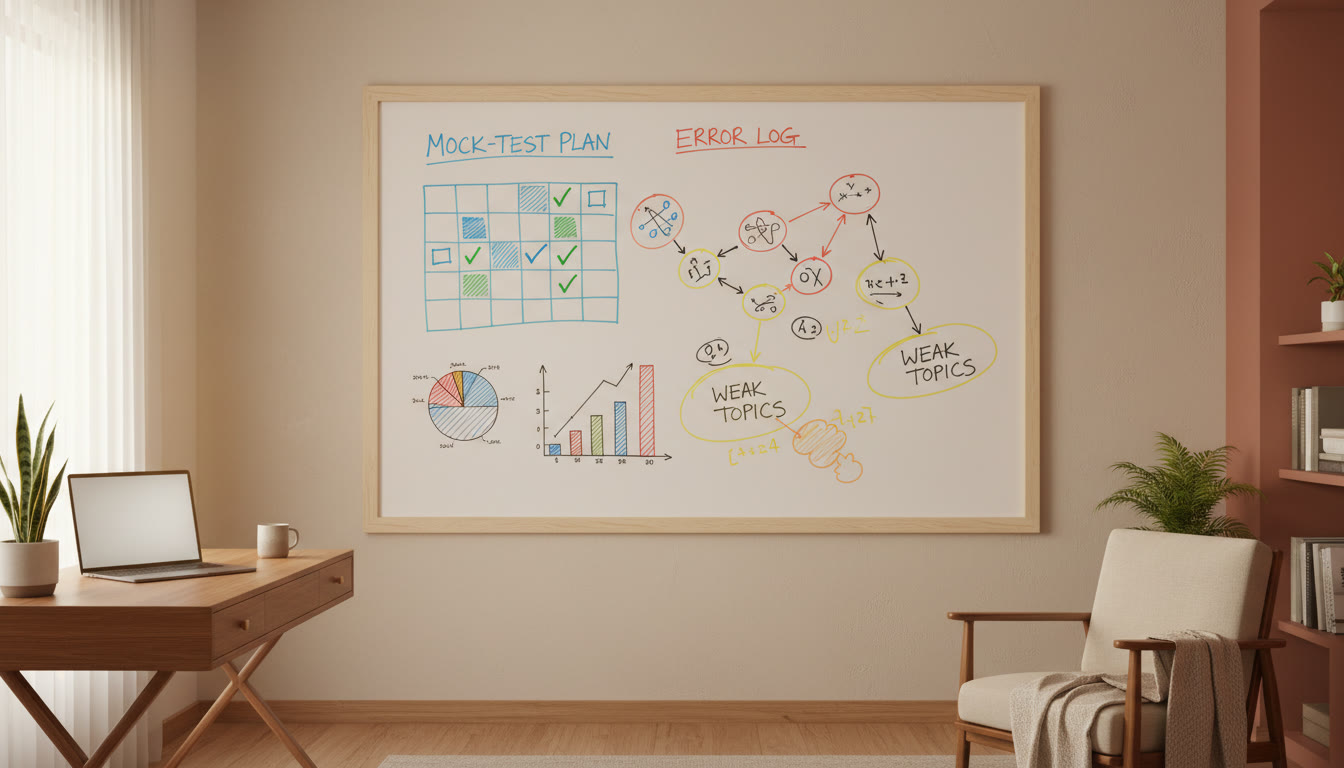
- After the mock: immediate calm-down for 10–15 minutes, then detailed analysis. Separate errors into conceptual, careless, and timing. Build a micro-plan: the next three study sessions should target the highest-frequency error category from your mock.
- Keep track of trend lines: record percentile-equivalent progress for at least 6–8 mocks. Individual mock fluctuations are normal; what matters is upward trend and decreasing variance.
Sample weekly plan (adjustable)
The plan below is a template you can adapt. The idea is to keep variety, focused practice, and review balanced so gaps don’t grow.
| Day | Primary Focus | Micro-goals |
|---|---|---|
| Monday | Mathematics (Calculus, Problem Set) | 2 new problems + 4 application drills + 30-min concept review |
| Tuesday | Physics (Mechanics/Optics) | Concept derivations + 6 mixed-difficulty problems |
| Wednesday | Chemistry (Physical/Organic) | Reaction mechanisms + 10 MCQs for speed |
| Thursday | Mixed-topic practice | Timed 3-hour mini-mock or two sectionals |
| Friday | Weak-topic drill | Targeted revision + problem bank practice |
| Saturday | Full-length mock | Simulate exam, then 90-min analysis |
| Sunday | Recovery and light review | Short notes revision + rest |
Three quick drills you can start this week
- Accuracy drill: For one hour, do only medium-difficulty MCQs and aim for 95% accuracy. The goal is not speed — it’s error elimination.
- Time-slice drill: Give yourself 45 minutes per subject block and try to complete a balanced mix of 10 questions per block. Record time per question to find pacing leaks.
- Variety drill: Pick one topic and solve three classical, three novel, and three real-application problems. This builds flexible thinking.
When to bring in focused mentoring
Many high-performers reach a plateau that self-study alone won’t break. The right kind of help is precise, not generic: a short series of 1-on-1 sessions to fix recurring blind spots, a tailored study plan to prioritize weak topics, or AI-driven analysis that finds patterns in your mock errors.
If you choose mentoring, look for help that offers:
- Diagnostic-first approach — a clear error map from your mocks.
- Short, targeted interventions — not long, unspecific courses.
- Personalized pacing and accountability — weekly check-ins and measurable goals.
One practical option is to combine targeted human tutoring with data-driven insights. For example, Sparkl‘s model blends 1-on-1 guidance, tailored study plans, expert tutors, and AI-driven insights to help refine weak areas quickly and sustainably.
Final checklist: tiny habits that make a big difference
- Do at least one full three-hour mock every week and analyze it thoroughly.
- Keep a short error log and review it twice weekly — track mistakes by type and by topic.
- Practice selective attempts and measure your guess hit-rate; adjust your risk tolerance accordingly.
- Rotate every topic at least once a week so nothing goes untouched for long.
- Train stamina with real-time simulated sessions, and protect sleep and nutrition during heavy practice phases.
Closing thought
Scoring in the 99 percentile is less about dramatic last-minute leaps and more about consistently avoiding the common traps outlined here: shallow practice, poor mock analysis, timid time management, and delayed correction of weak spots. Keep your preparation diagnostic, disciplined, and targeted; treat each mock as a feedback loop, not a grade; and refine strategy with focused help when progress stalls. These are the academic habits that shift your results into the competitive band.






















No Comments
Leave a comment Cancel