
NEET Anxiety Management Guide: Calm, Focus, and Perform
Walking into a NEET exam hall feels like the finish line and a mountain peak at the same time: you can see where you want to get, but every breath feels heavy. That feeling — a racing heart, a mind that refuses to pull the right formula — is common and fixable. This guide treats anxiety the way you’d treat a tricky concept: with simple, repeatable techniques, realistic practice, and a plan you can rely on under pressure.
NEET is an MCQ-based test across Physics, Chemistry, and Biology, taken in a strict OMR format with negative marking and a fixed three-hour window. These exam specifics shape how anxiety interferes with performance. If you learn not only how to study the syllabus but also how to manage the stress the exam creates, you’ll convert nervous energy into steady focus. Below you’ll find practical routines, short exercises you can use inside the exam hall, longer-term habits that build resilience, and a realistic way to use personalized tutoring when it helps.

Why NEET Anxiety Shows Up (and what it does to your performance)
Anxiety is not a moral failing; it’s a physiological reaction that once helped humans survive. Today it shows up when stakes are high — like an exam that shapes a future. Recognizing the patterns helps you manage them.
How anxiety affects exam work
- Working memory shrink: anxiety can make it hard to hold a question’s data and formulas in your head simultaneously.
- Speed vs accuracy confusion: anxiety pushes many students either to rush (sacrificing accuracy) or to freeze (sacrificing time).
- Poor retrieval: stress often blocks recall of neat, well-learned facts or derivations under pressure.
- Behavioral slips: under stress, small habits like OMR discipline, filling roll numbers correctly, or following instructions are the most vulnerable.
Knowing these effects, your goal shifts from eliminating nerves entirely to recognizing them early and having reliable tools to restore control.
Make the Exam Familiar: Practice That Builds Calm
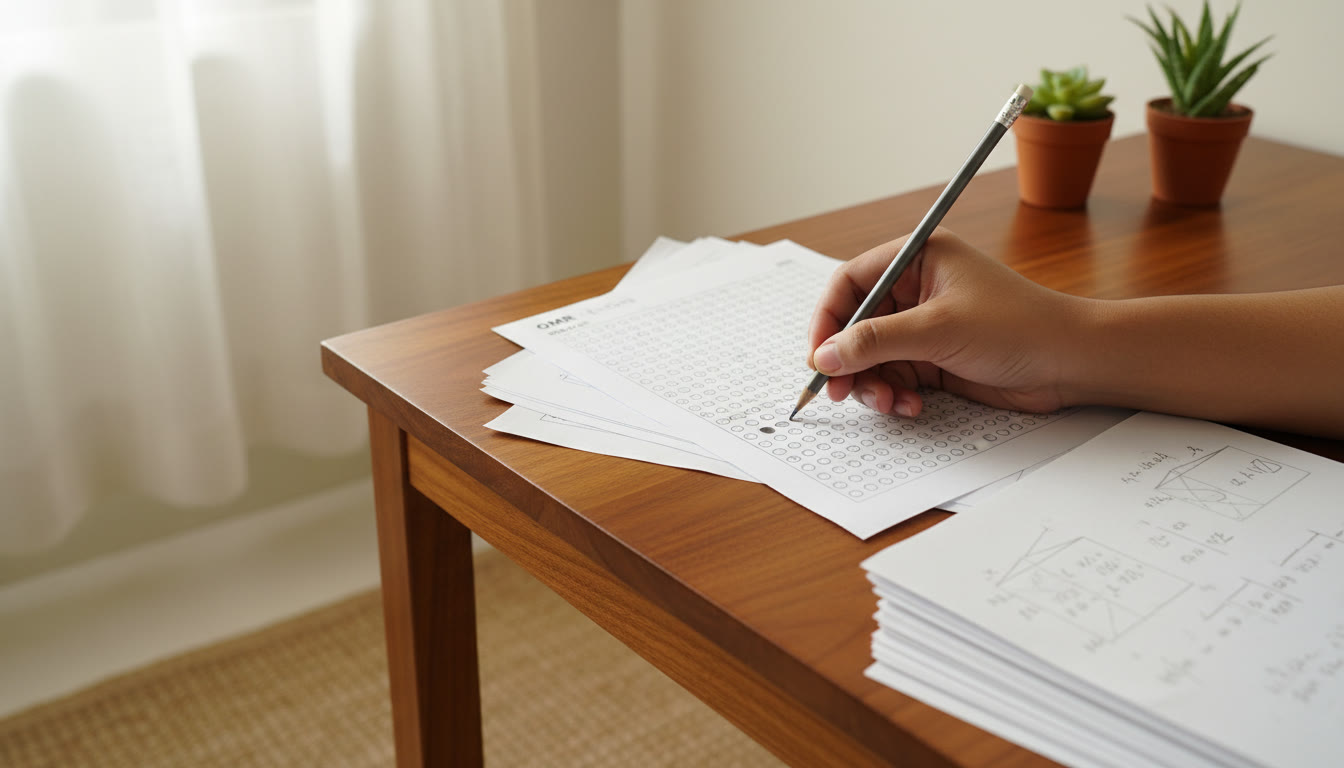
Fear loves the unknown. The single-best antidote is faithful simulation: take full-length, timed, OMR-style practice tests in a three-hour block, using the same break and rough-sheet routine you’ll use on the day. Treat each mock like the real thing: sit in a quiet place, limit devices, and simulate the time pressure. This does two things — it improves your test skills, and it desensitizes the fight-or-flight reaction.
Mock-test checklist
- Three-hour timed window with MCQ format and negative marking rules applied.
- Strict OMR discipline: bubble answers, fill roll details, and practice using the same pointers (pencil/pen type) you will use.
- Simulate breaks and what you’ll eat or drink beforehand.
- Use a physical timer or exam software that enforces time limits.
Repeated simulations move anxiety from a loud, surprising rush to a manageable background hum.
Daily Habits That Reduce Baseline Anxiety
Long-term resilience is built from small, repeatable daily choices. Think of mental health like physical conditioning for the brain.
Essential daily routine
- Structured study blocks: 50–90 minute focused sessions with short breaks. Use active recall and spaced repetition rather than passive rereading.
- Quality sleep: prioritize consistent sleep cycles; even modest improvements in sleep raise cognitive stamina.
- Movement: short walks, yoga, or 20–30 minute workouts several times a week sharpen attention and reduce stress hormones.
- Nutrition and hydration: stable blood sugar and good hydration make your focus reliable across long sessions and the exam day.
- Small wins: close each study day by listing two specific things you improved — it rewires the brain to notice progress, not just deficits.
Study techniques that ease stress while boosting scores
- Active recall: ask yourself questions exactly as NEET MCQs are structured, then check answers without peeking.
- Spaced repetition: revisit weak topics at increasing intervals; it reduces last-minute panics.
- Practice OMR behavior: treat answer marking as part of the exam skill, not an afterthought.
- Short, focussed revision notes: keep one-page concept sheets for each topic to review in short bursts.
Short Tools to Use When Anxiety Starts Spiking
In the moment, you need techniques that are quick, undetectable, and effective. Here are tactical interventions you can use during study, right before a mock, or inside the exam hall.
Breathing and grounding (60–90 seconds)
Box breathing: inhale four counts, hold four counts, exhale four counts, hold four counts — repeat three times. This slows the heart rate and calms the mind. Grounding: notice five things you can see, four things you can touch, three sounds, two smells, and one thing you can taste or recall. Both restore working memory capacity fast.
Refocusing method (30–60 seconds)
- If stuck on a question for more than 60 seconds, mark it, move on, and return later — this protects pace and reduces sticky anxiety.
- Use a two-pass strategy: quick first pass to secure easy marks, second pass for time-rich questions, third pass for triage.
How to Use Practice Tests Wisely (Not Just More Stress)
Mocks are diagnostic tools, not destiny. Treat each mock like a physics experiment: record outcomes, hypothesize causes, and change only one variable at a time so you know what works.
After-mock routine
- Analyze errors by type (concept gap, careless mistake, OMR slip, time pressure) rather than by paper score alone.
- Create a quick remediation plan: three targeted learning actions you will take before the next mock.
- Simulate exam-day constraints at least some of the time (no mobile, timed full length, proper seating).
Quick Table: Which Calm Technique to Use and When
| Technique | Duration | Best Moment To Use | How to Practice |
|---|---|---|---|
| Box breathing | 1–2 minutes | Before entering hall; during short breaks | Practice daily until automatic |
| Two-pass answering | Exam-long strategy | During test to protect time | Use in every mock |
| Grounding (5-4-3-2-1) | 30–60 seconds | When panic spikes mid-question | Pair with breathing in rehearsal |
| Progressive muscle relaxation | 5–10 minutes | Evening before sleep; pre-exam calm | Follow guided audio then practice solo |
Deal with Negative Marking and OMR Discipline Calmly
Negative marking changes the thinking pattern: accuracy matters more than raw attempts. The best defense against panic-driven random guessing is a pre-decided strategy. Decide before the exam what kinds of guesses you’ll take — for example, educated guesses where you can eliminate one or two options — and stick to it. That removes indecision, which fuels anxiety.
OMR discipline checklist
- Fill the identification area first, carefully and slowly.
- Use the same pencil/pen practice in mocks and on exam day.
- Mark and move: don’t erase repeatedly; if you must change an answer, erase fully and mark cleanly to avoid scanner errors.
- Allocate time at end for cross-checking bubbles with answer list — but only if you have practiced this without running out of time.
When Anxiety Feels Bigger Than Practice: Cognitive Tools
Technique-focused work helps short-term spikes, but sometimes the mind needs reframing. Cognitive techniques shift how you interpret stress.
Reframing and acceptance
- Label the feeling: name it (“That’s test anxiety, not a fact about my ability”). Naming reduces intensity.
- Shift goals from absolute to process-based: instead of “I must score X,” set goals like “I will complete three full revision cycles this month.”
- Practice acceptance: notice anxiety without trying to annihilate it. You can perform well with some nerves.
Make failure a data point, not a verdict
A low mock score is useful information. Treat it like a diagnostic report: what went wrong and what you will change? This reduces catastrophic thinking and increases actionable progress.
Study-Life Balance: Social and Emotional Supports
Preparation doesn’t happen in isolation. Your friends, family, and mentors are part of the environment that determines how stress shows up.
Practical ways to get support
- Tell one trusted person your mock schedule so they can help with logistics (food, restful environment) around key test times.
- Limit comparison: follow a narrow set of role models and focus on comparing yourself only to your past performance.
- Regular non-study time: schedule weekly social or relaxation time to recharge and remind your brain there is life beyond the paper.
How Personalized Tutoring Can Reduce Anxiety
Sometimes anxiety is driven by uncertainty about what to study or how to prioritize across a vast syllabus. When the path is unclear, stress rises. Targeted, 1-on-1 guidance can help you pare down the essential work and offer accountability that reduces rumination. For students who benefit from tailored pacing or need precise remediation on weak topics, Sparkl‘s personalized tutoring — with 1-on-1 guidance, expert tutors, tailored study plans, and AI-driven insights — can provide structure and calm: clearer study priorities, specific question strategies, and practice plans that match your pace.
Short Scripts and Phrases to Use When Panic Hits
Prepared words act like a bridge back to focus. Keep a few short, rehearsed phrases in mind.
- “Breathe. Read. Break it down.”
- “This is a question, not a judgment.”
- “Two-pass rule: secure what I know.”
- “Numbers, not meanings: fill OMR carefully.”
Myth-Busting: Common Misconceptions That Inflate Stress
Clearing myths helps you avoid unnecessary pressure.
- Myth: Anxiety must be eliminated to perform. Reality: Moderate nerves are common and manageable; routine beats perfection.
- Myth: Longer study hours are always better. Reality: Focus quality and method (active recall, mocks) matter more than raw hours.
- Myth: One mock score predicts outcome. Reality: Patterns across multiple mocks are informative; single tests are noisy.
Emergency Toolkit: What to Carry in Your Head on Exam Day
Memorize a tiny mental kit you can call on when stress interferes: 1) two deep breaths to reset, 2) decide to follow the two-pass answering plan, 3) quick physical check (shoulders down, jaw relaxed), 4) micro-goal for the next 20 minutes (complete 20 questions accurately).
Practical Examples: Turning Stress into Strategy
Example 1: If a student keeps panicking at long numerical problems in Physics, their plan might be: daily ten-minute numerical drills, a one-page checklist for common pitfalls, and a rule to mark and move if calculations take longer than 3 minutes in the exam.
Example 2: For a biology-heavy student who freezes on long reading passages, the plan might be: practice skimming for main ideas, 3-hour mock sections with timed reading, and rehearsal of two-pass answering focusing first on direct recall questions.
Final Practical Checklist Before You Walk into the Hall
- Wear comfortable clothes and know the exact venue logistics ahead of time.
- Have a small routine: a calm breakfast you’ve tested, arrival time buffer, and a breathing exercise five minutes before the doors open.
- Carry only permitted items and a small handkerchief to wipe hands if needed; avoid new foods or unfamiliar supplements.
- At the first sign of anxiety inside the hall, use box breathing, mark and move, and rely on OMR discipline over speed.
Concluding Thought
Success in NEET is as much about steady nerves as it is about correct answers. By combining exam-specific practice (three-hour full-length mocks, OMR discipline, and negative-marking-aware strategies) with simple, repeated mental-health routines — breathing, rehearsal, and targeted remediation — you create a dependable system. Over time, the system reduces surprises and gives you back the calm needed to think clearly under pressure.






















No Comments
Leave a comment Cancel