
Study Plan for Concept Clarity: Why this matters more than shortcuts
If you’re preparing for NEET, clarity is the single greatest advantage you can build. Exams that are MCQ-based reward the student who understands why a principle works, not just who can memorize a fact. With a three-hour full-length test format, negative marking on incorrect answers, and strict OMR discipline, the smarter route is to make concepts your default reaction—then let targeted practice translate that clarity into speed and accuracy.

What concept clarity really means for NEET-style exams
Concept clarity is more than knowing definitions. It’s the ability to connect a formula to a real situation, draw a diagram to explain a biological process, or break a multi-step chemistry problem into a simple logic chain. When questions are framed to test application rather than recall, clarity lets you eliminate wrong choices faster, make educated guesses when needed, and avoid time-wasting missteps that come from fuzzy understanding.
Five guiding principles for a concept-first study plan
- Learn the core idea before the trick: a single correct concept will unlock many question types.
- Practice application, not just repetition: every study session should include problems that force you to apply an idea in new ways.
- Use active recall and spaced repetition to lock concepts into long-term memory.
- Simulate exam conditions regularly: full-time mocks with OMR discipline are essential.
- Diagnose and repair: every error should lead to a short, targeted mini-lesson so the same mistake doesn’t repeat.
Balanced time allocation: a realistic weekly snapshot
Instead of an ambiguous “study hard” mantra, a clear weekly plan assigns time to learning, practice, revision and analysis. Below is an example distribution you can adapt to your starting point and available hours.
| Component | Hours per week (example) | Purpose |
|---|---|---|
| New concept learning (Physics/Chemistry/Biology) | 12–16 | Understand definitions, derivations, mechanisms and core diagrams |
| Practice problems / MCQ sets | 10–14 | Apply concepts to varied questions; build speed |
| Revision & flashcards | 6–8 | Spaced repetition for key facts, formulas, reactions, diagrams |
| Full-length mock or sectional timed tests | 3–6 | Exam simulation, OMR practice, time management testing |
| Mock analysis and targeted correction | 3–6 | Error logs, concept repair, re-practice |
How to structure a study session
- Start with a 10–15 minute warm-up: quick flashcards or a short problem set to get the mind alert.
- Spend 40–60 minutes on deep work: learn a concept, annotate textbook notes, draw diagrams—no distractions.
- Do a short practice block (20–30 minutes) applying the concept to MCQs and short problems.
- Finish with 10–15 minutes of reflection: make a one-page note of mistakes and action items for next review.
Subject strategies: practical routes to clarity
Physics — turn intuition into formulas
Physics rewards an intuitive grasp of cause and effect. Focus on the few fundamental laws in every topic and practice how they show up in different guises: thought experiments, numerical problems, dimension checks, and graphical reasoning. Use diagrams liberally—sketch forces, fields, circuits—because a correct drawing often cuts a multi-step problem to a clear path.
- When studying a derivation, aim to understand each assumption; try re-deriving it in fewer steps.
- Create a short formula-sheet for each chapter that highlights when and why that formula applies.
- Include one ‘challenge problem’ in every study block to stretch application skills.
Chemistry — see patterns, not isolated facts
Chemistry is about patterns: periodicity, reaction mechanisms, and quantitative problem structures. For inorganic chemistry, build classification trees and rules of thumb; for organic chemistry, map reactions as cause → intermediate → product; for physical chemistry, focus on the behavior behind the equations rather than rote memorization. Reaction mechanisms and conceptual scaffolding will help you eliminate distractor options in MCQs.
- Make short reaction maps instead of long rote lists.
- Practice calculation sets by grouping similar methods (thermochemistry together, kinetics together) to see procedural overlap.
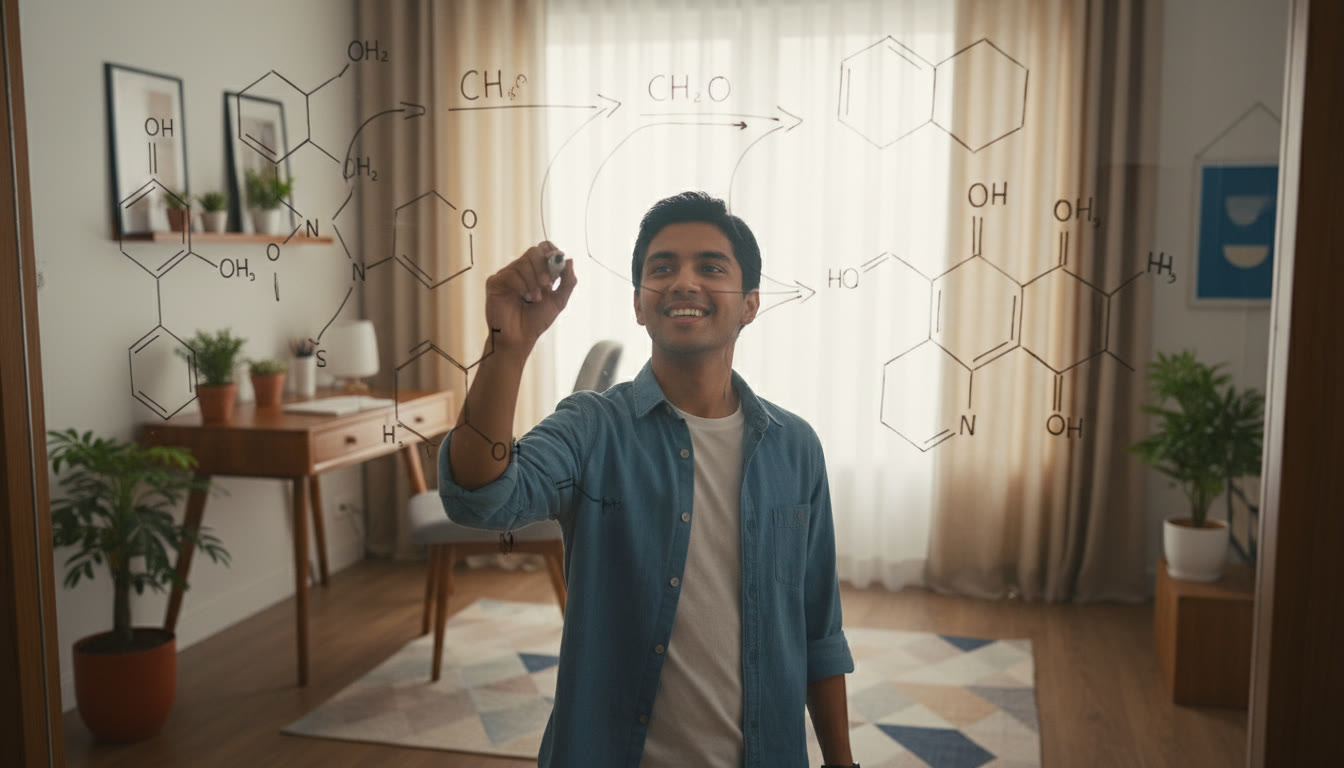
Biology — narrative plus diagrams
Biology is narrative-driven: processes, lifecycles, and cause-effect chains. Turn long descriptions into compact flowcharts and annotated diagrams. Since the exam is MCQ-based, practice converting paragraphs into “if–then” statements that map to single correct choices. Use diagrams as memory scaffolds—labelling a cellular process on a sketch helps retention far better than rereading paragraphs.
- After reading a topic, try to explain it in two minutes or teach it to a friend; this reveals weak spots instantly.
- Convert complex descriptions into 4–6 step flowcharts for rapid revision.
Practice strategy: how to use mocks and problem sets to refine concepts
Practice isn’t practice unless it challenges your understanding. Full three-hour mocks are non-negotiable because they train stamina, pacing, and OMR discipline. Regular sectional practice is also useful when you are targeting weak chapters. Always simulate timing, reading conditions, and answer recording exactly as you will face it on exam day.
Mock test schedule example
| Phase | Frequency | Focus |
|---|---|---|
| Early preparation | Once every 2–3 weeks | Identify weak chapters and time leaks |
| Mid preparation | Weekly | Build pacing and OMR accuracy |
| Final preparation | 2–3 full mocks per week | Stamina and fine-tuning strategy |
Mock analysis checklist
- Record time spent per question type and per passage set.
- Classify errors: conceptual gap, careless mistake, calculation slip, or OMR/format error.
- Create an error log entry with a one-line fix (example: “missed effect of friction—review non-conservative forces”) and schedule that repair in the next two sessions.
- Practice the same topic with two fresh question sets within three days to confirm repair.
Active learning tools that build durable clarity
Passive rereading is the enemy of lasting clarity. Use active techniques:
- Feynman technique: explain a concept in plain language and identify gaps in your logic.
- Spaced repetition: short, frequent recall sessions for formulas, reaction steps and key diagrams.
- Interleaving practice: mix related topics so you learn to choose the right approach under uncertainty.
- Mind-mapping: connect topics across subjects (e.g., how thermodynamics in Physics relates to chemical equilibria).
Sample focused 8-week repair plan for a weak chapter
This micro-plan shows how deep repair looks: short, targeted effort with repeated application.
| Week | Objective | Activities |
|---|---|---|
| 1 | Diagnose the gaps | Take a 20-question test on the chapter; list top 5 recurring errors |
| 2 | Repair basics | One focused study session on core concepts; do short practice set |
| 3 | Apply with variation | Solve mixed-style problems; attempt 2 timed mini-tests |
| 4 | Reinforce visual memory | Create diagrams/flowcharts; use flashcards for definitions |
| 5 | Speed and accuracy | Time-bound practice and error log updates |
| 6 | Mixed review | Integrate chapter problems into broader mixed-topic sets |
| 7 | Mastery test | Full mock focusing 30–40% on repaired chapter |
| 8 | Consolidation | Short daily flashcards and one weekly 20-question mixed set |
When and how to use personalized help
There are moments in preparation when outside perspective shortens the path to clarity: stuck on a recurring mistake, needing a tailored revision plan, or when managing time around school commitments. Personalized tutoring can compress months of wandering into weeks of focused progress. If you explore such options, look for support that offers one-on-one guidance, a tailored study plan, experienced tutors, and insights into practice patterns—features that improve not just scores but understanding.
For example, Sparkl‘s personalized approach combines expert tutors with AI-driven insights to help you identify weak points and craft efficient practice—without replacing the hard work of learning and practicing the concepts yourself.
Exam-day discipline: OMR, pacing and mental clarity
Exam day is where preparation meets process. Discipline on the day is as important as the months that came before.
- OMR practice: simulate filling in bubbles under timed conditions. Train your hand to be steady and accurate; stray marks can cost time and clarity.
- Timing strategy: allocate an average time per question and keep a watch on sections where you habitually slow down.
- Answer selection: use elimination to narrow options. Reserve blind guessing for when you can reduce choices to two—educated guesses are different from random ones because negative marking penalizes wild attempts.
- Rough work discipline: do rough calculations in the dedicated spaces; avoid scribbling on the OMR sheet.
- Mental reset: if a question stalls you for more than the planned time, mark and move on—return later if time allows.
Common pitfalls and straightforward fixes
- Pitfall: Studying too many resources at once. Fix: Pick a core set of materials and use others only for targeted practice.
- Pitfall: Practicing without analysis. Fix: After every practice set, spend time diagnosing mistakes and creating micro-tasks.
- Pitfall: Ignoring weak chapters until late. Fix: Use an 8-week repair plan to tackle one chapter at a time.
- Pitfall: Over-reliance on memorization for conceptual questions. Fix: Convert every fact into an application problem you can solve.
Putting it together: a daily checklist for concept-first progress
- Morning: short revision of flashcards (15–20 minutes).
- Late morning: deep learning session on a new concept (45–60 minutes).
- Afternoon: applied practice problems (40–60 minutes).
- Evening: review errors, update the error log, and do a short mixed MCQ set (30 minutes).
- Weekly: one full mock under exam conditions and a separate session to analyze it in detail.
Final thought
Concept clarity is a cumulative advantage: it shortens problem-solving paths, reduces careless errors, and transforms study time into reliable performance. Build habits that favor understanding, practice under realistic conditions, and repair gaps with focused mini-plans until the idea becomes second nature. This steady, disciplined approach is what converts knowledge into accurate answers on exam day.

















No Comments
Leave a comment Cancel