

Finding your North Star: why the Career-to-College Alignment Plan matters in the IB DP
You chose the IB Diploma because it stretches your thinking, asks for intellectual curiosity, and rewards depth alongside breadth. That blend is brilliant—but it also asks a practical question: how do you turn an IB learning pathway into a purposeful college major and, eventually, a career? The Career-to-College Alignment Plan is exactly that: a compass that helps you connect the skills, subjects, and experiences of the DP with the majors and professions you are considering, without forcing you into a narrow box.

This article walks you through a calm, step-by-step approach you can follow with your school counsellor, subject teachers, parents, and mentors. You’ll find practical checklists, subject–career mappings, mini case studies, and a clear plan you can start using right away, whether you have a clear career goal or are still experimenting. Along the way I’ll show how targeted support—like one-on-one tutoring and tailored study plans—can make alignment smoother and less stressful, while keeping the IB values at the centre.
Start with who you are: the self-inventory that guides choices
Skills, values, and the IB learner profile
Before you pick subjects or research majors, pause for a real self-inventory. The IB learner profile gives you language for what matters—thinkers, open-minded, balanced, reflective—and you can translate those into things universities and employers recognize. Ask yourself:
- Which activities make time feel short? (labs, debates, creative work, coding sessions)
- Which skills do you enjoy practicing—analysis, explanation, hands-on design, narrative, collaboration?
- What values drive you—helping others, building things, solving puzzles, influencing policy?
- How do you like to show mastery—exams, projects, portfolios, public performance?
Write short, honest answers. This three-part map—interests, skills, values—becomes your anchor when subject choices get pressured by reputation or convenience.
Translating careers into college majors (and into DP choices)
From career cluster to academic pathway
Careers and majors don’t align one-to-one. A career like “environmental consultant” could begin with majors in environmental science, geography, engineering, or even economics, each emphasising different strengths. The trick is to identify the core academic knowledge and skills most commonly required for the majors you’re considering and then choose DP subjects that build those foundations.
- Identify 2–3 career clusters you’re curious about.
- For each cluster, list related college majors and the usual academic prerequisites.
- Choose DP HL subjects that satisfy those prerequisites and showcase your passion.
DP subject strategy: align depth (HL) with discovery (SL)
Your HL choices send a clear academic signal to universities. Think of HLs as the evidence you will present that you are ready to study a major’s core topics in depth. SL subjects still matter—many majors accept diverse SLs—but HLs are where you invest most of your IB study hours.
How subjects map to career clusters
Use the table below as a working map—adapt it to your interests and to the specific prerequisites of the universities you plan to apply to. It’s illustrative, not exhaustive.
| IB DP Subject (typical HL) | Career Cluster | College Major Examples | Key Skills Built |
|---|---|---|---|
| Biology | Health & Medicine, Research | Medicine, Biomedical Science, Biotech | Lab skills, scientific method, data interpretation |
| Chemistry | Pharmacy, Chemical Engineering, Materials | Chemistry, Chemical Engineering, Materials Science | Quantitative lab work, analytical thinking |
| Physics | Engineering, Tech, Physical Sciences | Engineering, Physics, Computer Engineering | Problem solving, modelling, math application |
| Mathematics (AA/AI) | Engineering, Data, Finance | Mathematics, Data Science, Actuarial Science | Logical reasoning, calculus, statistics |
| Computer Science | Software, AI, Systems | Computer Science, Software Engineering, AI | Programming, algorithms, computational thinking |
| Economics | Business, Policy, Finance | Economics, Business, Finance | Data analysis, modelling, argumentation |
| English A / Languages | Law, Humanities, Communications | Law, English, Journalism, International Relations | Critical analysis, communication, research |
| Visual Arts / Music | Design, Arts, Architecture | Fine Arts, Design, Architecture | Creative process, portfolio work, visual literacy |
| Geography / Environmental Systems | Environment & Sustainability | Environmental Science, Geography, Urban Planning | Fieldwork, data mapping, interdisciplinary analysis |
| History / Global Politics | Public Policy, Law, Social Research | Political Science, International Relations, Law | Argumentation, contextual analysis, research |
Tip: When a major lists prerequisite subjects, match those with your HL choices. If a direct match isn’t possible, plan compensating experiences—extra courses, summer programmes, or a strong Extended Essay that proves engagement.
Use the DP core as strategic evidence
Extended Essay, TOK, CAS—more than requirements
The DP core is where your curiosity turns into documented proof. A well-chosen Extended Essay shows admissions tutors that you can conduct independent research in a subject area; Theory of Knowledge demonstrates reflective thinking; CAS provides tangible activities that show commitment beyond the classroom.
Examples of strategic choices:
- Extended Essay in Chemistry for a student aiming for engineering or medicine—choose a focused lab-based question with clear methodology.
- CAS project leading a community debate series for a politics-inclined student—evidence of leadership, communication, and service.
- TOK presentation that connects a science method to ethical implications—demonstrates interdisciplinary maturity.
Build a portfolio that proves intent and breadth
Colleges look for consistency and growth. Your academic choices show depth; your extracurriculars and projects show breadth and motivation. Think of your portfolio as a narrative: it should say who you are, what you’ve tried, what you’ve learned, and where you’re going.
- Academic evidence: grades, HL subjects, Extended Essay, teacher comments.
- Project evidence: research, internships, design portfolios, coding repos, published articles.
- Community evidence: CAS projects with measurable outcomes, sustained commitments, leadership roles.
The Career-to-College Alignment Plan: a step-by-step checklist
Below is a practical plan you can adapt. Each step has a clear purpose and suggested actions you can take with your counsellor or mentor.
Phase 1 — Explore and reflect
- Purpose: Clarify interests and realistic clusters.
- Actions: Self-inventory, career quizzes as a starting point (not the final word), conversations with family and teachers.
Phase 2 — Research and map
- Purpose: Translate careers into major options and prerequisites.
- Actions: Look at major requirements, speak to university admissions officers when possible, map DP subjects to requirements.
Phase 3 — Decide subjects and core focus
- Purpose: Choose HLs that match intended majors and develop evidence via the EE and CAS.
- Actions: Confirm HL choices with teachers, sketch EE ideas tied to major interests, plan at least one meaningful CAS project.
Phase 4 — Build and demonstrate
- Purpose: Create demonstrable achievements and a coherent application story.
- Actions: Pursue internships or research, build a portfolio, keep reflective logs for CAS, prepare for interviews or auditions if required.
Phase 5 — Finalise and present
- Purpose: Make a compelling application packet that aligns subjects, experiences, and personal statement.
- Actions: Draft personal statements showing intellectual curiosity and alignment, request targeted teacher references, polish your EE for submission.
| Phase | Focus | Sample Actions |
|---|---|---|
| Explore | Self-understanding | Reflection exercises, shadowing, informational interviews |
| Map | Discovery | Match careers → majors → DP subjects |
| Demonstrate | Evidence | EE, CAS, internships, portfolios |
| Present | Applications | Personal statements, teacher references, interview prep |
Case studies: three realistic student pathways
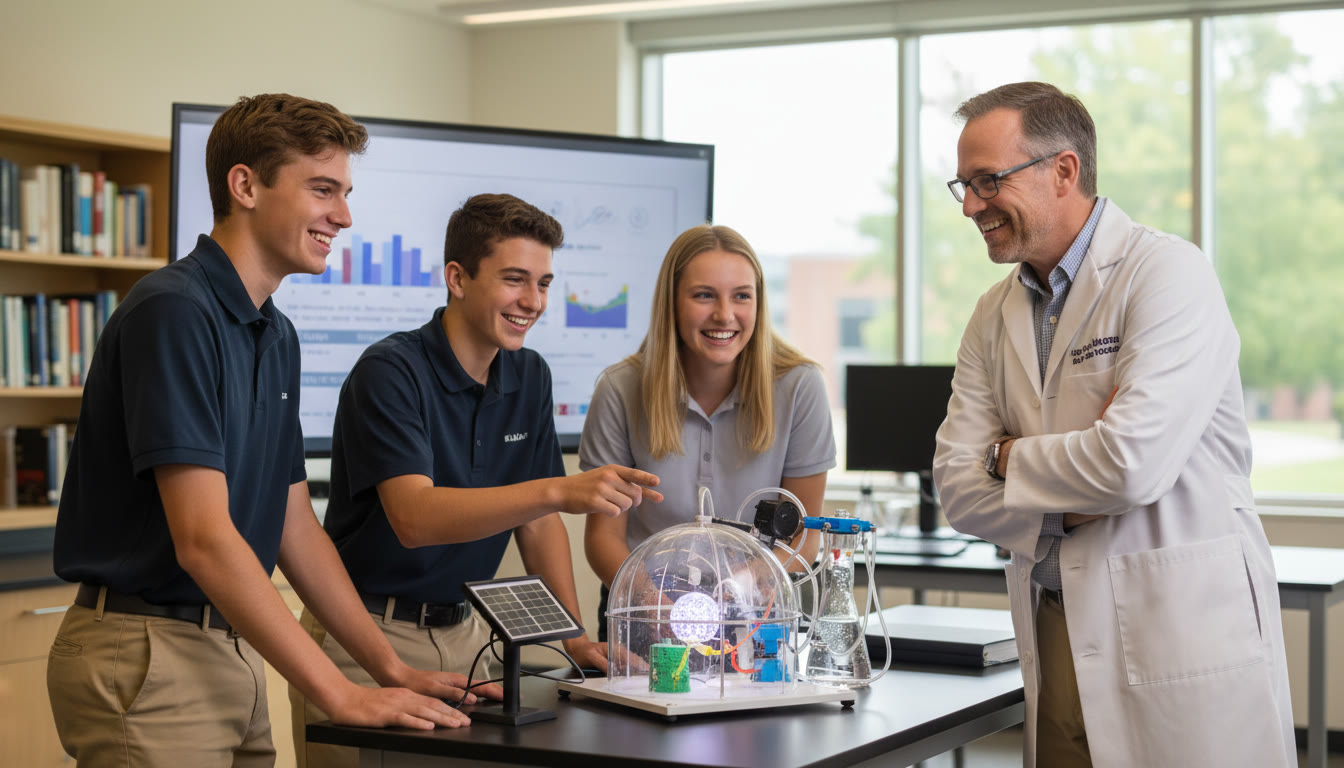
Case A — Curious about biomedical research
Background: Strong in lab sciences and math, enjoys research and problem-solving.
- DP plan: Biology HL and Chemistry HL, Mathematics AA/AI at HL if possible, plus a supportive language or humanities SL.
- EE: A lab-based experimental extended essay in biology or chemistry that tests a clear hypothesis.
- CAS: Volunteer shifts with a community health programme, shadowing at a research lab, or running a peer-led study group for younger students.
- Why it works: HL sciences build the background for majors like biomedical science; a strong EE demonstrates research capacity; CAS shows sustained service and communication.
Case B — Drawn to architecture and design
Background: Highly visual, enjoys model-making, strong spatial skills.
- DP plan: Visual Arts HL, Mathematics (Applications) at HL or SL depending on focus, one science (Physics or Environmental Systems) for technical grounding.
- EE: A research project on sustainable materials or an analysis of a local architect’s work—either can bind practice and theory.
- CAS: A sustained design-build community project or curated exhibitions that create a portfolio of real-world outcomes.
- Why it works: Architecture admissions value portfolios and demonstrated curiosity about space, materials and social impact. The DP allows a strong creative thread plus technical grounding.
Case C — Interested in policy or international relations
Background: Loves debate, history, and languages; interested in global issues.
- DP plan: History or Global Politics HL, Economics HL or Language HL, plus a language A or B to show cross-cultural capability.
- EE: A close comparative study of a policy issue or a primary-source-based historical investigation.
- CAS: Lead a Model UN club, coordinate community campaigns, or volunteer with a local NGO to build leadership and applied policy experience.
- Why it works: HL in social sciences shows readiness for policy-related majors; EE and CAS show engagement with public issues and leadership.
Troubleshooting common dilemmas
I like two very different paths—what now?
Many students feel pulled between, for example, engineering and music. Two strategies help: keep one strong HL aligned to the most rigorous academic path, and use the EE/CAS/portfolio to preserve the alternative interest. That way you remain admissible to technical programmes while showing a distinct, non-academic strength.
My school doesn’t offer a required HL—options?
It happens. You can compensate by: arranging online courses or summer programmes, planning a rigorous EE that shows independent study in the field, or choosing majors with flexible prerequisites. In some cases, universities accept related HLs when accompanied by strong evidence of motivation.
What if my grades lag but I have strong interests?
Admissions panels look for both potential and trajectory. Use the EE and teacher references to show intellectual engagement; pursue projects that produce tangible outputs; and consider targeted tutoring to raise grades. Structured, personalised support can make a measurable difference in both knowledge and confidence.
Where to get focused help
Your first port of call should be your school counsellor and subject teachers—those conversations are essential. If you want tailored academic support to strengthen HL performance, build a portfolio, or prepare for research-based Extended Essays, consider targeted options that offer one-on-one guidance and curriculum-aligned planning. For example, Sparkl‘s personalised tutoring can complement school guidance with expert tutors, tailored study plans, and AI-driven insights that identify gaps and boost efficiency. Combining school counsellor direction with targeted tutoring often leads to the clearest alignment between DP work and college goals.
Putting it together: a realistic monthly checklist (adapt to your timeline)
- Document your intellectual narrative: keep a concise file of EE notes, major projects, and CAS reflections.
- Maintain a subject evidence folder: key assignments, lab reports, creative works, and teacher feedback.
- Schedule conversations: meet your counsellor each semester to review alignment and adjust HL/SL choices as needed.
- Plan mock interviews or portfolio reviews with teachers or mentors.
Final academic note — how success in the DP becomes a signal to colleges
The DP’s combination of rigour, independent research, and community engagement makes it uniquely powerful as a foundation for higher education. When you deliberately align HL subjects with your intended major, use the Extended Essay and CAS to produce concrete evidence of interest, and present a coherent narrative in your applications, you move from a hopeful applicant to a convincing candidate. That coherence—subject choices that match prerequisites, a research project that demonstrates intellectual appetite, and extracurriculars that show commitment—creates a clear academic signal that admissions teams can read easily. Aim for depth where it matters, breadth where it supports your story, and documented evidence that proves you can thrive in the next academic step.
























No Comments
Leave a comment Cancel