
How to Crack JEE Main at Home Effectively
If you’ve decided to prepare for JEE Main from home, welcome — this is absolutely possible, and it can be an empowering, structured, and focused journey. The trick is to combine discipline with smart choices: regular 3-hour full-length mock practice, mindful time management, subject-specific tactics, and continuous analysis of your performance. This guide walks you through a realistic, human plan that keeps stress manageable and progress measurable.

Understand the exam blueprint before you begin
Before you design a study plan, know what the exam asks of you. JEE Main is an objective, MCQ-driven assessment across three core subjects: Physics, Chemistry, and Mathematics. The test is administered under timed, three-hour sessions; many cycles include both multiple-choice questions (MCQs) and numerical-answer type questions. MCQs typically carry negative marks for incorrect answers, so accuracy and strategic attempt patterns matter. Also note: objective tests like this don’t give partial credit for incomplete steps — clarity and correctness of the final selected option is what counts.
That understanding changes how you practice: timed full-length mocks, accuracy drills, and OMR-like discipline (or CBT interface practice if you’re practicing on a computer) are essential. Treat every mock as a simulation — not a casual quiz.
Design a realistic home study routine
One of the biggest advantages of studying at home is flexibility — but flexibility without structure becomes chaos. Build a weekly routine that balances focused study, regular revision, and full-length timed practice. Here are the principles to follow when creating your plan:
- Consistency beats intensity: short, focused sessions every day are more effective than marathon cramming.
- Rotate subjects so that no single day becomes monotonous; your brain needs variety to retain complex concepts.
- Reserve fixed weekly slots for 3-hour full-length mock tests to build stamina and timing instincts.
- Include daily micro-revisions (20–30 minutes) to consolidate formulae, key reactions, and theorems.
Sample weekly rhythm (compact and adaptable)
Use this sample as a template — adapt the hours to suit your school commitments and personal energy curve. The specific numbers matter less than the habit: daily study, spaced revision, and weekly full mocks.
| Day | Morning | Afternoon | Evening | Purpose |
|---|---|---|---|---|
| Monday | Physics concept session (2–3 hrs) | Problem practice (1.5–2 hrs) | Revision + short test (1 hr) | Learn + apply |
| Tuesday | Chemistry theory (2–3 hrs) | Organic practice + reactions (1.5–2 hrs) | Recall & flashcards (30–45 min) | Memorize + practice |
| Wednesday | Mathematics topic (2–3 hrs) | Problem set (2 hrs) | Mock mini-test (45 min) | Speed & accuracy |
| Thursday | Weak-topic focus (2–3 hrs) | Mixed practice (2 hrs) | Revision notes (30–45 min) | Repair gaps |
| Friday | Concepts & derivations (2 hrs) | Problem-solving (2 hrs) | Self-analysis of week (1 hr) | Consolidation |
| Saturday | Full-length mock (3 hrs) | Mock review and error log (2–3 hrs) | Relaxed revision (1 hr) | Test + analysis |
| Sunday | Targeted practice (2–3 hrs) | Project / long-form problems (2 hrs) | Plan next week + rest | Reset & prepare |
How to plan study blocks that actually work
Study blocks should be 45–90 minutes long with a short 5–15 minute break between them. Start a block with a clear goal: finish a set of derivations, solve ten mixed problems, or memorize a set of organic reactions. Always end the block with a one-line action item: what will you review tomorrow? That tiny habit forces spaced repetition.
- Use the Pomodoro method or a modified version that fits your attention span.
- Keep a visible error log: every mistake tells you what to revisit. Don’t bury errors in long notebooks — list mistakes and the corrective step beside each.
- Make short, neat revision sheets for formulae and reactions — these are gold in the final weeks.
Subject-wise tactics: Physics, Chemistry, Mathematics
Each subject has its own rhythm. Treat them differently rather than applying the same technique to all three.
Physics — build intuition, then practice numerics
- Start with physical intuition: imagine the phenomenon (a falling body, a circuit, a field). A clear picture reduces rote memorization.
- Focus on key derivations once; then extract the formulae and practice three problem types where the formula is used differently.
- Numerical practice is essential: do layered practice — easy first, then medium, then hard. Accuracy with units and significant figures matters.
- Make short concept maps for mechanics, electricity & magnetism, optics, and modern physics to connect ideas quickly.
Chemistry — balance understanding with recall
- Physical chemistry needs problem practice; work problems until solution steps become instinctive.
- Organic chemistry is pattern recognition: learn mechanisms and practice transforming reagents into products. Build reaction flashcards for quick recall.
- Inorganic chemistry often requires memorization; convert lists into stories or anchored visuals to remember groups, oxides, and electronic configurations.
- Keep a ‘reaction sheet’ and a ‘formula sheet’ for quick daily revisions.
Mathematics — problem cataloguing and timed practice
- Master standard techniques (integration tricks, coordinate geometry transformations, vectors, and complex numbers) and then apply them in different contexts.
- Catalog problems by method: when you solve a geometry problem by inversion or coordinate shift, tag it — later you’ll know which trick to try under time pressure.
- Practice mixed timed sets to avoid getting stuck on a single question for too long.
Mock tests: how to get the maximum learning from each 3-hour test
Mocks are the backbone of an at-home strategy. Schedule them weekly or bi-weekly and treat each as a rehearsal. The mock should be full-length (3 hours), taken under quiet, exam-like conditions. After each test, do a thorough review.
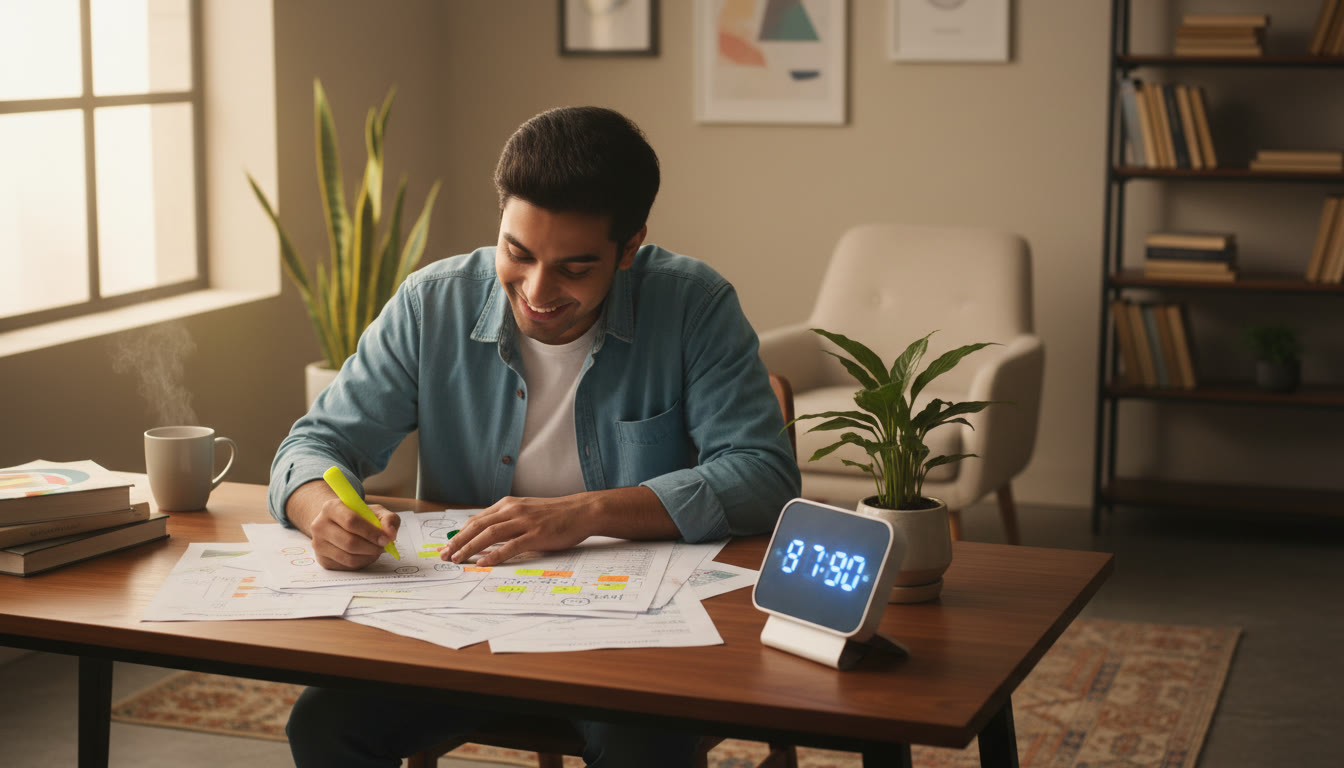
- Simulate the test environment: no phone, no notes, and a timer set to three hours.
- Record raw metrics: score, accuracy, attempts, time per section, and number of negative marks.
- Do a focused error analysis: classify mistakes into conceptual, calculation, silly, or time-pressure errors.
- Create improvement tasks: e.g., ‘Reduce silly errors in Physics by practicing 10 accuracy drills’ or ‘Revise integration tricks and solve 20 timed calculus questions.’
Managing negative marking and attempt strategy
Negative marking changes your risk calculus. Use these practical rules:
- Never guess randomly. If elimination leaves you with a 50:50 choice and the penalty is small relative to gain, it can be worth the attempt — but estimate carefully based on your accuracy track record.
- Start the paper by attempting high-confidence questions to secure marks and build momentum; then move to medium difficulty questions and reserve time to tackle harder ones.
- Time management is your defensive strategy — don’t spend disproportionate time on a single problem when there are solvable marks elsewhere.
Exam-day simulation: OMR discipline and CBT habits
Even though many sessions are computer-delivered, train with OMR-style practice sheets sometimes to sharpen marking discipline and avoid careless errors. Whether you practice on paper or on a computer, follow these habits:
- Read questions carefully — one missed word can change the answer.
- Mark unattempted questions quickly and move on; flag them for review if the interface allows.
- Keep an eye on the clock — ideally, do a time-check after every 30–40 minutes.
Tracking progress: metrics that matter
Don’t track everything. Focus on a handful of metrics that actually show growth:
- Net score and sectional nets (after negative marking)
- Accuracy (correct/attempted) over recent 6–8 mocks
- Average time taken on easy, medium, and hard questions
- Frequency of similar mistakes (calculation slips, conceptual gaps)
Create a simple weekly dashboard (spreadsheet or notebook) where you update these after each mock. A visible trend line beats a single high score any day.
Use technology and personalized help wisely
At-home preparation doesn’t mean doing everything alone. Smartly chosen support makes your effort ten times more effective. Personalized tutoring offers targeted correction and accountability: 1-on-1 guidance helps you fix weak points faster than generic classes, and tailored study plans ensure your hours are focused where they yield the most improvement. For example, Sparkl‘s approach to personal coaching combines expert tutors with AI-driven insights to identify weak topics and adjust practice loads dynamically, which can dramatically shorten the learning curve for tricky concepts.
If you use a coaching or tutoring option, ensure that the help you pay for does three things: identify your mistakes, give clear corrective steps, and reduce the noise — not add more indistinct materials. One short, sharp personalized session that fixes a recurring error pattern is more valuable than ten unfocused lectures.
Common pitfalls and how to avoid them
- Over-reliance on long theory reading: switch to active problem solving as soon as you understand the concept.
- Neglecting revision: spaced repetition beats cramming; review formulae and key reactions weekly.
- Poor mock analysis: doing many mocks without extracting learnings wastes time. Always complete a post-mock action list.
- Chasing perfection in every topic early on: prioritize topics by their weight and your personal weakness.
Mental fitness: study sustainably
Stamina isn’t just physical — it’s mental. Build it with disciplined rest, short exercise, and healthy sleep. Small rituals help: a 10-minute walk before a mock test, a short breathing exercise during breaks, or a strict no-screens rule an hour before bed. If you feel burnout creeping in, reduce study hours for a week but keep quality high — recovery is a performance tool, not a failure.
Tools that help at home
- Timer or digital stopwatch for strict time management during problems and mocks.
- Problem log: a notebook or spreadsheet listing every missed question, the reason it was missed, and the corrective step.
- Revision flashcards (digital or paper) for equations, reactions, and important theorems.
- Periodic short check-ins with a mentor or tutor to validate progress and tweak the plan.
How to revise in the last stretch
In the weeks leading up to the exam window, switch from learning new topics to consolidating: reduce the creation of new notes and increase revision frequency. Do short daily revisions of all three subjects, prioritize error-free problem sets, and increase the number of full-length mocks with review. Focus on accuracy more than raw speed in the final phase; a clean net score often beats a faster but error-prone attempt.
Final tips — small habits that make a big difference
- Write neat, minimal notes after every mock: what went well, and one targeted correction for the next week.
- Practice question selection: learn to identify a 2-minute question versus a 15-minute question quickly.
- Keep a calm pre-mock routine: warm up with short revision, do a 10-minute confidence-building problem set, then start your mock.
- During the real test, read all options carefully before locking an answer; often the trap is in the wording or units.
Closing academic note
Preparing for JEE Main at home is a test of consistent habits, strategic practice, and honest analysis. Build a routine that balances concept-building with timed practice, record and repair recurring errors, simulate exam conditions through 3-hour mocks, and use focused, personalized support when a recurring problem slows your progress. Over time, disciplined study and reflective practice will convert effort into reliable performance on the actual exam.














No Comments
Leave a comment Cancel