
Mastering Content-Heavy HLs: Your roadmap to a 40+ Diploma
Taking three content-heavy Higher Level (HL) subjects is a brave and rewarding choice. It means deep learning, longer syllabuses, and often richer internal assessments — but it doesn’t mean you are locked out of a 40+ overall score. With a strategic approach, deliberate practice, and smart prioritization, students who choose demanding HLs regularly reach and surpass that target.
This article is written for you: the student juggling thick HL textbooks, long lab reports, essays, and packed timetables. Expect practical systems, clear examples, and study routines you can adapt — not vague motivation. We’ll walk through the scoring logic, lesson-by-lesson habits that build mastery, exam strategies that protect marks on test day, and realistic schedules so effort turns into high grades.

What aiming for 40+ really means (and how HLs fit in)
First, the scoreboard. Your IB Diploma score comes from six subjects scored 1–7 and up to three bonus points from Theory of Knowledge (TOK) and the Extended Essay (EE). That structure makes HLs important for depth and university entrance, but not numerically ‘heavier’ — an HL 7 equals an SL 7 on the points scale. The difference is the workload and expectation: HLs demand broader content knowledge, greater depth of understanding, and often longer or more challenging assessment tasks.
So when you set a goal of 40+, your plan must do two things at once: (1) deliver consistent high scores across all six subjects and (2) secure those precious TOK/EE points. Practically, that means you want a set of target grades that add up to 40 or more while protecting against occasional low marks.
Sample target breakdown (what to aim for)
| Subject | Target Grade | Why this target? |
|---|---|---|
| HL 1 (content-heavy) | 6–7 | HLs require depth; converting core knowledge into exam-style answers is critical. |
| HL 2 (content-heavy) | 6–7 | Manage workload by focusing on high-yield topics and exam technique. |
| HL 3 | 6–7 | Consistent practice and IA completion will lock these marks. |
| SL 1 | 5–7 | SLs can consolidate balance across the diploma. |
| SL 2 | 5–7 | Choose SLs where you can reliably gain marks with less time. |
| TOK + EE | 2–3 bonus points | Thoughtful topics and regular feedback often secure these points. |
Choose strategy, not sacrifice: picking and pacing three HLs
Passion matters — you need it to sustain long-term motivation — but so does strategy. When your HLs are content-heavy, balance is everything. Ask yourself: do these three HLs complement each other in skills (e.g., mathematical reasoning vs essay writing vs lab technique)? Can one HL feed into your Extended Essay or TOK essay so that work overlaps intelligently?
- Pairing strategy: align at least one HL with your EE topic or a TOK theme to multiply returns on your effort.
- Skill distribution: make sure the three HLs don’t all demand the same daily resource (for instance, avoid three HLs that simultaneously need long lab sessions each week).
- Backup planning: have clear contingency routines for the weeks when one of your HLs channels suddenly needs more time.
Build a study system that scales — not a heroic sprint
High achievers succeed by doing the same sensible things repeatedly, not by burning out on last-minute marathons. The study system I recommend is modular, measurable, and forgiving — it acknowledges the reality of other commitments while creating forward motion in each HL.
Core elements:
- Micro-syllabus mapping: break each HL syllabus into 8–12 learning modules and assign them to your study calendar. Modules are the unit of progress (not ‘finish textbook’).
- Weekly rotations: rotate intensive study across HLs so that at any time one HL has a deep week (focused revision and past-paper practice) while the others have maintenance weeks (concept checks and flashcards).
- Active checks: a weekly, timed mini-assessment (20–40 minutes) per HL to test retrieval and application. Make these non-negotiable.
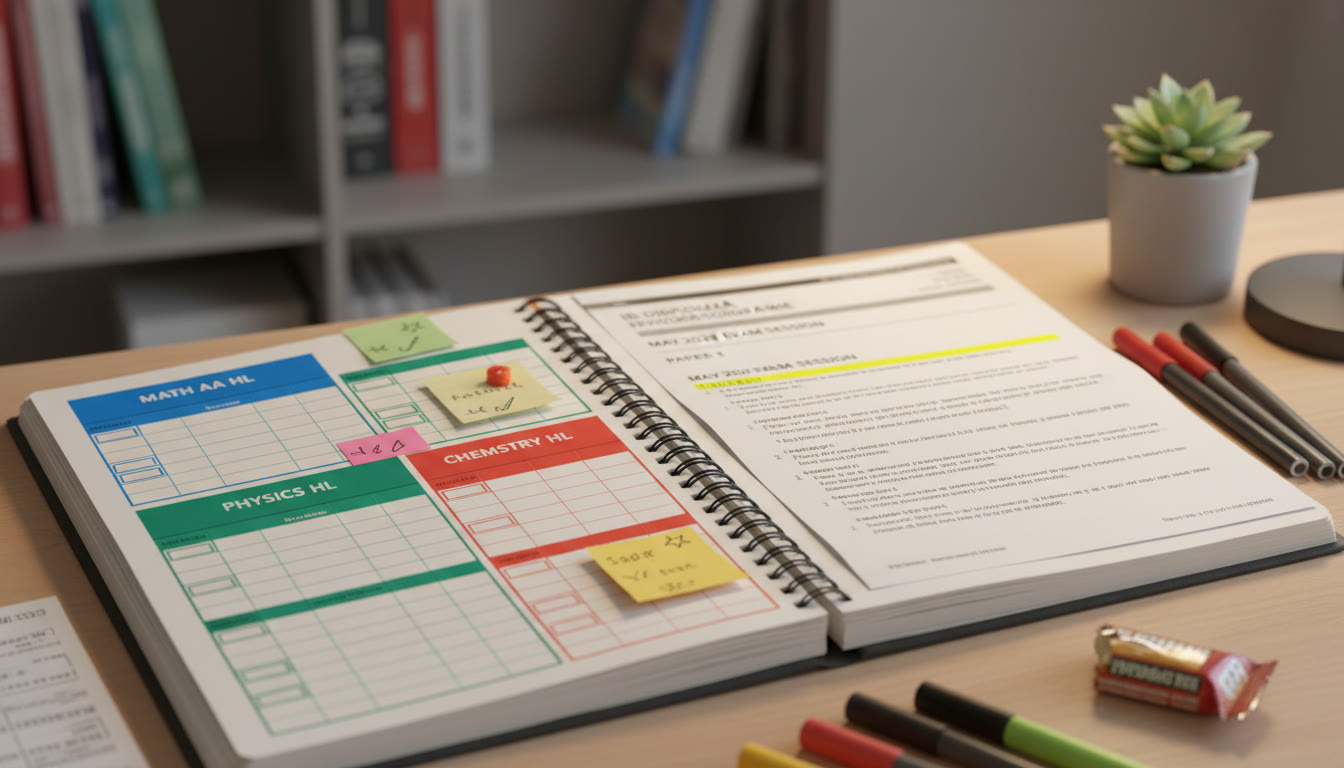
- Visible progress: track module completion, timed-practice scores, and IA deadlines on one dashboard or notebook so nothing is left to memory alone.
Study routines that actually create mastery
Content-heavy HLs reward deep processing over passive re-reading. Here are techniques that convert study hours into reliable, transferable knowledge.
- Active recall: After reading a section, close the book and write a one-paragraph summary from memory, then identify three test-style questions that probe the core idea.
- Spaced repetition: Schedule short reviews of material at increasing intervals. Use flashcards for definitions, formulas, key dates, and concepts.
- Interleaving: Mix problem types from different modules in one session — it improves long-term application more than blocked practice.
- Concept mapping: Draw links across HLs and topics (e.g., how a political theory links to a case study in history). These maps become valuable in TOK and essays.
- Teach to learn: Explain a topic to a peer or record yourself explaining it. If you can’t explain the nuance clearly, your revision needs work.
Exam technique: how to stop losing marks
Content knowledge gets you close to the top. Exam technique pulls you over the line. For content-heavy HLs, the last 15% of marks often depend on technique: precise wording, proper use of terminology, clear structure, and time management.
- Command terms: Memorize and practice responses for command terms (e.g., ‘compare’, ‘evaluate’, ‘justify’) so your structure matches the question’s requirement.
- Answer skeletons: For common question types (data analysis, 15-mark essays, practical design), prepare a 3–4 bullet skeleton you can adapt under time pressure.
- Mark-sense practice: When doing past papers, simulate exam conditions and then grade against mark schemes. Note how many marks are given for each component and practice hitting those markers explicitly.
- Time budgeting: Do a quick time allocation before you start each paper and stick to it. If a question is taking too long, make a concise, high-quality attempt and move on to capture remaining marks.
Practical examples by subject type
Different HLs demand different habits. Here are concise, practical moves for common content-heavy HLs.
- Sciences (Biology, Chemistry, Physics HL): Prioritize problem sets and past paper calculations. Create a laboratory log with one-page summaries of technique, typical errors, and common calculations that reappear in exams.
- Humanities (History, Geography HL): Build evidence banks and timeline summaries. Practice writing under timed conditions and annotate exemplar essays to see how arguments earn marks.
- Mathematics (Maths HL): Drill problem types, but also write one-page ‘trouble-shooters’ for each topic (e.g., integration substitutions, asymptote tests) so you can quickly find an approach in exams.
Internal Assessments and the Extended Essay — play smart
IA and EE are long-form workstreams that reward early starts and narrow, manageable questions. For content-heavy HL students, using the IA/EE as learning leverage is a high-ROI move: choose topics that deepen your HL knowledge so time spent produces dual benefits.
- Start early — schedule milestones for proposal, data collection, first draft, and teacher feedback.
- Scope tightly — a focused question that lets you apply HL skills is better than an overambitious one that becomes sloppy.
- Use feedback loops — build at least two structured feedback cycles and act on them quickly.
Sample weekly study allocation (workable for 3 content-heavy HLs)
| Subject | Hours/week (recommended) | Main weekly focus |
|---|---|---|
| HL 1 (content-heavy) | 7–9 | Module deep-dive + past paper practice |
| HL 2 (content-heavy) | 6–8 | Problem sets + IA/skill work |
| HL 3 | 5–7 | Concept clarity + timed essays/questions |
| SL 1 | 3–4 | Maintenance and quick practice |
| SL 2 | 3–4 | Application practice and notes consolidation |
| TOK/EE | 2–4 | Drafting, feedback, and reflection |
These are weekly averages — push more time into one HL during its deep week and scale back on maintenance subjects briefly. The key is predictability and making progress on each module every two weeks at least.
How to practice past papers the smart way
Past papers are the single most reliable predictor of exam success. But how you use them matters more than how many you do.
- Plan practice cycles: learn → apply → review. Read a topic, do a timed past-paper question, then review with the markscheme and rewrite a superior answer.
- Target weaknesses: rotate past papers around specific question types you find difficult rather than doing whole papers randomly.
- Quality over quantity: one well-scored, corrected paper with a detailed error log is worth two rushed papers with no review.
When and how to get targeted help
Targeted, individual support accelerates progress by removing guesswork. If a particular HL has stubborn gaps — persistent errors in exam technique, unclear conceptual blocks, or IA uncertainties — consider focused 1-on-1 sessions rather than generalized group classes. Personalized tutoring can help you identify the smallest changes that produce the biggest grade improvements: better structure for essays, faster problem approaches, or clearer lab technique.
For example, Sparkl‘s personalized tutoring offers 1-on-1 guidance, tailored study plans, expert tutors, and AI-driven insights that can pinpoint weak spots and suggest concrete next steps. Used selectively, this kind of support can be an efficient accelerant in the months leading up to major assessments.
Daily habits that compound into mastery
Small, repeatable habits matter. Here are field-tested routines students use to protect study quality while staying balanced.
- Daily 25/5 blocks: 25 minutes focused study, 5 minutes break — repeat. Use the short breaks to quickly review flashcards or stretch.
- Weekly planning session: 20 minutes every Sunday to schedule topic modules, mock exams, and IA milestones for the week.
- Nightly summarization: before bed, write three new things you learned and one question you still have — it keeps your brain primed for memory consolidation.
- Accountability partner: one peer who reviews your mini-assessments once a week and gives honest feedback.
Health, sleep, and the exam window
High performance is not only cognitive — it’s physiological. Regular sleep, short exercise, and consistent meals protect concentration and memory retention. Aim for consistent sleep schedules during heavy revision windows, and practice your full-exam-day routine (wake time, breakfast, travel time to exam centre) during mocks so nothing surprises you on the day.
Common pitfalls and how to avoid them
- Over-hyping productivity: Long study sessions without direction create fatigue. Use modules and timers.
- Ignoring markschemes: Students often do past papers but fail to map their answers to the markscheme. Do the mapping — it reveals exactly what examiners reward.
- Late IA crunches: IA and EE rushed at the end often cost marks. Build deadlines for drafts and feedback early.
- Too many resources: Stick to a small set of trusted textbooks, past papers, and classroom resources to avoid confusion.
Putting it together: a four-week focus plan
Month-long cycles are manageable and create momentum. A four-week cycle could look like:
- Week 1 — Module learning: cover new content, make concept maps.
- Week 2 — Application: problem sets, essay outlines, lab technique practice.
- Week 3 — Past-paper focus: targeted timed questions and markscheme mapping.
- Week 4 — Consolidation: mini-assessments, IA/EE drafting, and a reflective review to plan the next cycle.
Conclusion
Scoring 40+ while taking three content-heavy HLs is demanding but entirely achievable when you replace overwhelm with a system: clearly defined modules, evidence-based study techniques, regular past-paper practice, and targeted support for sticking points. Prioritize consistent small wins — weekly mini-assessments, disciplined feedback cycles on IAs and the EE, and time-boxed revision — and the grades will follow.























No Comments
Leave a comment Cancel