
How to Crack JEE Main in Your First Attempt: A Practical Roadmap
There’s a clear difference between wishing to clear JEE Main and building a plan that reliably gets you there. If you’re aiming to clear JEE Main in your very first attempt, this article is for you — written in plain language, full of practical habits and strategies you can start using today. You’ll find a realistic study blueprint, test-day discipline, and methods to turn weak spots into scoring strengths. This is a long game built from short, consistent wins.

Start with the exam reality: format, timing, and scoring
Before you plan anything, understand what the exam demands. JEE Main is an objective, time-bound exam that tests your Physics, Chemistry and Mathematics (PCM). The test is typically computer-based and administered in fixed-duration sessions — plan your practice around the full exam duration. Expect multiple-choice style questions and numerical-type questions in the current cycle, with negative marking for incorrect MCQs in many sections. There is no partial credit for descriptive answers in JEE Main-style assessments; accuracy counts, and so does time management.
Two immediate takeaways: practice under timed, full-length conditions (three hours) and treat every practice question like a mini-exam — answer selection, elimination of wrong options, and careful marking matter. In computer-based settings, use the interface’s features (flag-for-review, clear marking) the way you would use neat OMR discipline in a paper test: deliberate marking, no random ticking, and always re-check flagged questions if time permits.
Mindset: consistency beats intensity
One dramatic week of cramming rarely beats steady, targeted effort across months. Here’s a simple mental model: think of preparation as building a house. Foundation (basic concepts) comes first, then the frame (routine problem solving), then the finishing (timed tests, revision, and polishing weak topics). Keep a long-term outlook — small consistent steps compound into deep understanding.
- Accept growth: your understanding grows when you make and correct mistakes.
- Embrace deliberate practice: short, focused sessions on specific skills beat marathon reading.
- Be adaptable: if a strategy isn’t working after a month of honest trial, tweak it.
Build a study plan that’s realistic and measurable
Generic study plans fail because they’re built without the person in mind. Instead, design a plan that fits your school load, sleep requirements, and daily energy rhythm. Break the year into phases — foundation, consolidation, and exam-sharpness — and create measurable weekly goals: number of topics finished, number of problem-sets completed, and mock-test score targets.
| Phase | Duration (approx) | Primary Focus | Weekly Mock/Test Cadence |
|---|---|---|---|
| Foundation | 6–10 weeks | Concept clarity, basics of PCM, easy-to-moderate problems | 1 short timed test + topic quizzes |
| Consolidation | 8–12 weeks | Speed, accuracy, problem variety, advanced questions | 1 full-length mock + 1 sectional test |
| Exam-sharpness | 4–8 weeks | Revisions, full-mocks, error correction, time strategy | 2 full-length mocks per week |
Use that table as a scaffold — adapt duration to where you stand today. If you’re revising after school hours with limited time, push more focused practice on weak topics and use weekends for full mock sessions.
Daily routine: precision over long hours
It’s not about how many hours you sit, but what you do while you’re sitting. Here’s a practical daily structure you can tailor:
- Morning (high alertness): 60–90 minutes of a difficult topic (Math derivations, conceptual Physics).
- Late morning / afternoon: School or lighter study; focus on concept consolidation and short problem sets.
- Evening (post-break): 60–90 minutes of chemistry practice or mixed problem solving.
- Night (light revision): 30–45 minutes of error-log review or flashcards.
Quality checkpoints: every study block should have a concrete outcome — finish a chapter, solve a set number of problems, or correct five past mistakes from your error log.
How to study each subject: targeted habits
Physics
Physics rewards conceptual clarity and the ability to turn a physical situation into equations fast. Practice deriving results from first principles so the result becomes natural to you. For mechanics and electricity topics, practice free-body sketches and dimensional checks. When approaching a problem, follow this micro-routine: read fully, note what’s asked, list given physical quantities (with units), sketch, select equations, solve, and check units.
Chemistry
Chemistry splits into conceptual (inorganic), mechanism-driven (organic), and calculation-focused (physical) parts. Don’t treat reactions as memorization alone — group reactions by patterns and logic. For physical chemistry, practise numerical problems under timed conditions; for organic, create reaction-flow maps that show transform pathways rather than isolated steps.
Mathematics
Mathematics is cumulative: the next topic sits on the shoulders of previous ones. Focus on understanding why a technique works (not just how to use it). Solve problems in increasing difficulty: routine → moderately tricky → olympiad-level occasionally. The last category builds creativity, but don’t spend most of your time on it.
Practice strategy: variety and depth
A smart practice plan mixes three things: focused problem work, timed full-length mocks, and targeted revision. Keep an error log for every test and practice session. For each mistake, note the category (careless, conceptual gap, calculation slip, time pressure), the corrective step, and the number of repetitions required before you consider the topic mastered.
| Mock Metric | Good Target | How to Improve |
|---|---|---|
| Attempt rate (questions attempted) | 70–85% | Faster question selection + sectional timed practice |
| Accuracy | 75%+ | Focused revision and elimination techniques |
| Time per question | Medium: 2–3 min overall avg | Practice shortcuts, avoid redoing steps |
Three-hour mocks: more than a score
Full-length mock tests replicate the exam environment: time pressure, syllabus mix, and mental fatigue. Take at least one full-length mock every week during consolidation, and increase to two per week as the exam nears. Treat every mock like a laboratory experiment — run it, record the data, analyze, and adjust.
- Before the mock: ensure a quiet environment and reliable timer.
- During the mock: stick to your strategy; don’t marathon a single hard question early.
- After the mock: spend at least twice the test time analyzing — don’t just look at the score.
Smart question selection and elimination
Two things decide many JEE Main scores: the questions you choose to attempt and how efficiently you eliminate wrong options. If you can eliminate two wrong options in a four-choice MCQ, your probability of success rises. Use process-of-elimination, estimate bounds, and sanity checks. For numerical-type questions, small rounding checks often catch careless slips.
Revision that sticks: spaced and active
Revision isn’t re-reading; it’s active retrieval. Use spaced repetition — revisit a topic at increasing intervals. Convert notes into quick recall prompts: key formulas, reaction patterns, and one-line concept checks. Quiz yourself under time pressure and use the error log as the spine of your revision.
Health, sleep and short breaks
Brains consolidate learning during sleep. Short naps and consistent sleep schedules improve memory and problem-solving speed. Plan short breaks every 50–90 minutes and reserve at least one full day a week for light study or a disciplined mock-and-relax routine to avoid burnout.
When to ask for help
If a topic resists repeated honest attempts — more than 2–3 focused weeks with small measurable progress — get targeted help. Personalized tutors can accelerate correction of misconception loops; one-on-one guidance shortens the feedback loop and helps design remedial drills. For tailored study plans, focused doubt-clearing, and AI-driven insights into weak areas, consider guided support such as Sparkl. If you write possessively about their model, mention it as Sparkl‘s focused help when appropriate.
Exam-day strategy and calm execution
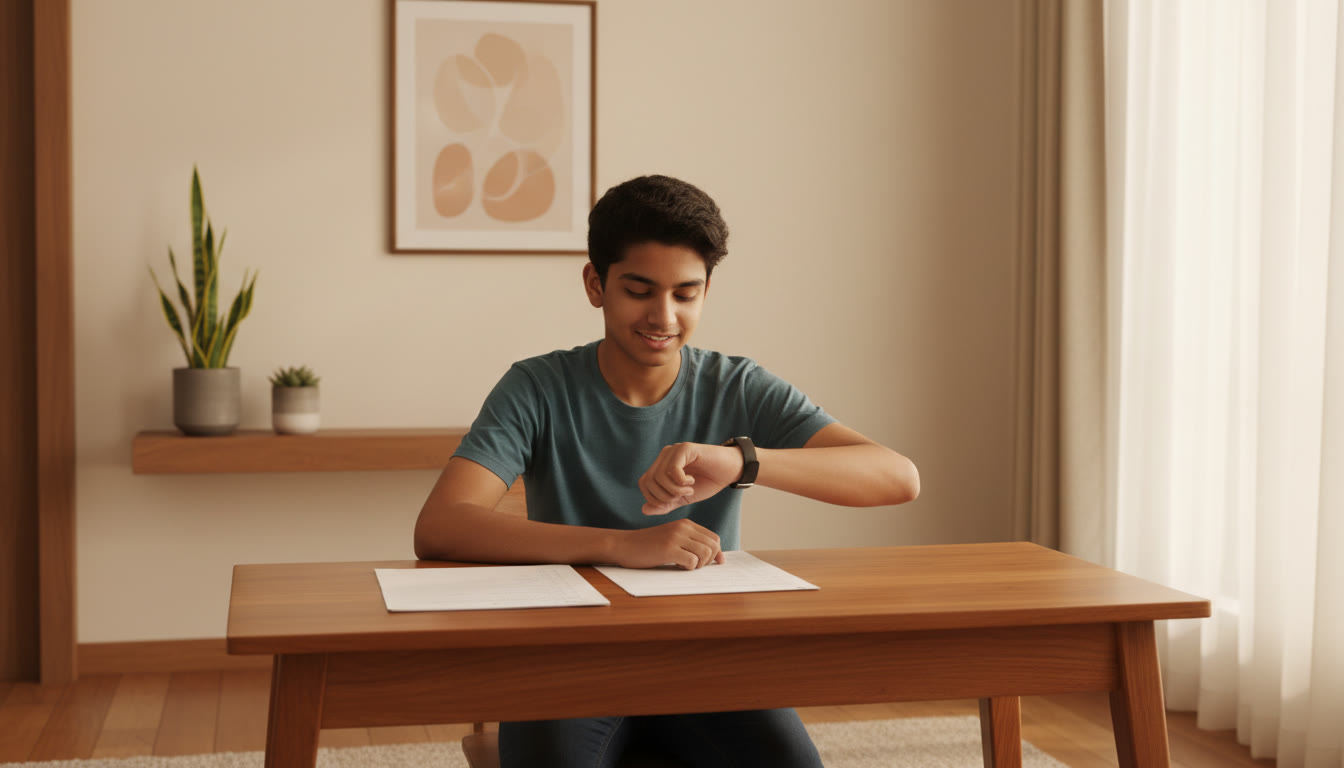
On the big day, execution matters more than raw knowledge. Start with the paper section where you are most comfortable to build momentum. Use the first 10–12 minutes to scan the paper and select low-hanging questions. Keep strict time checks: allocate time blocks for sections and keep reserves for flagged questions. Resist the urge to chase a single tough problem early. If the exam is computer-based, be disciplined with on-screen flags and answer confirmation — don’t let interface anxiety steal minutes from your test.
Mistake-proofing: the error log and micro-actions
Your error log is the most valuable study artifact. For every wrong answer capture: topic, exact mistake, corrective drill, and a date for re-check. Micro-actions — 10–15 minute drills targeting the same mistake — are more effective than lengthy, unfocused sessions. Over weeks these micro-actions reduce repeated errors drastically.
Examples and how to apply them
Example 1 — Physics: if you falter on kinematics questions, rewrite core equations on a single sheet, solve five progressively harder problems daily until your time and accuracy improve. Example 2 — Chemistry: if equilibrium calculations are slow, practice unit-conversion and dimension checks, then complete targeted sets of calculation problems for speed. Example 3 — Mathematics: if integration problems confuse you, create a quick-reference of common substitutions and practice pattern recognition over mixed sets.
Checklist: things to do every week
- Complete scheduled topic goals (as per your roadmap).
- Take at least one timed full or sectional test and analyze it deeply.
- Update and practice from your error log — perform corrective drills.
- Practice mental math and approximation for quick elimination.
- Sleep 7–8 hours on most nights and schedule one rest day weekly.
Tools and habits that really help
Use a single physical or digital calendar for deadlines and mock dates. Create a short formula/reaction booklet for last-minute revision. Prefer practice that mimics exam conditions — same time window, similar environment, and strict timekeeping. Avoid the temptation to switch too many resources; depth in a few focused resources outruns superficial breadth.
Sample 10-week sprint: what a focused month could look like
| Week | Focus | Target |
|---|---|---|
| 1 | Finish remaining foundation topics in weakest subject | Complete 10 topic modules + 2 sectional tests |
| 2 | Speed-building and accuracy drills | Timed sets; reduce careless errors by 30% |
| 3 | Full mock focus and analysis | 3 full mocks + deep analysis |
| 4 | Targeted revision of highest-yield topics | Daily short revisions; error log zeroed for those topics |
Final weeks: sharpen, don’t learn
As the exam window approaches, the arithmetic is simple: stop adding new, heavy topics and shift to consolidation. Polish the high-yield topics that appear frequently, rehearse time strategy with mocks, and make your revision compact and active. The aim is mental sharpness and reliability, not novelty.
Common traps and how to avoid them
- Trap: Over-collecting resources. Fix: pick a small set and cover them deeply.
- Trap: Randomly solving problems without analysis. Fix: always analyze errors and set corrective tasks.
- Trap: Ignoring health. Fix: scheduled rest, exercise, and sleep blocks are non-negotiable.
What separates first-attempt success from near-misses
Two traits: the discipline to reproduce exam conditions repeatedly, and a relentless error-correction loop. The best first-attempters don’t necessarily solve the hardest problems; they maximize correct attempts in the time available and reduce avoidable mistakes. That combination — breadth with high accuracy — is the decisive edge.
Closing note: steady work and exam discipline
Cracking JEE Main on your first attempt is an organized journey: understand the exam, build a realistic plan, practice under real conditions, analyze every mistake, and take care of your physical and mental edges. Keep a small set of clear weekly goals, use full-length mock practice to test both speed and temperament, and keep improving through deliberate corrective drills. With steady habits and focused reflection, first-attempt success becomes an outcome of everyday choices rather than luck.




















No Comments
Leave a comment Cancel