

JEE Main PYQ Physics Analysis: Why past-year questions matter more than you think
If you’re juggling full-length mocks, chapter revisions and that nagging voice that asks “Did I miss something?” — welcome. PYQs (past-year questions) are not magic spells but powerful lenses: they reveal recurring concepts, show how examiners phrase traps, and teach you the exact level of reasoning the test rewards. A careful, empathetic read of PYQs turns scattershot practice into a targeted training plan.

What a thoughtful PYQ analysis actually gives you
- Pattern recognition: which topics appear frequently and which surface as surprise checks.
- Question-style clues: numerical computation vs conceptual MCQs, multi-concept mashups, or quick one-liners.
- Difficulty calibration: what counts as “easy” or “time-eating” at exam level.
- Strategy cues: which questions are worth solving first, which to mark and return to, and where partial work helps avoid silly mistakes.
Core exam realities you must accept (and use)
Keep these concrete rules top of mind while examining PYQs and while taking mocks: the paper is MCQ-based and built to be finished in a 3-hour full-length mock environment; there is negative marking so blind guessing is costly; OMR discipline — clean, consistent bubbling — is essential to avoid avoidable slips. The syllabus alignment is with Physics, Chemistry, and Mathematics; treat diagrams, derivations, and neat rough work as study tools rather than as “answers” you can rely on to gain partial credit in the final sheet.
Topic hotspots: what PYQs tend to favour in Physics
From a careful look across many cycles, certain areas show up repeatedly and form the backbone of the physics section. Below is an approximate topic-weight table that helps prioritize study hours — think of these as strategic probabilities, not absolute rules. Use them to triage your revision and to build a topic-by-topic error log.
| Topic | Approx. % of Questions | Typical Difficulty | Revision Focus |
|---|---|---|---|
| Mechanics (Kinematics, Newton’s laws) | 20–25% | Easy–Moderate | Free-body diagrams, limiting cases, dimension checks |
| Work, Energy & Power | 8–12% | Moderate | Energy methods, conservative forces, multiple-step problems |
| Rotational Dynamics & Equilibrium | 8–10% | Moderate | Torque, moment of inertia, angular momentum conservation |
| Waves & Oscillations | 8–12% | Easy–Moderate | Simple harmonic motion, superposition basics |
| Thermodynamics & Kinetic Theory | 8–12% | Moderate | First law applications, PV diagrams, ideal gas relations |
| Electrostatics | 12–16% | Moderate–Challenging | Field/ potential intuition, symmetry tricks, Gauss’ law basics |
| Current Electricity & Magnetism | 12–16% | Moderate–Challenging | Circuit simplification, Biot–Savart sense checks, magnetic force geometry |
| Optics (Geometrical & Wave) | 6–10% | Easy–Moderate | Ray diagrams, lens/mirror formulae, interference basics |
| Modern Physics (Photoelectric, Atomic, Nuclear) | 8–12% | Easy–Moderate | Energy quantization, photon relations, simple nuclear facts |
| Units, Dimensions & Experimental Skills | 1–3% | Easy | Dimensional analysis, reading graphs and OMR-style experimental setups |
How to interpret that table
Use the approximate percentages to distribute your revision energy. High-probability topics need both depth and speed: you must be able to solve representative problems fast. Medium-probability areas demand reliable conceptual clarity and selective practice. Low-percentage items are worth a quick conceptual sweep and error-free practice but should not dominate your final three-week plan.
From PYQ to practice: a concrete mock-test blueprint
Turning PYQ insight into exam performance requires a disciplined mock strategy. Treat every full-length mock like a surgical rehearsal: set objectives, simulate constraints, then reflect with ruthless honesty.
Simulate the exam, exactly
- 3-hour full-length mock: sit in a quiet room, use a printed OMR-style sheet or the same online interface your mock uses, and time strictly.
- Strict negative-marking discipline: do not make blind guesses — learn to convert uncertain answers into educated guesses using elimination.
- Rough work etiquette: use one side of a page for calculations and keep answers neat for quick re-checking before bubbling. Maintain a consistent OMR bubbling pace to avoid last-minute rush errors.
Recommended time allocation (a starting point)
| Phase | Minutes | Purpose |
|---|---|---|
| Initial fast pass | 20–25 | Attempt obvious easy questions across all sections to secure quick marks |
| Focused solving | 120–130 | Tackle medium and hard questions; allocate time by your strengths |
| Mark & revisit | 20–25 | Return to marked questions with fresh focus |
| Final check & bubbling | 10–15 | Verify OMR bubbles, units, and glaring arithmetic mistakes |
This plan is an anchor — your natural strengths should nudge the numbers. If you’re confident in Physics, a slight time shift to Math might be sensible. The key point: follow a plan, don’t improvise timing under pressure.
Practical PYQ analysis routine (what to do after every mock)
Practicing is not valuable unless accompanied by reflection. Use this short, repeatable routine after every mock to convert mistakes into reliable gains.
- Tag every wrong or slow question by topic and by mistake-type (conceptual slip, calculation error, careless reading, OMR error).
- Write a one-line corrective action next to each tagged problem: “re-derive formula,” “memorize sign convention,” or “practice vector projections.”
- Create a micro-drill of 5–8 problems that target your top 3 recurring mistake-types; do this drill under timed conditions and re-analyze.
- Maintain an error log and revisit it weekly; circuit-breaker items should be prioritized in every revision session.
A worked sketch: how to approach a typical PYQ-style physics problem
Here’s an invented example that illustrates approach rather than answer-copying — the skill you need is how to think fast on a timed sheet.
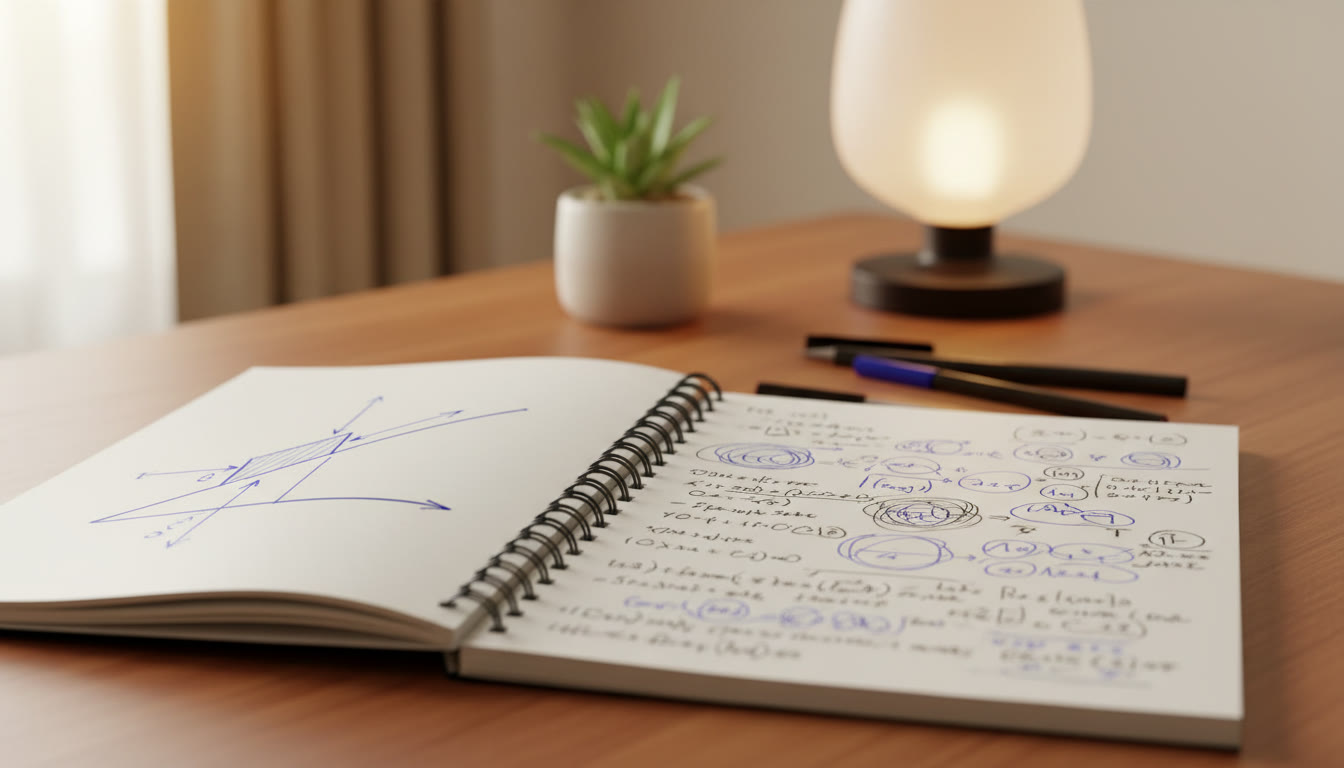
Sample (paraphrased style): A light rod of negligible mass rotates in a horizontal plane with a small mass attached at one end; the tension provides centripetal force. If the rod length is L and angular speed is ω, which expression gives the equilibrium angle when a small vertical perturbation appears?
Reasoning approach (summary):
- Identify forces and choose a coordinate system quickly — radial and vertical is natural here.
- Apply equilibrium conditions or small-angle approximations if the PYQ suggests small perturbations.
- Dimensional check: ensure the candidate expression has units consistent with angle or length as appropriate.
- Eliminate answer choices using limiting cases: ω → 0 should reduce to vertical; large ω should lead to near-horizontal rod — this helps discard inconsistent options fast.
That quick heuristic — draw, write equations, test limits — is often far faster than grinding algebra under time pressure.
Common PYQ traps and how to avoid them
- Unit confusion: Always convert to SI for intermediate work; build a habit of checking units before final bubbling.
- Sign mistakes in vector problems: mark directions early and stay consistent.
- Overcomplicating simple questions: if a quick trick or limit yields the answer, don’t start a long derivation.
- OMR errors: bubble the answer immediately after solving or use a strict two-question bubble pace to avoid last-minute frantic filling.
- Assuming partial credit: MCQ scoring is not partial — verify answer certainty before guessing under negative marking rules.
How to use PYQs to build a smarter study plan
PYQ analysis should directly inform what you practice and how you practice it. That means:
- Prioritise high-frequency topics for speed drills and low-frequency but high-utility topics for conceptual clarity.
- Convert repeated PYQ themes into 10–15 minute micro-sessions: e.g., “5-minute electric field intuition” or “10-minute wave superposition drill.”
- Balance depth and breadth: a small set of problems taken to mastery from each recurring theme beats rote completion of large problem sets without consolidation.
Sample weekly practice block (how a week can look)
| Day | Focus | Activity |
|---|---|---|
| Mon | Mechanics | PYQ drill: 15 solved + 10 quick conceptual checks |
| Tue | Electrostatics & Circuits | Timed set + error-log corrections |
| Wed | Revision & Mock | Full-length mock under exam conditions |
| Thu | Optics & Waves | Concept mapping + 10 PYQs |
| Fri | Modern Physics & Thermo | Rapid problem set + limits practice |
| Sat | Weak-point drills | Targeted 30-minute drills based on error log |
| Sun | Consolidation | Review mistakes, short revision notes |
How one-on-one guidance amplifies PYQ gains
Personalized feedback makes PYQ practice far more efficient. A targeted tutor helps you identify which wrong answers are conceptual and which are habits, and then prescribes short corrective drills. For students who find one-on-one support helpful, Sparkl‘s personalized tutoring offers 1-on-1 guidance, tailored study plans, expert tutors and AI-driven insights to convert recurring errors into mastered skills. When your tutor can look at your error log, timed papers and thought process, the fixes become surgical rather than spray-and-pray.
Specific ways personalized tutoring helps with PYQs
- Individual error diagnosis: a tutor spots small recurring mistakes you might miss in a sea of problems.
- Tailored micro-schedules: compress your most-needed work into high-value short sessions.
- Exam-simulation feedback: a coach helps correct OMR habits, timing ergonomics, and answer-selection logic under pressure.
Last-mile tactics: speed, accuracy and jitter control
At the close of preparation the questions aren’t about new content — they’re about execution. That means building three habits:
- Speed via pattern recognition: train common question forms until the first 30–40 seconds tell you the route to the answer.
- Accuracy via micro-checks: a two-second units check and a limit test can catch 30–40% of silly mistakes.
- Jitter control via simulated pressure: timed, noisy-room mocks are awkward but effective; learn to moderate adrenaline spikes with breathing and a fixed micro-routine before a hard question.
Quick checklist for mock day execution
- Start with a calm 60-second plan: decide whether you’ll do subject-wise passes or interleaved quick passes.
- Bubble consistently: if you solve answers in batches, leave enough time to transfer carefully to the OMR sheet.
- Avoid chasing time-sinks: if a question looks like a long derivation, mark and return later.
- Use elimination for educated guesses under negative marking.
Final words on making PYQs work for you
Past-year questions are not trophies — they are instructions. Read each one to learn what examiners value: clear concepts, smart approximations, limit-based checks and the ability to pick the fastest correct path. Your mock routine should turn insight into habit: simulate test conditions, tag and fix recurring mistakes, and keep the revision loop short and surgical. Where individual guidance speeds things up, targeted tutoring can help optimize practice with tailored drills and focused feedback. Above all, treat each mock as an experiment: hypothesize a weakness, test it under timed conditions, and iterate until the data — your scores and error logs — show measurable improvement.
This analysis concludes with the academic point that disciplined PYQ study, disciplined mock simulation, and a ruthless post-mock correction routine are the reliable levers that turn practice into predictable performance.



















No Comments
Leave a comment Cancel